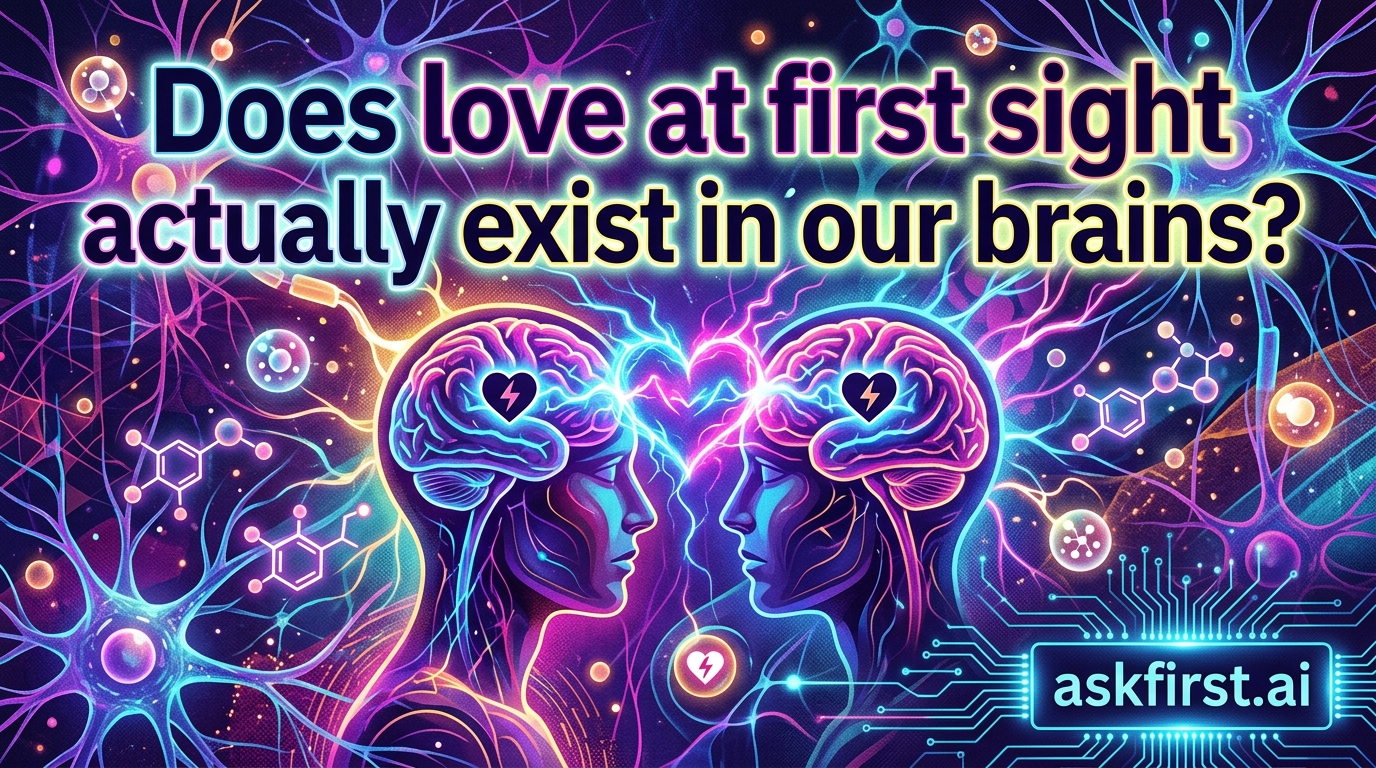
The Neurological Reality of Instant Attraction
Love at first sight has captivated poets, playwrights, and dreamers for centuries, often dismissed as a mere romantic trope. However, when neuroscience examines the phenomenon, the results reveal a fascinating interplay between rapid cognitive processing, evolution, and hormonal surges. The brain is not merely observing a person; it is engaged in a high-speed survival analysis disguised as infatuation.
The Anatomy of a Millisecond Impression
When an individual experiences what is described as love at first sight, the brain undergoes a complex process within approximately one-fifth of a second. According to research published in journals such as the Journal of Sexual Medicine, this sensation is the result of twelve distinct areas of the brain working in tandem. When someone sees an attractive face, the ventral tegmental area—a region rich in dopamine—is stimulated. This is the same reward pathway activated by cocaine, explaining the intense 'high' reported by those who experience immediate, overwhelming attraction.
The Survivalist Perspective: Evolutionary Biology
Evolutionary psychology suggests that the 'love' felt instantly is actually a heuristic—a mental shortcut used to determine genetic compatibility. This process, often subconscious, evaluates:
- Symmetry and Health: The brain scans for indicators of biological fitness, such as skin texture and facial symmetry.
- Genetic Diversity: Through pheromone detection, the human brain subtly assesses Major Histocompatibility Complex (MHC) genes to ensure potential offspring have a diverse immune system.
- Resource Assessment: The subconscious mind evaluates body language and carriage to determine social status or energy levels.
These rapid-fire assessments are not conscious decisions; they are ancient, instinctive mechanisms refined over millennia to ensure reproductive success. What the mind interprets as 'soulmate recognition' is often the biological imperative for 'genetic alignment' echoing through the neural circuitry.
The Halo Effect and Cognitive Bias
Much of what we label as love at first sight is heavily influenced by the Halo Effect. This cognitive bias causes observers to assume that because an individual is physically attractive, they must also possess positive character traits such as intelligence, kindness, or humor. When the brain encounters an aesthetically pleasing stimulus, it often fills in the unknown blanks with positive assumptions. This creates an immediate, albeit imagined, intimacy. The neural response to visual beauty triggers a halo of projection, making the observer feel as if they 'know' the stranger deeply, even without a single word being exchanged.
The Neurochemical Cocktail
Once the brain registers a 'hit' of extreme attraction, it releases a potent cocktail of neurotransmitters that alter perception:
- Dopamine: Creates the focused attention and energy characteristic of early infatuation.
- Norepinephrine: Induces the 'fight or flight' symptoms often felt as a racing heart, sweaty palms, and nervous excitement.
- Oxytocin: Known as the 'cuddle hormone,' it begins to promote feelings of trust and bonding even in the earliest stages of social interaction.
These chemicals serve to narrow the focus of the observer, essentially filtering out the rest of the world until only the subject of the attraction remains. This neurochemical tunnel vision is exactly why the experience feels so all-consuming and 'meant to be.'
Distinguishing Infatuation from Attachment
It is critical to distinguish between the 'instant spark' of neural firing and the deep, enduring attachment of long-term love. Science confirms that while the initial spark of 'love at first sight' is real in terms of neural activation, it is closer to the neurobiology of addiction than to the neurobiology of long-term companionship. True, sustainable love requires the subsequent activation of the brain’s ventral pallidum and the sustained release of oxytocin and vasopressin—compounds associated with stable relationships, stability, and mutual care.
Conclusion: Is it Real?
If the question is whether the brain can experience an immediate, visceral, and chemically profound reaction that feels like love, the answer is a resounding yes. The neural pathways involved in reward, motivation, and visual recognition are indeed capable of firing in perfect synchronization upon the first glance of a new individual. However, science reminds us that this is a psychological and physiological phenomenon—a blend of evolutionary survival instincts, cognitive biases, and intense neurochemical reactions. While it is not the mystical 'fate' stories suggest, it is a very real, measurable, and highly effective biological mechanism that acts as the initial ignition for human connection. Understanding this allows individuals to appreciate the beauty of the spark while respecting the work that follows to turn a momentary neural flash into a lasting human bond.