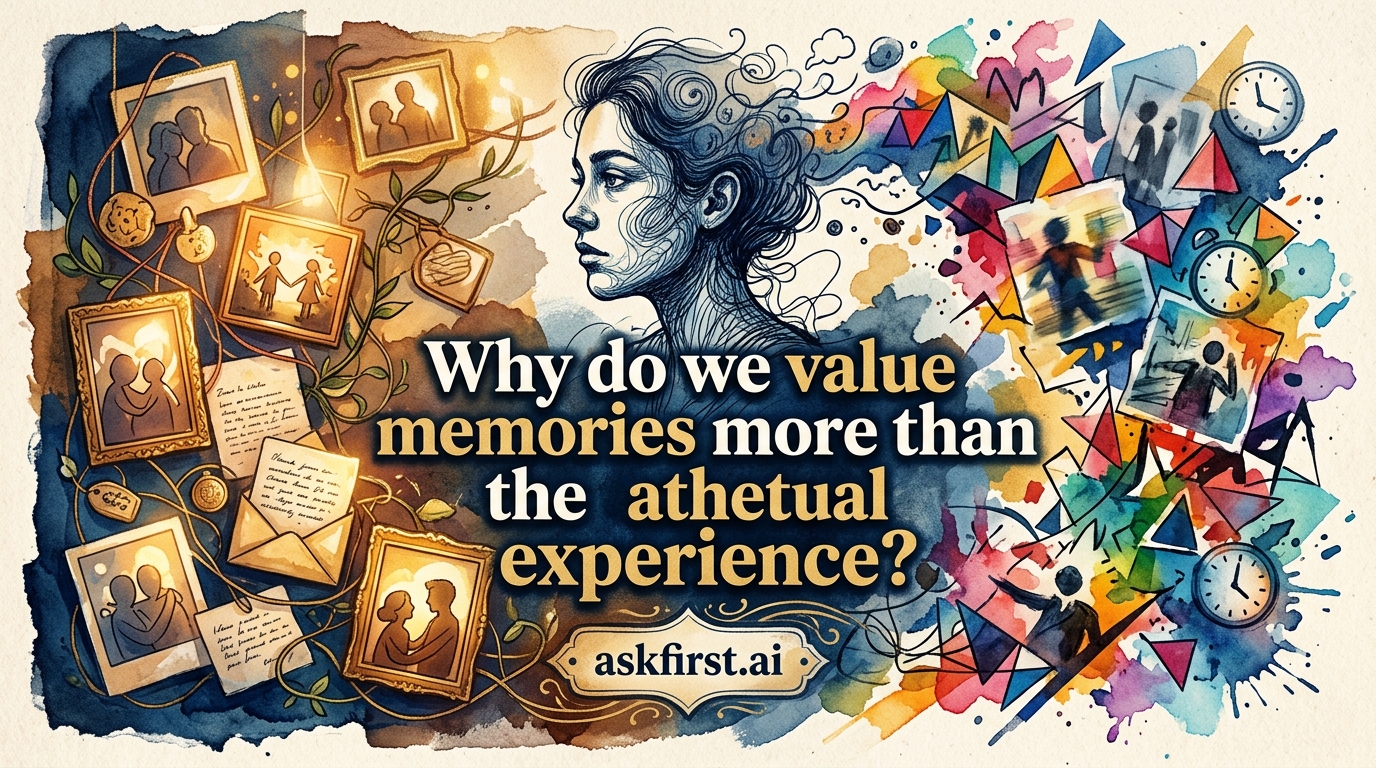
The Cognitive Architecture of Retrospection
The phenomenon of prioritizing memory over immediate experience is rooted in the fundamental way human consciousness processes time. While an experience exists in the fleeting present, a memory acts as a narrative construct that allows the mind to synthesize, edit, and derive meaning from the past. Psychologists argue that the 'experiencing self' lives in the absolute present, often clouded by sensory input and immediate stressors, while the 'remembering self' creates a curated portfolio of life's highlights. This dichotomy, popularized by Nobel laureate Daniel Kahneman, illustrates why the human psyche treats the past not as an objective record, but as a masterpiece of subjective significance.
The Peak-End Rule
One of the most compelling explanations for the elevation of memory is the Peak-End Rule. Human brains do not encode experiences linearly like a video camera. Instead, the memory is primarily shaped by two factors: the peak intensity of the moment (whether positive or negative) and the emotional state at the conclusion of the event. This means that a long, mostly mundane experience can be remembered as 'wonderful' if it ends on a high note. Conversely, a fantastic journey that ends poorly can be tainted in recollection. Because we judge our lives by these condensed fragments, we naturally value the mental 'highlight reel' over the actual, messy, and often tedious reality of the experience itself.
The Narrative Self and Identity Formation
Memories are essential building blocks for the Narrative Self. Humans are storytelling creatures; we define who we are based on the sequence of events we have lived through. A single experience, once completed, becomes a static asset in the personal library of the self. By reflecting on these memories, individuals can weave them into a coherent identity. The experience itself is gone the moment it ends, but the memory remains as a malleable object that can be revisited, shared, and reinterpreted to bolster one's self-worth or life philosophy. This process of meaning-making provides a sense of continuity that the chaotic present cannot offer.
The Psychological Distance and Hedonic Adaptation
Through the lens of Construal Level Theory, psychological distance changes how we perceive events. When an event is in the past, it becomes abstract. Abstract ideas are often easier to categorize and idealize. While living through an experience, one might be distracted by logistical annoyances—a long wait, a minor discomfort, or environmental noise. These 'noise' factors disappear in memory, leaving behind a polished, idealized version of the event. This is why a camping trip, riddled with mosquitoes and bad weather in reality, often becomes a 'bonding adventure' in the rearview mirror. Memory filters out the mundane, creating a higher 'signal-to-noise' ratio of enjoyment.
The Economy of Experiences
In the modern era, the value placed on memories has shifted into an economic force. The 'Experience Economy' demonstrates that people are increasingly willing to pay a premium for experiences that are 'memorable' or 'Instagrammable.' This confirms that the ultimate product is not the service or item consumed, but the mental asset created. We prioritize memory because it represents a permanent investment in personal capital. Unlike physical goods that depreciate, memories—if curated correctly—can appreciate in value over time as they become integrated into one's life story.
Evolutionary Utility
From an evolutionary perspective, the ability to store and prize memories over experiences serves a vital survival function. If humans were perfectly satisfied living in the present, the drive for future improvement would be diminished. By valuing the memory of past success, we create a template for future behavior. By valuing the memory of past joy, we are motivated to seek similar conditions again. This cognitive bias encourages exploration and goal-setting. Our brains are essentially wired to archive experiences that maximize our chances of future satisfaction, ensuring that the 'remembering self' constantly pushes the 'experiencing self' toward growth.
Summary of Key Drivers:
- Cognitive Efficiency: The brain simplifies complex experiences into manageable emotional narratives.
- Meaning Creation: Memories allow for the construction of a cohesive personal identity.
- The Peak-End Rule: Retrospection is dominated by intense moments and the closure of the event.
- Abstraction: Distance allows for the removal of sensory 'noise' and logistical stressors.
In conclusion, the preference for memories is not a flaw in human cognition but a sophisticated adaptation. It allows for the translation of fleeting, ephemeral moments into lasting, meaningful wisdom. We value memories because they transform the passing clock-ticks of existence into the enduring substance of a life well-lived.