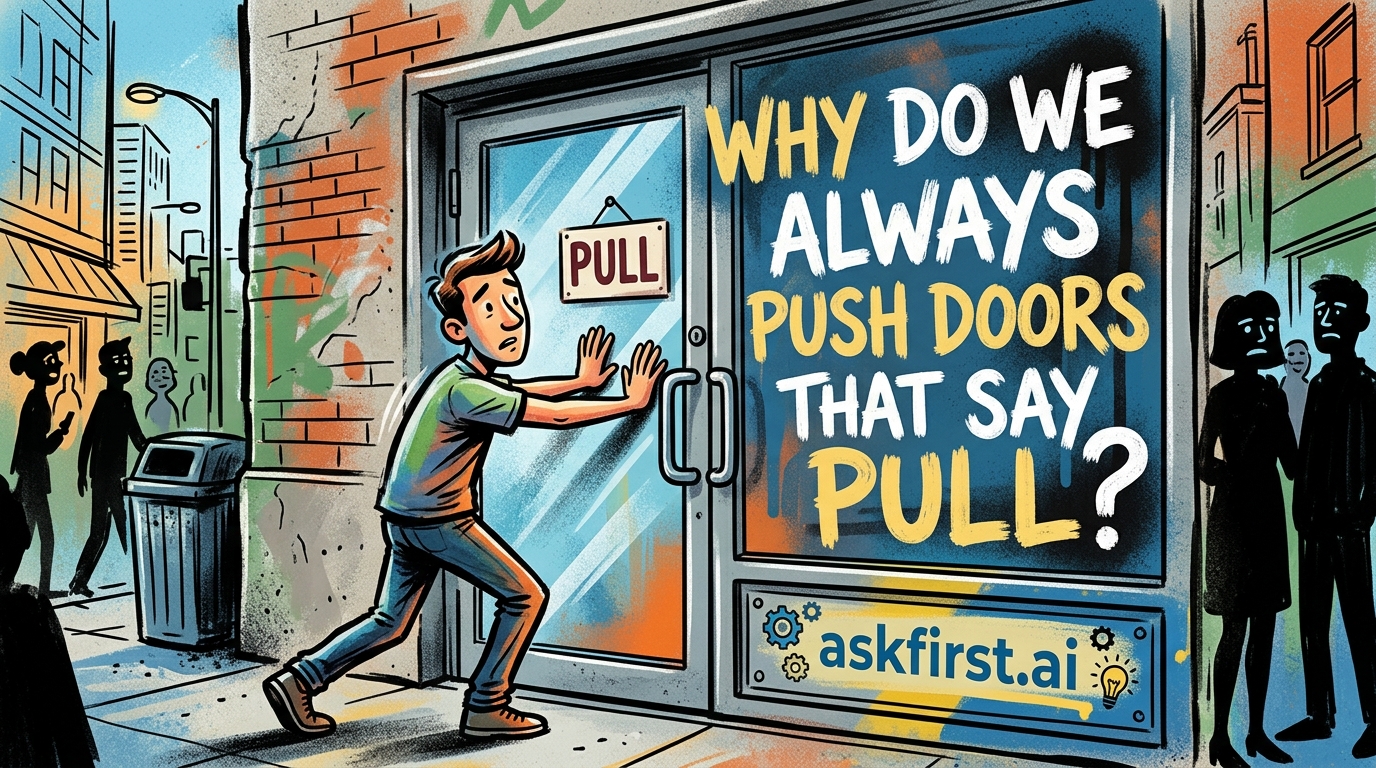
The phenomenon of pushing a door labeled 'pull' is a classic example of a 'Norman Door', a concept coined by design expert Don Norman in his seminal work, The Design of Everyday Things. This behavioral error is rarely a reflection of human intelligence but rather a failure of industrial and architectural design. When a door does not provide immediate visual clues about how it operates, the human brain relies on heuristics, or mental shortcuts, to anticipate the interaction.
The Psychology of Affordances
At the core of this interaction is the concept of affordances. An affordance is a visual or physical property of an object that dictates how it should be used. For instance, a flat plate on a door signifies 'push' because it covers the surface, providing a natural place to exert force. Conversely, a vertical handle or a knob signifies 'pull' because it allows for a gripping motion. When a door has a flat plate but a sign saying 'pull,' or a handle that is oriented in a way that suggests pushing, the brain encounters a conflict between perceived affordance and instructional signage.
- Sensory Dominance: Human vision is designed to process the physical form of an object faster than it processes linguistic information. We see the shape of the door handle and make a motor-command decision before our conscious mind has the time to process the text on the sign.
- Overlearned Behaviors: Many doors in public spaces are configured to push open for safety reasons, particularly in fire-prone environments where exits must swing outward. Because most doors we encounter daily operate on a push-to-exit mechanism, our muscle memory defaults to pushing as the primary strategy for opening any gateway.
Why Signage Often Fails
Signage is frequently an 'afterthought' design choice. When an architect realizes that a door design is confusing, the standard fix is to apply a sticker. However, this relies on explicit memory rather than implicit intuition. If a user has to read a sign to understand how to interact with an object, the design has objectively failed.
- The Inattentional Blindness Factor: We often scan our environment with a focus on our goal (entering or exiting) rather than the minute details of the architecture. If the signage is small, poorly contrasted, or placed at an unusual height, the brain may filter it out entirely as 'background noise'.
- Habitual Processing: Humans are cognitive misers; we prefer to expend the least amount of mental energy possible. Attempting to push is a 'low-cost' physical action that we perform automatically. Reading, by contrast, is a 'high-cost' cognitive task. When we approach a door, we are usually thinking about our next meeting or destination, not the mechanics of the entrance.
Bridging the Gap: Designing for Intuition
To solve this, modern architects are shifting toward human-centered design. The most intuitive designs eliminate the need for signs altogether. If a door needs to be pulled, it should be designed with a handle that cannot be pushed (e.g., a pull-bar that offers no surface area for a palm). If it needs to be pushed, it should have a flat plate.
This principle, often called 'poka-yoke' (mistake-proofing) in lean manufacturing, ensures that the physical configuration of the object renders errors impossible. If you are struggling with a door, remember that it is not a deficiency on your part. It is a misalignment between the environment and the way the human brain has evolved to interact with physical space. By understanding that our brains prioritize physical geometry over written instructions, we can begin to appreciate why these 'Norman Doors' remain a persistent frustration, even in the most technologically advanced environments.