The Psychology of Social Projections
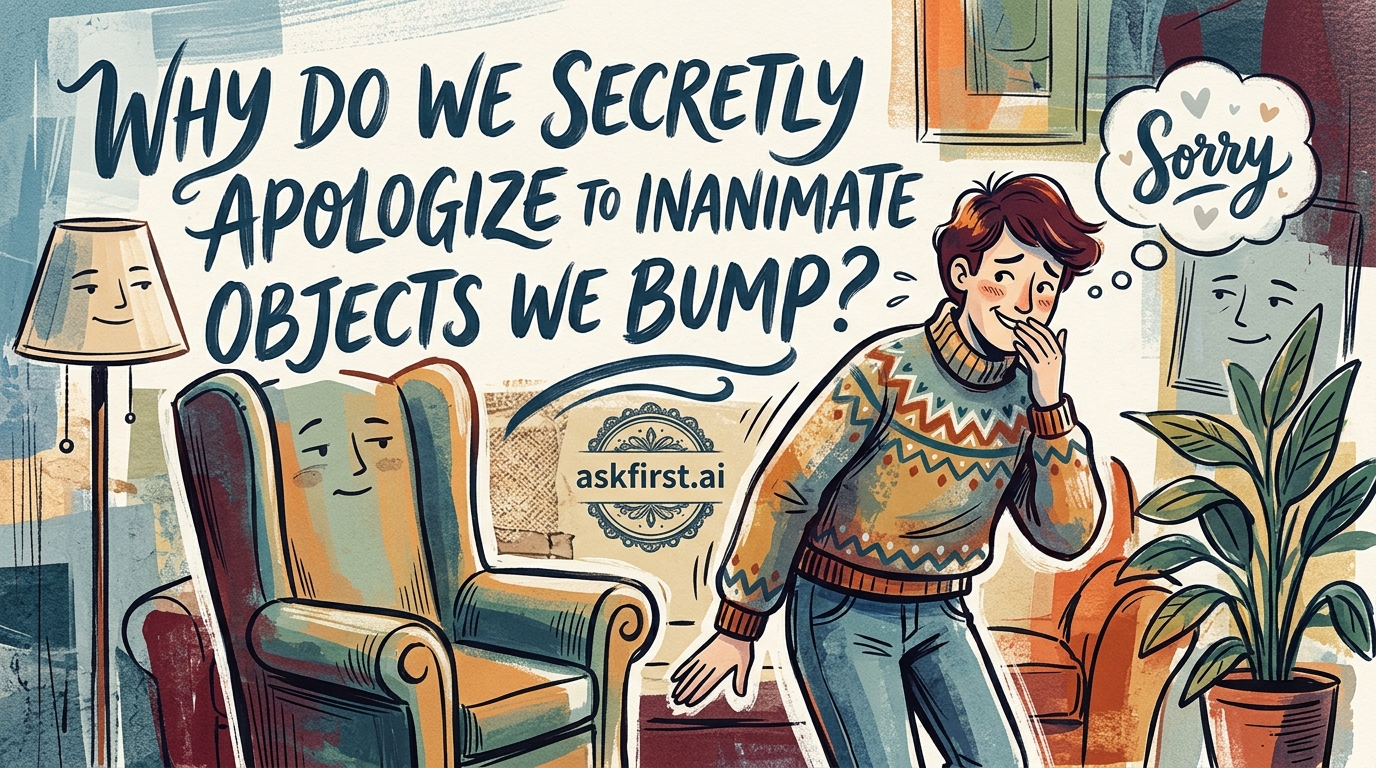
Human interaction with the non-living world represents one of the most fascinating intersections of cognitive psychology and social behavior. While apologizing to a table corner or a doorframe may seem irrational at a conscious level, the underlying mechanisms are deeply rooted in the brain's attempt to navigate a complex environment. At its core, this phenomenon is known as anthropomorphism—the attribution of human-like traits, emotions, or intentions to inanimate objects. This process is not a sign of confusion, but rather a functional cognitive shortcut that the human brain utilizes to simplify social navigation.
The Evolutionary Benefit of Social Simulation
From an evolutionary perspective, the human brain is hardwired for social existence. Over millennia, the ability to predict the behavior of others—known as 'Theory of Mind'—was the single most important survival trait. Humans thrived by empathizing and anticipating the needs and reactions of their peers. Because the human brain developed within a social context, it frequently applies these social algorithms to everything it encounters, including inanimate obstacles. When an individual bumps into a chair, the brain experiences a sudden social 'mismatch' or a momentary lapse in the physical prediction loop. Apologizing serves as an automatic, subconscious reset button designed to soothe that social discomfort. By treating the chair as if it were a sentient participant, the individual momentarily restores social homeostasis.
Cognitive Offloading and Predictive Error
Neurologically, the act of apologizing functions as a form of cognitive offloading. When a person encounters a sudden, sharp physical impediment, the brain's 'error-detection' system fires. According to studies in cognitive neuroscience, this system—often involving the anterior cingulate cortex—monitors for conflict. If the conflict is social, the brain naturally reaches for a social solution. If that conflict is physical, the brain might default to the same social habit simply because it is the most ingrained motor program available for 'clearing' a conflict. Essentially, the 'I'm sorry' is an automated reflex, much like blinking, triggered by the startling sensation of an unexpected collision.
Cultural Conditioning and Linguistic Habit
Beyond innate neurological triggers, cultural conditioning plays a massive role in why this behavior persists. From childhood, individuals are taught that bumping into people requires an apology to maintain social harmony. Over time, the linguistic pairing of 'collision' and 'apology' becomes a deeply ingrained habit loop. Psychologists refer to this as habitual social mimicry. The brain often executes these motor plans before the frontal lobe can intervene to point out the logical absurdity of the situation. This linguistic reflex is so powerful that even individuals who are highly aware of the lack of sentience in the object will find themselves whispering an apology. It is a testament to the fact that social behaviors are not always under conscious, rational control.
Empathy and the 'Extended Self'
Furthermore, many people project a sense of 'extended self' onto their belongings. The chair, the phone, or the car is often viewed as an extension of one's personal space. When that personal space is violated or bumped, the brain processes the event as a disruption of self-coherence. By apologizing, the individual is effectively trying to appease the environment. This reflects the psychological concept of Animism, where humans intuitively feel that the world around them has a degree of agency or interconnectedness. While we know objectively that a table has no feelings, we intuitively experience the world as a responsive entity.
The Role of Social Smoothing
- Stress Reduction: The simple act of vocalizing an apology can lower heart rate and reduce the sudden spike of adrenaline that occurs during a minor physical shock.
- Humor as a Buffer: Laughing at oneself after an apology to a coffee table is a classic human coping mechanism that transforms a minor clumsy moment into a social bond.
- Proactive Politeness: Practicing politeness, even toward inanimate objects, reinforces a broader behavioral trait of kindness that likely bleeds over into real-world human interactions, creating a more cohesive social experience overall.
Conclusion: A Sign of Humanity
In conclusion, apologizing to inanimate objects is not a flaw in logic, but rather a feature of a highly sophisticated, socially-oriented brain. It demonstrates how deeply embedded social intelligence is within our cognitive structure. Instead of viewing the behavior as 'silly,' it should be recognized as a testament to the pervasive nature of empathy. The human brain is a social machine designed to anticipate, respond, and maintain harmony, and it would rather err on the side of kindness than risk missing a social cue. Even when that 'cue' is nothing more than the sharp leg of a wooden table.