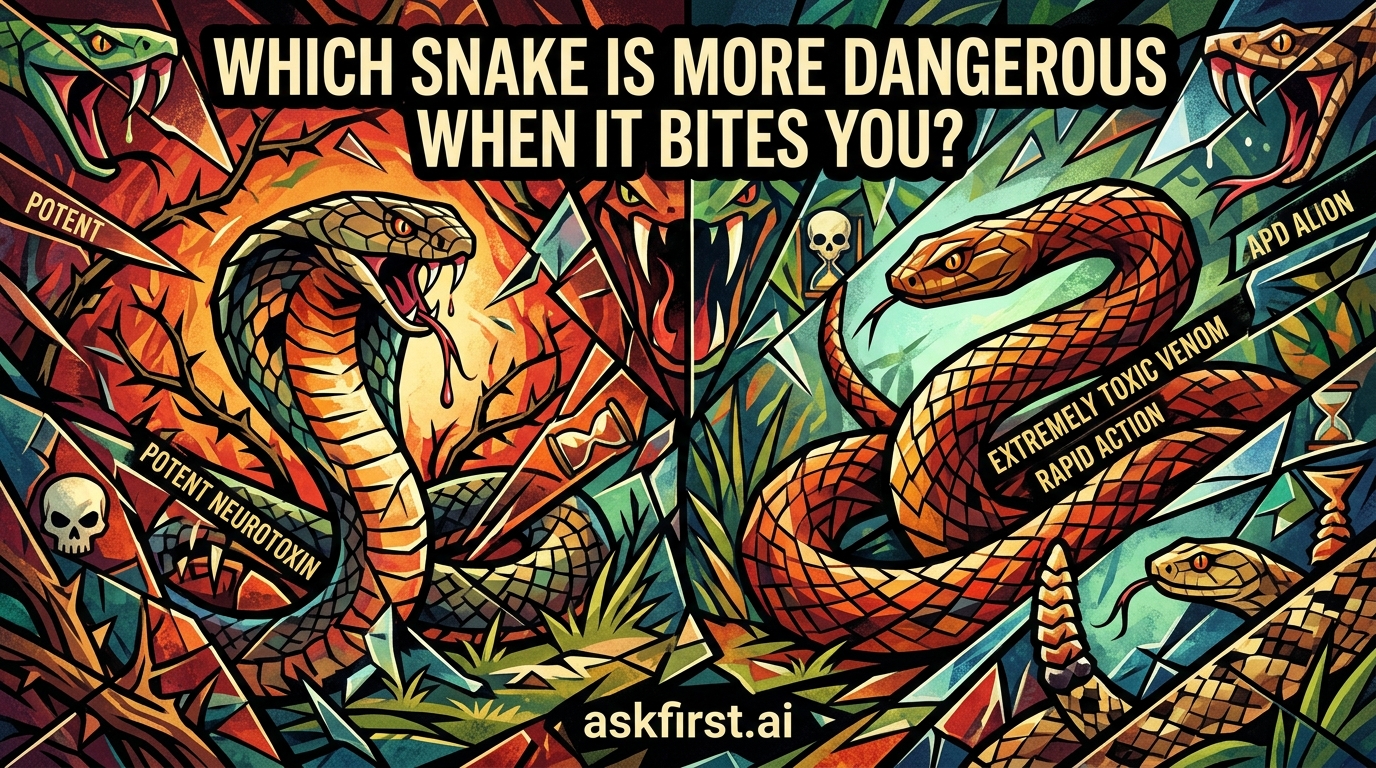
Determining which snake is the "most dangerous" is a complex exercise in toxicology, behavioral ecology, and clinical medicine. While the inland taipan (Oxyuranus microlepidotus) possesses the most potent venom on the planet, danger is a function of venom toxicity (LD50), venom yield, human proximity, and the availability of antivenom. To understand the true hierarchy of danger, one must distinguish between lethal potential and the probability of a fatal encounter.
The Quantifiable Metric: Venom Toxicity
In the field of herpetotoxicology, the standard measurement for venom potency is the LD50 (Lethal Dose, 50%), which represents the amount of venom required to kill 50% of a test population of mice.
The Inland Taipan, native to the arid regions of central Australia, holds the record for the most toxic venom. According to Bryan Grieg Fry, a renowned toxinologist at the University of Queensland, a single bite from an inland taipan contains enough venom to kill approximately 100 adult humans. Its venom is a complex cocktail of neurotoxins (paradoxin), procoagulants, and myotoxins that cause rapid paralysis and systemic clotting failure. However, because this snake lives in remote, desolate areas and is notoriously shy, human bites are exceptionally rare.
The Practical Threat: Frequency and Proximity
When evaluating danger to the average human, we must shift our focus to species that share our habitats. The Black Mamba (Dendroaspis polylepis) of sub-Saharan Africa is arguably more dangerous in a practical sense. Unlike the reclusive taipan, the mamba is territorial and highly reactive. As noted by Mark O’Shea in his comprehensive work, Venomous Snakes of the World, the black mamba’s venom is not only highly neurotoxic but is delivered in large quantities—often 100 to 400 milligrams in a single strike. Without immediate access to polyvalent antivenom, a bite from a black mamba is almost universally fatal, often within 20 minutes to a few hours.
The High-Volume Killers: The "Big Four"
In terms of annual mortality, the snakes that pose the greatest risk to humanity are not necessarily those with the most potent venom, but those that live in densely populated agricultural regions. In India, the "Big Four"—the Indian Cobra (Naja naja), the Common Krait (Bungarus caeruleus), the Russell’s Viper (Daboia russelii), and the Saw-scaled Viper (Echis carinatus)—are responsible for the vast majority of snakebite-related deaths globally.
- The Common Krait: This nocturnal elapid is particularly dangerous because its bite is often painless, and victims may be bitten while sleeping. By the time the neurotoxic effects (respiratory failure) manifest, it is frequently too late for clinical intervention.
- Russell’s Viper: This snake is a significant medical challenge because its venom causes multi-system organ failure, including acute kidney injury and severe coagulopathy. Unlike the swift death of a mamba bite, a Russell's Viper bite can lead to a prolonged, painful, and complex medical struggle that often results in permanent disability even if the victim survives.
The Role of Delivery Systems
The danger of a snake bite is also dictated by the method of envenomation. Elapids (like cobras and mambas) possess fixed, short fangs that require a firm "chew" to deliver venom effectively. Vipers, however, possess long, hinged fangs that can fold against the roof of the mouth, allowing for deep, precision-guided injection of venom into muscle tissue. This enables vipers to deliver a massive dose of venom in a fraction of a second, even through thick clothing or leather boots.
Clinical Management and the "Golden Hour"
The danger of any bite is mitigated by the speed of medical intervention. In his seminal textbook, Handbook of Clinical Toxicology of Animal Venoms and Poisons, Julian White emphasizes that the "Golden Hour" is critical. The most dangerous snake is the one that forces a victim into a state of shock or respiratory collapse before they can reach a facility with antivenom.
For instance, the Saw-scaled Viper is responsible for more human deaths than almost any other snake in the world because it is small, aggressive, and highly camouflaged in the sandy terrains of the Middle East and India. Its venom is a potent hemotoxin that causes internal bleeding and systemic hemorrhage. Because it is so frequently encountered in human-altered landscapes, the sheer volume of bites makes it a greater statistical danger than the biologically "more toxic" inland taipan.
Conclusion
If you are asking which snake is the most dangerous in a laboratory setting based purely on the chemical potency of its venom, the Inland Taipan is the undisputed champion. However, if you are asking which snake is the most dangerous to encounter in the wild, the title belongs to the Black Mamba for its speed, aggression, and toxic load, or the Saw-scaled Viper for its ubiquity and the frequency of its interaction with human populations. Ultimately, the most dangerous snake is the one that you do not see until it is too late, regardless of its position on the LD50 scale. Awareness of local species, avoiding contact, and immediate access to professional medical care remain the only true defenses against the diverse array of venomous reptiles across the globe.