The Evolutionary Basis of Social Replay
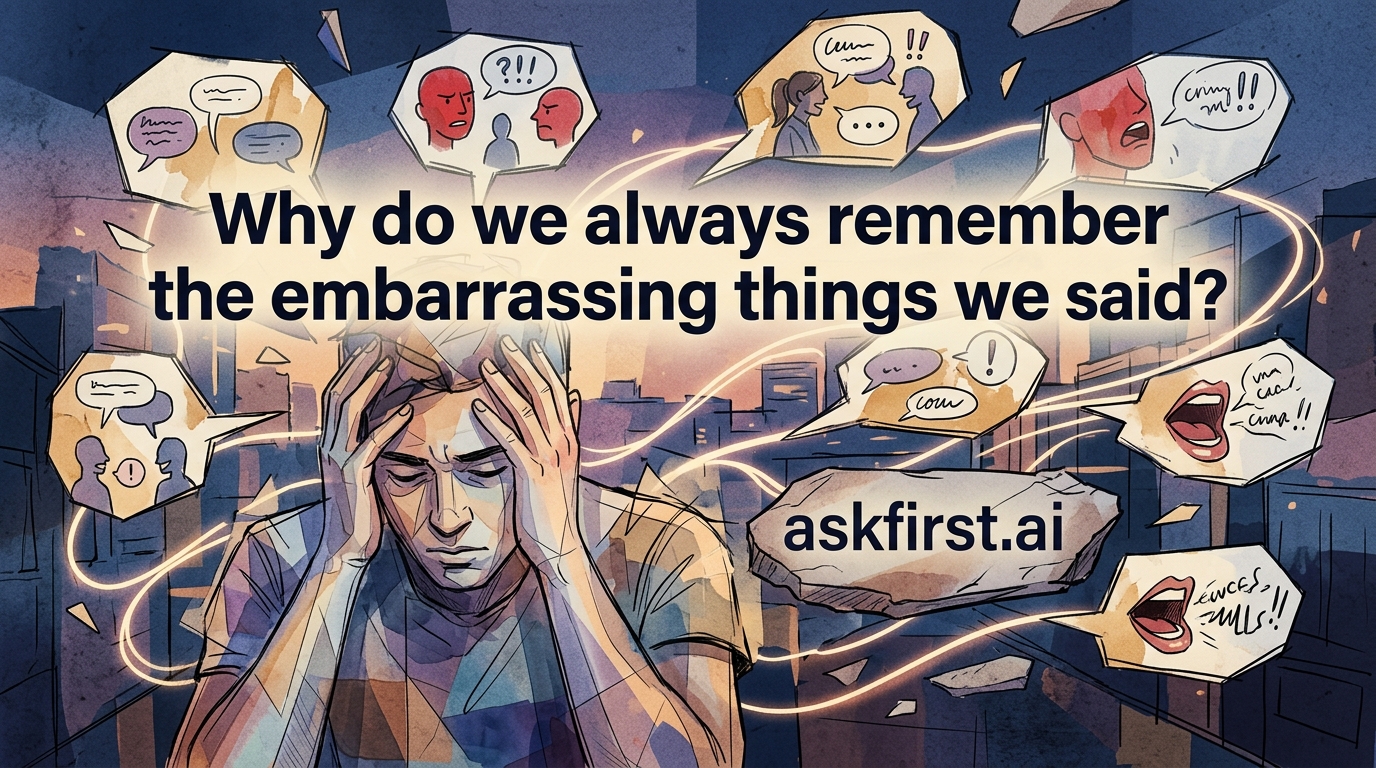
Human memory is not a perfect recorder of objective reality. Instead, it acts as a selective filter designed primarily for survival and social cohesion. The reason humans vividly recall embarrassing moments—a phenomenon often called the 'spotlight effect' or 'intrusive social rumination'—lies in the evolutionary necessity of maintaining a stable position within a social hierarchy. In ancestral environments, being ostracized from the tribe was a death sentence. Consequently, the brain evolved an over-active alarm system to monitor social blunders, ensuring that mistakes are learned from to avoid future expulsion.
The Negativity Bias and Cognitive Salience
The brain is hardwired with a negativity bias, which prioritizes negative experiences over neutral or positive ones. This is a survival mechanism: missing a predator is more dangerous than missing a meal. When we say something embarrassing, our emotional centers, specifically the amygdala, become highly activated. This heightened emotional arousal triggers the release of stress hormones like cortisol and adrenaline, which tell the hippocampus to 'burn in' the memory. This is why a cringe-worthy comment from ten years ago feels as vivid as an event from yesterday. The brain treats social pain with the same neurological hardware as physical pain, reinforcing the memory to ensure the individual corrects the behavior.
The Spotlight Effect
Psychologists Thomas Gilovich and Kenneth Savitsky coined the term spotlight effect to describe the tendency to overestimate how much others notice our appearance and behavior. We often believe we are the center of everyone's attention, leading to the assumption that an embarrassing remark has defined our character in the eyes of others. In reality, most observers are preoccupied with their own internal thoughts and are far less focused on the minor social slip-ups of peers. This discrepancy between perceived public scrutiny and the actual lack of it creates a feedback loop of anxiety that reinforces the memory of the event.
Why We Loop on 'Cringe' Moments
When the brain encounters downtime, it enters the Default Mode Network (DMN). This is a state where the mind drifts, often reflecting on the self, relationships, and past events. If a person feels insecure about their social standing, the DMN will naturally retrieve negative social interactions to perform an 'autopsy' on what went wrong. While this feels like mental torture, it is an attempt by the brain to re-process the social data to find a better outcome. The brain is essentially trying to 'patch' the social software, but because the event is past, the patching process runs indefinitely.
Strategies for Mitigating Rumination
To move past these intrusive thoughts, consider the following psychological reframing techniques:
- The Perspective Gap: Consciously acknowledge that others have their own 'spotlight' focused entirely on their own behaviors. Recognizing that observers have already moved on can diminish the impact of the memory.
- Cognitive Defusion: Instead of identifying with the thought ('I am a fool'), label the process ('I am having the thought that I said something silly'). This creates psychological distance from the memory.
- The 5-Year Rule: Ask whether this specific moment will matter in five years. If the answer is no, prioritize the release of the emotional charge.
- Self-Compassion: Treat the self as a friend. If a friend told you a story about a minor social slip, you would not judge them harshly. Applying this same empathy to personal history breaks the cycle of rumination.
The Functional Advantage
It is important to understand that the ability to 'cringe' is a sign of high social intelligence. It demonstrates that an individual cares about communal norms and values interpersonal relationships. People who lack the capacity for social rumination are often unable to gauge the emotional state of those around them, which leads to long-term social isolation. By analyzing past awkwardness, humans refine their social scripts, improve their communication skills, and develop greater empathy for the vulnerability of others. The memory of embarrassment is ultimately a tool for social calibration, transforming temporary discomfort into long-term behavioral refinement.