The Neural Mechanism of Sensory Suppression
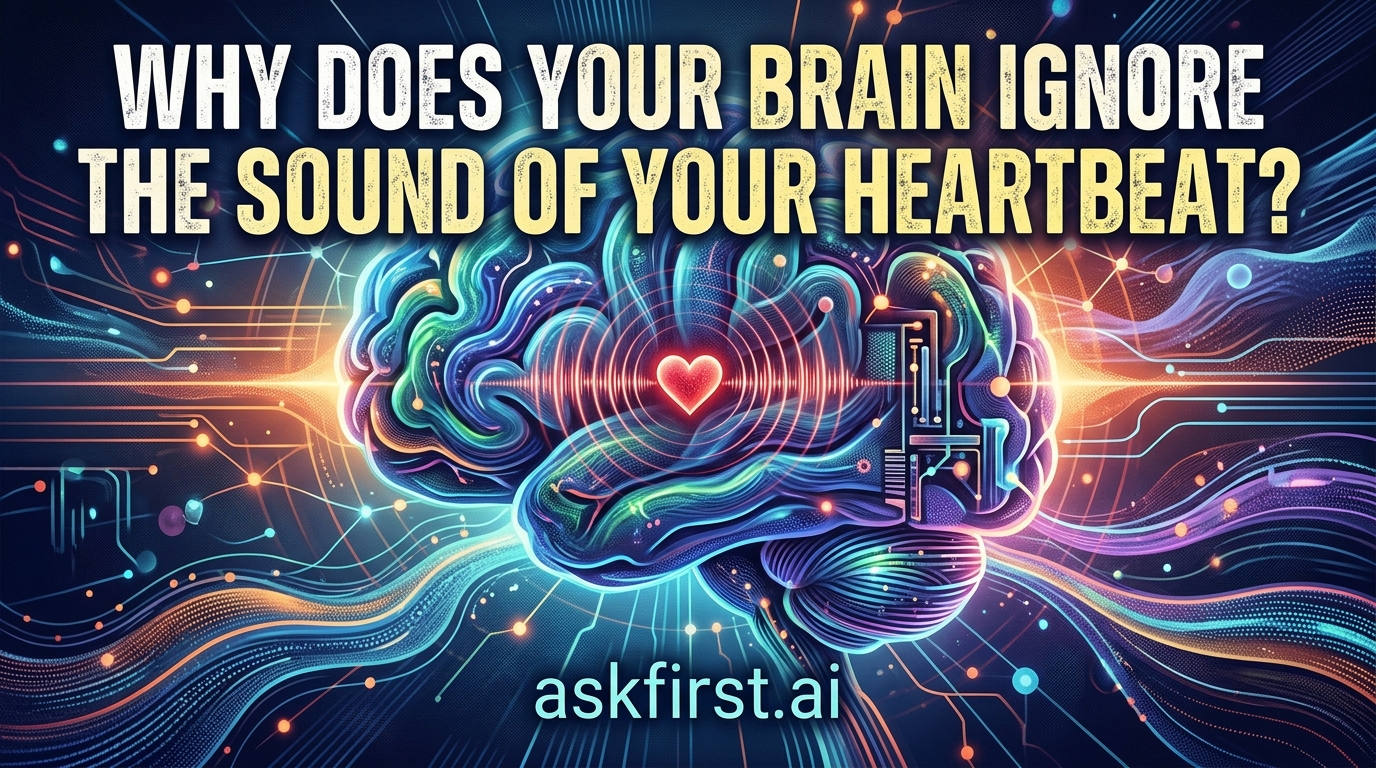
The human brain is a master of selective attention, a complex filter that decides which sensory inputs deserve conscious awareness and which should be discarded as background noise. The reason a heartbeat goes unnoticed—despite being a loud, constant thumping occurring only inches from the inner ear—lies in a neurobiological process known as sensory adaptation, or more specifically, corollary discharge.
The Concept of Corollary Discharge
When the brain initiates a motor command, such as moving an arm or triggering a rhythmic biological function like the heart, it sends a copy of that signal to the relevant sensory processing regions. This internal copy is called a corollary discharge. Essentially, the brain informs the auditory and sensory cortex that a specific sound or sensation is about to occur because the brain itself ordered it. Because the brain knows it caused the heartbeat, it suppresses the resulting auditory input. This prevents the constant, booming sound of the cardiovascular system from interfering with the processing of external information, which is far more vital for survival.
Habituation: Why Repetitive Sounds Fade
Beyond corollary discharge, the nervous system employs habituation. This is a decline in a response to a stimulus after repeated exposure. If a sound is constant and lacks novel information—meaning it does not signal danger, a new predator, or a change in environment—the neurons dedicated to processing that sound reduce their firing rates. Your brain effectively labels the heartbeat as 'non-essential static' or 'background noise.' By ignoring the steady rhythm, the brain saves precious metabolic energy that would otherwise be wasted on processing redundant data.
The Predictive Coding Model
Modern neuroscience often explains this through the predictive coding framework. In this model, the brain is constantly generating a model of the world and attempting to predict incoming sensory data. When the incoming data matches the prediction, the brain does not need to waste resources updating its conscious map of reality. Because your heartbeat is perfectly rhythmic and predictable, the error signal generated between the predicted sound and the actual sound is negligible. Consequently, the input is filtered out before it reaches the level of conscious perception. You only truly hear your heart when it deviates from this rhythm—such as during high-intensity exercise, extreme anxiety, or a panic attack—because these events create 'prediction errors' that force the brain to pay attention to the unexpected shift in cadence.
When the Illusion Breaks: Tinnitus and Pulsatile Conditions
Sometimes, this filtration system fails or becomes over-sensitive, leading to a condition known as pulsatile tinnitus. In these instances, the brain stops treating the internal circulatory sounds as background and begins perceiving them as external audio signals. This is often caused by physical changes in the blood flow dynamics, such as turbulence in the carotid arteries or heightened blood pressure, which make the sound louder or different enough that the brain can no longer categorize it as internal 'self-generated' noise. When the brain can no longer predict the sound with perfect accuracy, it labels the sound as 'new' or 'relevant,' resulting in the awareness of a heartbeat within the ears.
Evolutionary Advantages
From an evolutionary perspective, the ability to tune out the body's internal machinery provided a massive survival advantage. Ancient humans who were constantly distracted by the thumping of their own blood would have been poorly equipped to detect the subtle, faint sounds of a predator stalking through the grass. The survival of the organism depended on the capacity to prioritize external signals—rustling leaves, distant animal calls, or approaching footsteps—over the internal monologue of one's own biology. By relegating the heartbeat to the subconscious, the brain maintains a high-fidelity 'listening mode' for the world beyond the skin.
Conclusion: The Silent Engine
Your heart serves as the most reliable metronome in your existence, beating over 100,000 times per day. That you remain blissfully unaware of this effort is a testament to the sophistication of the human neural network. It is not that you cannot hear your heart; it is that your brain is working tirelessly to ensure that you don't. By filtering the predictable from the unknown, your mind grants you the clarity needed to focus on the external world, turning a constant physiological uproar into a background hum, keeping you centered, focused, and alert to the changes in your environment that truly matter.