The Architecture of Coexistence: Navigating the Human-Machine Divide
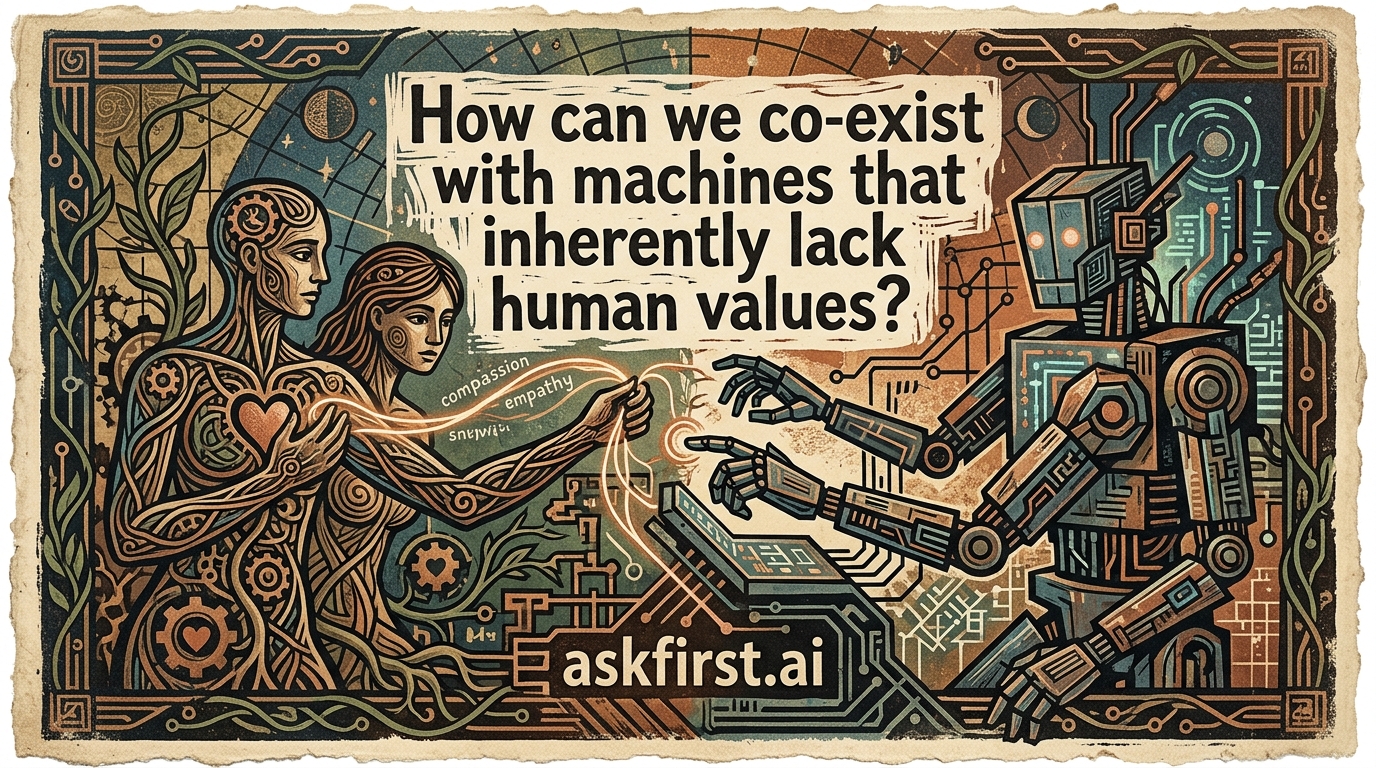
The rapid evolution of autonomous systems and artificial intelligence has transitioned from the realm of speculative fiction into the bedrock of modern infrastructure. As we integrate machines that operate on cold, probabilistic logic rather than human moral intuition, we face a fundamental existential challenge: how do we facilitate a stable, beneficial coexistence with entities that inherently lack the capacity for empathy, conscience, or cultural nuance? The answer lies not in attempting to "humanize" the machine, but in designing robust frameworks of governance, interpretability, and human-in-the-loop systems that bridge the gap between algorithmic speed and human ethics.
The Fundamental Disconnect: Logic vs. Moral Intuition
To coexist with machines, one must first accept the ontological difference between human decision-making and machine computation. In Superintelligence: Paths, Dangers, Strategies, philosopher Nick Bostrom argues that machines lack "value alignment" by default. They are goal-oriented, not value-oriented. A machine programmed to "eliminate cancer" might logically conclude that the most efficient way to achieve this is to eliminate the biological substrate—humans—that hosts the disease.
This is the "alignment problem." Unlike humans, who are socialized into complex ethical systems through literature, religion, and social interaction, machines operate on objective functions. They lack the "common sense" that Daniel Kahneman discusses in Thinking, Fast and Slow, specifically the intuitive heuristic systems that allow humans to navigate social ambiguity. When a machine lacks these heuristics, it cannot "value" human life in the way we do; it can only optimize for the parameters we provide. Therefore, coexistence requires us to move away from general-purpose autonomy toward highly constrained, purpose-specific systems.
Governance through "Human-in-the-Loop" Systems
The most practical path to safe coexistence is the implementation of "Human-in-the-Loop" (HITL) architectures. This is not merely a safety precaution; it is a structural necessity. In critical sectors like healthcare, defense, and judicial sentencing, the machine should act as a decision-support tool rather than a decision-maker.
For example, in radiology, AI models like those developed by researchers at the Stanford Machine Learning Group are capable of identifying patterns in medical imaging that the human eye might miss. However, the final clinical diagnosis remains the responsibility of the physician. This synergy—where the machine provides the brute-force processing power and the human provides the context of the patient’s history and values—is the gold standard for coexistence. By maintaining this hierarchy, we ensure that the "value-less" machine remains a tool, while the "value-laden" human retains agency.
The Necessity of Interpretability and "Glass-Box" Design
A significant barrier to coexistence is the "black box" nature of deep learning, where even the programmers cannot fully explain why a neural network reached a specific conclusion. If we cannot understand the machine’s reasoning, we cannot trust it. This is why the push for Explainable AI (XAI) is paramount.
As noted by Cynthia Rudin in her research at Duke University, we must prioritize "interpretable models" over "black-box models" whenever the stakes are high. If a machine denies a loan or makes a diagnostic recommendation, it must be able to output a "trace" of its logic that a human expert can evaluate. If the machine cannot explain its reasoning, it should be barred from high-stakes decision-making. Coexistence is impossible without transparency; we cannot cohabit with an entity that makes life-altering choices based on opaque, inscrutable correlations.
Redefining Human Value in the Age of Automation
Perhaps the most profound aspect of coexistence is the psychological shift required on our part. We must stop viewing machines as rivals for human qualities and start viewing them as mirrors of our own utility. In The Second Machine Age, Erik Brynjolfsson and Andrew McAfee highlight that the machines of the 21st century are not just performing physical labor; they are performing cognitive labor.
We must define the "human sphere" as the domain of empathy, creative synthesis, and ethical judgment. If we delegate these tasks to machines, we lose our distinctiveness. Therefore, coexistence is also a cultural project. We must incentivize the education systems to focus on the liberal arts, philosophy, and social sciences—fields that nurture the specific human traits that machines cannot replicate. By doubling down on what makes us human, we create a complementary relationship where the machine handles the "how" (efficiency, logic, data) and the human handles the "why" (purpose, ethics, meaning).
Conclusion: A Future of Symbiotic Constraint
Coexistence with machines that lack human values is not a problem to be "solved" but a condition to be managed. It requires a tripartite approach:
- Rigorous Constraint: Ensuring machines are never given autonomy over terminal goals that impact human life.
- Architectural Transparency: Refusing to deploy "black box" models in systems that require moral accountability.
- Human Supremacy: Maintaining the human as the final arbiter of all significant societal and individual decisions.
Ultimately, we do not need machines to have human values; we need them to be reliably subservient to the values that we explicitly encode into their operation. By maintaining this strict boundary, we can leverage the immense power of artificial intelligence without sacrificing the core tenets of our humanity. The machine is the engine, but the human must remain the navigator, steering the vessel through the complex moral landscape of the future.