The Evolutionary Bias Toward Negativity
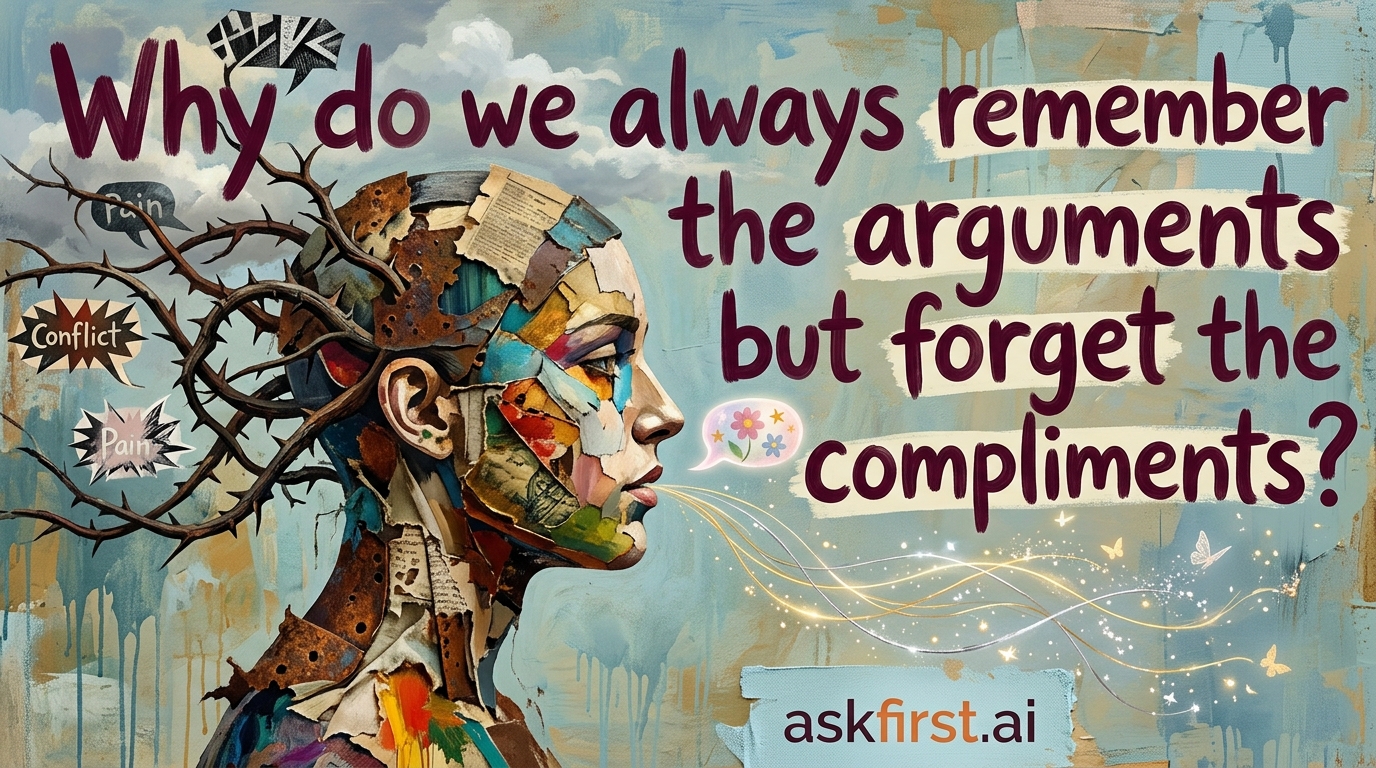
Human cognition is not a neutral recorder of experiences. Instead, it is an evolutionary filter designed primarily for survival rather than for happiness or self-esteem. The psychological phenomenon known as the Negativity Bias dictates that the human brain processes negative stimuli with greater intensity and duration than positive ones. Throughout human evolution, a missed compliment might result in a bruised ego, but a missed warning or an overlooked social conflict could result in expulsion from the tribe or physical peril. Consequently, the brain developed an efficient shortcut: prioritize threats.
The Role of Cognitive Salience
When an individual is involved in an argument, the body enters a state of heightened physiological arousal. Stress hormones like cortisol and adrenaline flood the bloodstream, which acts as a 'memory marker.' According to the principles of neuroscience, these chemical signals strengthen the neural pathways associated with the event. While a compliment often passes through the mind like a gentle breeze, an argument creates a neural anchor. The brain interprets the confrontation as high-salience data, deeming it necessary to preserve for future risk assessment. This is why a single critique often weighs heavier than ten praises.
The Zeigarnik Effect in Social Dynamics
Psychology introduces the Zeigarnik Effect, which posits that people remember uncompleted or interrupted tasks better than completed ones. In many social contexts, arguments feel like 'unfinished business.' If a disagreement remains unresolved, the brain continues to process it in the background, consuming mental resources. Compliments, conversely, are perceived as completed social transactions. Once the praise is accepted, the mind archives the information as a 'closed' file, essentially clearing the space for new information. This contrast creates an illusion where negative memories seem more persistent because they remain mentally active in the brain's workspace.
Psychological Shielding and Social Bonding
Relationships often face the 'Sandpaper Effect.' If one partner provides five compliments but initiates one sharp critique, the critique is what gets encoded into long-term storage. From a behavioral science perspective, this is a protective mechanism. The brain is scanning for 'violations of social contracts' or 'changes in environmental safety.' Arguments trigger this scanning mechanism, leading to deep rumination. Compliments, meanwhile, confirm the status quo. Since the status quo is considered 'safe,' the brain does not expend extra cognitive energy to analyze or store these positive affirmations deeply.
How to Rewire the Memory Bias
Understanding this phenomenon is the first step toward correcting the imbalance. Because the brain is naturally biased toward the negative, one must consciously practice cognitive reframing to retain positive social data. Practical strategies include:
- Active Visualization: When receiving a compliment, pause for ten seconds. Visualize the person saying it, the environment, and the feeling associated with the words. This intentional focus forces the hippocampus to treat the compliment as a high-salience memory.
- The Gratitude Journaling Technique: Documenting three positive interactions every night helps train the brain to treat positivity as a 'high-priority' category for the memory banks.
- Cognitive De-escalation: During arguments, remind the brain that it is currently being hijacked by survival instincts. Labeling the emotions as 'Negativity Bias' can reduce the intensity of the chemical stress response, preventing the memory from being 'burned' into the brain so deeply.
The Perspective of Future Wellbeing
In the grand tapestry of life, the reliance on negative memory is a relic of a primitive era. While modern humans no longer need to fear the same physical dangers that shaped their ancestors, the hardware remains the same. By shifting focus toward mindful appreciation and acknowledging this bias, individuals can break the cycle of ruminating on conflict. One can learn to appreciate the feedback loop of social validation, transforming the way memories are stored and retrieved. The capacity to treasure a compliment requires effort, whereas the capacity to obsess over an argument is an automatic biological default. Choosing to move against this default is a hallmark of emotional intelligence and psychological maturity.