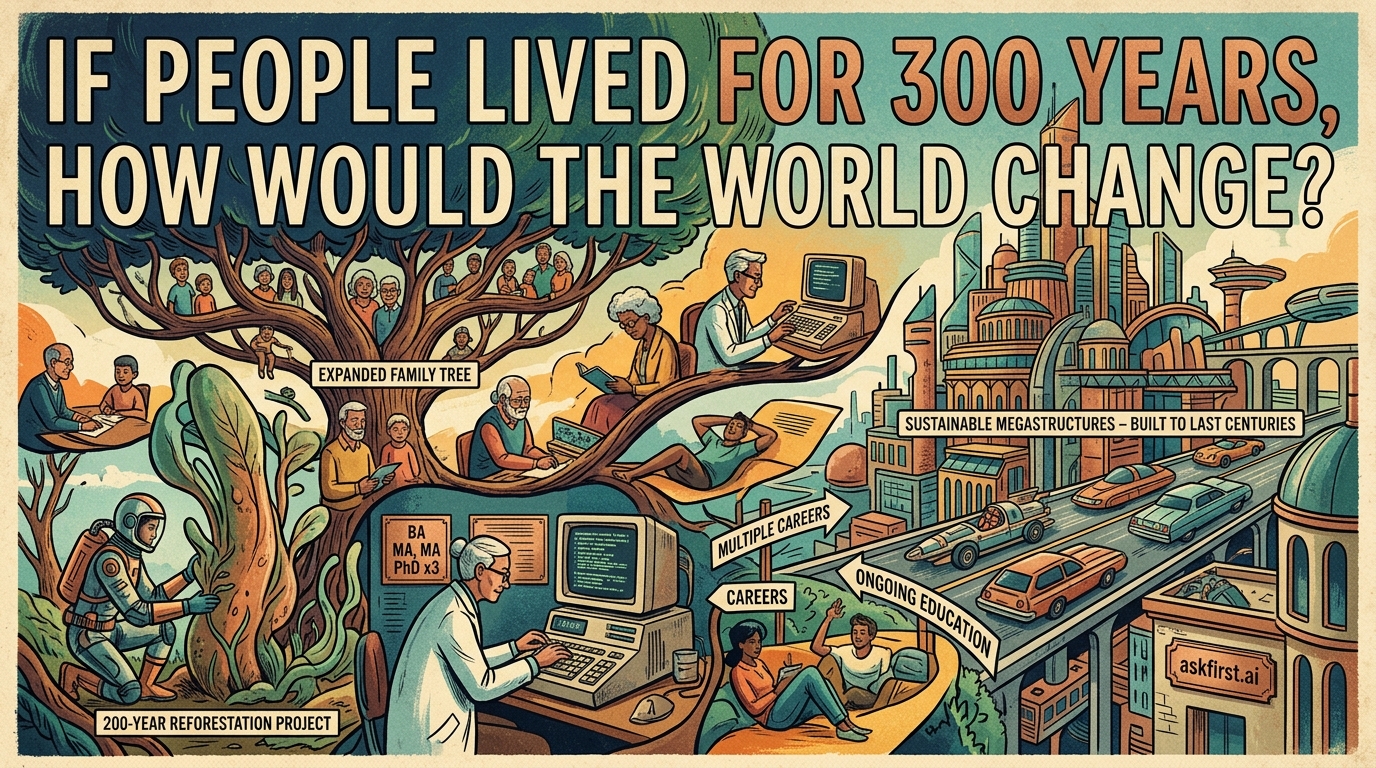
The prospect of human longevity extending to three centuries—an epochal shift from our current biological ceiling—would fundamentally rewrite the architecture of human civilization. If the average lifespan were to reach 300 years, the consequences would reverberate through every facet of existence, from the way we structure our careers and family dynamics to the very foundations of global economics and environmental stewardship.
The Transformation of Life Stages and Career Cycles
In our current paradigm, life is segmented into rigid phases: education, career, and retirement. With a 300-year lifespan, this "three-stage life" model would become obsolete. As noted by Lynda Gratton and Andrew Scott in their seminal book, The 100-Year Life: Living and Working in an Age of Longevity, the traditional linear path is already failing; at 300 years, it would be impossible.
We would likely transition into a "multi-stage life." An individual might pursue three or four distinct professional identities. One could spend fifty years as an engineer, another fifty as a philosopher, and another fifty as an environmental architect. The concept of "retirement" at age 65 would vanish, replaced by long periods of "re-tooling" or sabbaticals. Education would not be a front-loaded investment but a lifelong, recurring process. Society would need to embrace the idea that a person can be a novice at age 150, fundamentally changing the stigma surrounding career pivots and late-life learning.
Economic Implications and the Accumulation of Wealth
A 300-year life would necessitate a complete overhaul of global financial systems. Compound interest, over such an extended duration, would lead to levels of wealth concentration previously unseen in human history. If an individual saves or invests for 200 years, the resulting capital would dwarf the assets of current dynastic families.
Economist Thomas Piketty, in his exhaustive study Capital in the Twenty-First Century, highlights how capital accumulation tends to outpace economic growth. With 300-year lifespans, the "rentier" class could become permanent, potentially creating a rigid, neo-feudal social structure where the oldest members of society own the vast majority of productive assets. Governments would likely be forced to implement aggressive wealth redistribution or inheritance taxes to prevent a stagnant, gerontocratic economy where the youth have no path to property ownership or capital accumulation.
Societal Shifts: Relationships and Family Dynamics
The traditional nuclear family would likely dissolve or evolve into something far more complex. If one lives for 300 years, the notion of "till death do us part" becomes a monumental, and perhaps unrealistic, commitment. Serial monogamy would likely become the societal norm, with individuals having multiple "life-partnerships" lasting 40 or 50 years each.
Furthermore, the generational gap would widen into a chasm. With great-great-great-great-grandchildren living simultaneously, the definition of family would expand to include five or six generations of living ancestors. This could foster immense intergenerational wisdom, but it could also lead to extreme conservatism; if the founding generation of a culture is still alive and in positions of power, social progress might slow to a crawl as the "old guard" maintains a grip on the zeitgeist for centuries.
Environmental Stewardship and Long-Termism
One of the most profound psychological shifts would be the internalizing of "long-termism." Currently, environmental crises like climate change are difficult for humans to grasp because our biological horizon is relatively short. When people start thinking in terms of 200-year consequences rather than 20-year career cycles, the impetus for sustainable living would become existential.
As argued by Roman Krznaric in The Good Ancestor: How to Think Long Term in a Short-Term World, the "cathedral thinking" that characterized past eras—where people built structures they knew they would never see finished—would return. If you know you will be alive to witness the state of the planet in the year 2250, you are far more likely to invest in renewable energy, reforestation, and resource conservation. The world would shift from a "quarterly earnings" mindset to a "centennial planning" mindset.
The Political Gerontocracy
Perhaps the most daunting challenge would be political. Democracy relies on the turnover of ideas and the replacement of old values with new ones. If political leaders, CEOs, and cultural icons remain in power for 150 years, the flow of innovation could be stifled. We might see the rise of "age-gated" power, where term limits are not measured in years, but in absolute caps on the duration of influence. Without such measures, we risk creating a stagnant society where the past is perpetually preserved, and the future is denied the oxygen it needs to grow.
Conclusion
Living to 300 would be the greatest biological achievement in human history, but it would require a social and political revolution to manage. We would need to redefine success, restructure our economies to prevent permanent wealth stratification, and cultivate a culture that values the wisdom of the old without sacrificing the vitality of the new. While the prospect offers the potential for profound personal growth and long-term planetary stewardship, it also carries the risk of a static, deeply unequal, and hyper-conservative world. To thrive in a 300-year life, humanity would need to become as resilient and adaptable as the lifespans we seek to inhabit.