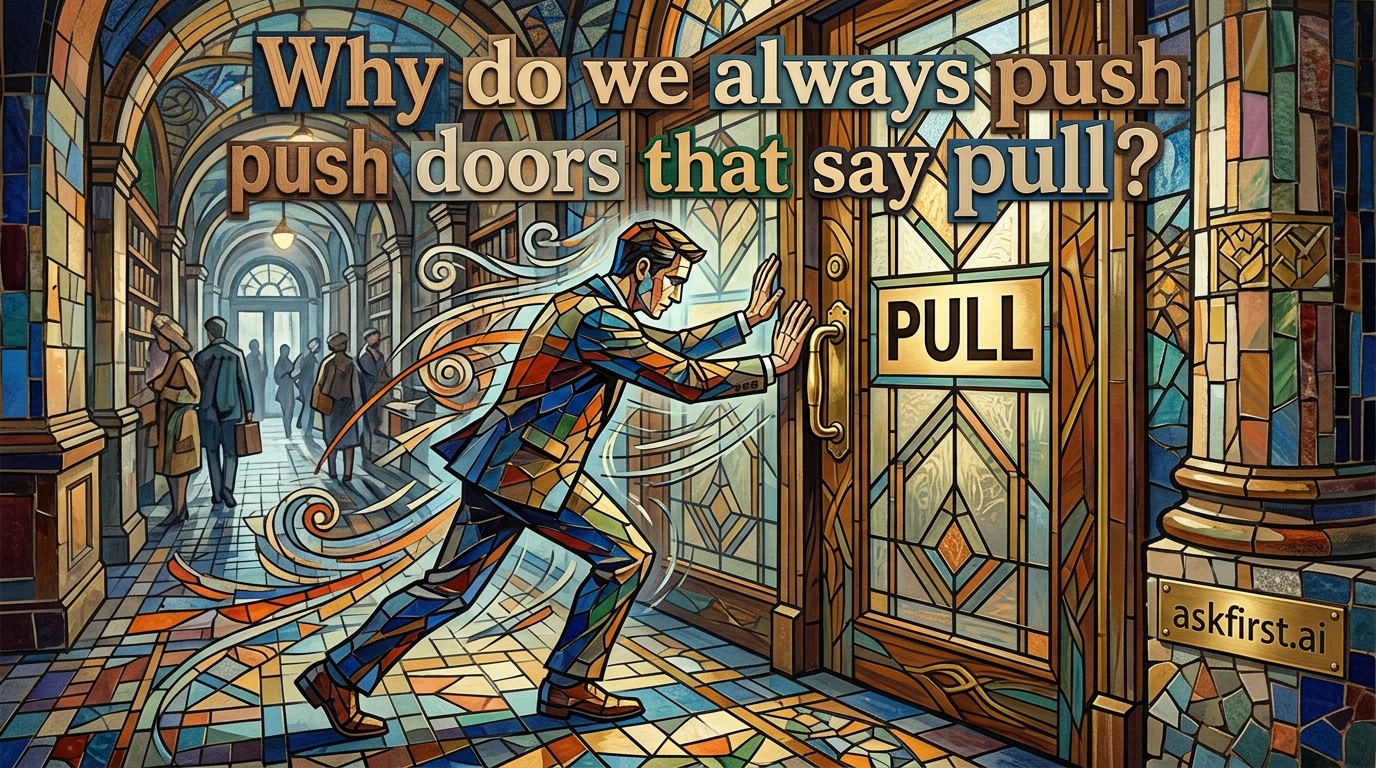
The phenomenon of pushing a door labeled 'pull' is a classic example of a Norman Door, a term coined by cognitive scientist Don Norman in his seminal work, The Design of Everyday Things. This behavioral error is rarely a result of human stupidity but rather a fundamental failure in industrial design. When an object’s physical form provides contradictory cues, the brain prioritizes tactile intuition over written instructions.
The Psychology of Affordances
An affordance is a property of an object that suggests how it should be used. For instance, a flat plate on a door acts as a visual 'push' signal, while a handle or a pull-bar suggests an 'opening' motion. When a door features a large, flat metal plate, the human brain perceives it as a surface designed for pressure. If that door is actually meant to be pulled, the design is functionally illiterate. The brain ignores the word 'pull' because the physical design is shouting 'push' at a subconscious level.
- Cognitive Load: Human brains are wired for efficiency. Reading text requires conscious processing, while interpreting physical shapes is intuitive and fast. When these two systems conflict, the intuitive system wins.
- The Power of Habit: Daily interactions reinforce mental models. If 95% of doors encountered are push-plates, the brain creates a heuristic: 'Flat plate equals push.'
Why Designers Fail
Architects and hardware manufacturers often prioritize aesthetics or manufacturing cost over human-centered design. A door that swings both ways or is situated in a high-traffic area might be designed to look uniform, leading to the use of identical hardware on both sides. This creates a gulf of execution, where the user struggles to bridge the gap between their goal (getting through the door) and the physical requirements to achieve it.
Strategies for Better Design
To mitigate these errors, designers employ several strategies to align physical affordances with user intent:
- Clear Mapping: If a door must be pulled, it should feature a handle that cannot be mistaken for a push-point. If it must be pushed, it should have a plate with no grab-point.
- Contextual Cues: Doors that swing outward for safety (common in fire codes) often use panic bars. The physical design of the bar makes it impossible to mistake for anything other than a push-point.
- Visual Consistency: Using high-contrast colors or tactile indicators helps users identify the opening mechanism before reaching the door.
The Impact of Norman Doors on Daily Life
Beyond the momentary frustration of a 'pull' door, these design failures highlight the broader necessity of user experience (UX) design. Whether in a digital interface or a physical building, poor design forces users to stop and solve a puzzle they shouldn't have to solve. When a design works well, it becomes invisible—people walk through doors without thinking about how they operate. When it fails, it disrupts the flow of life.
The Evolution of Accessibility
Universal design principles advocate for doors that accommodate everyone, including those with limited mobility or sensory impairments. Automatic sensors have largely solved the 'push vs. pull' dilemma in modern commercial buildings. By removing the decision-making process entirely, technology bypasses the cognitive errors associated with poor signage. As urbanization continues, the demand for 'frictionless' environments will likely lead to a decline in manual doors that confuse the average person.
Conclusion: Moving Beyond the Push
Understanding why people push 'pull' doors provides a fascinating look into the intersection of ergonomics, cognitive psychology, and industrial design. It serves as a reminder that the world around us is an interface. When we find ourselves struggling with a simple door, it is rarely a failure of our own intelligence. Instead, it is an invitation to examine how the objects in our environment are designed to communicate—or, as is often the case, how they fail to communicate effectively with the human mind. By prioritizing the user's mental model, designers can create environments that are intuitive, efficient, and ultimately, more seamless.