The Science of Shrinking Spaces: Why Homes Change
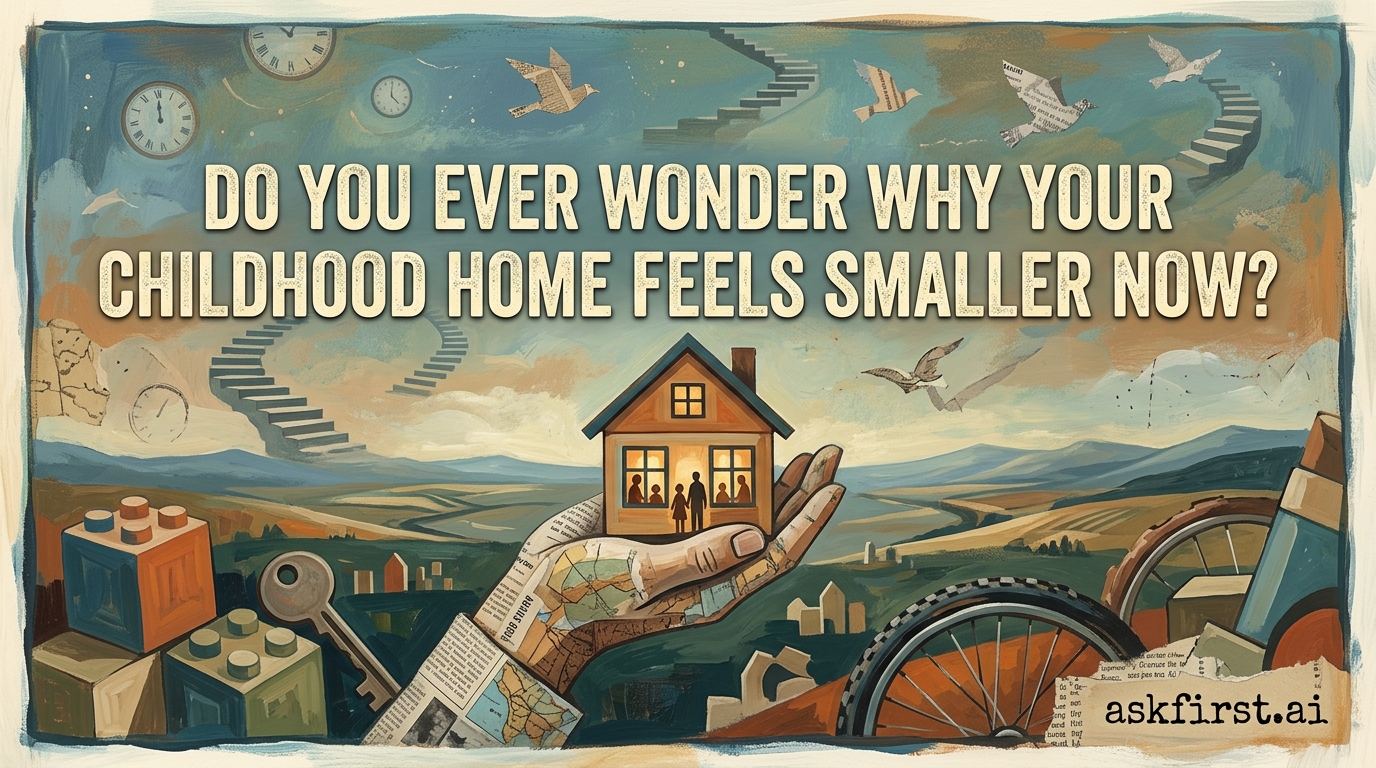
Returning to a childhood home after years of absence often triggers a profound sense of disorientation. What once felt like a sprawling, majestic landscape of corridors and cavernous bedrooms suddenly manifests as a compact, modest dwelling. This phenomenon is not merely an illusion; it is a fascinating intersection of cognitive psychology, developmental biology, and the mechanics of spatial memory. Understanding why childhood homes appear to shrink requires a journey into how the human brain encodes and reconstructs the architecture of reality.
The Developmental Scaling Hypothesis
The primary reason for this perceived shrinkage is simple physiological growth. When an individual is six years old, a standard door frame looms high above the head, and a kitchen counter reaches toward the chest. To a child, the environment is scaled relative to their own physical stature. Neuroscientists suggest that spatial memory is fundamentally tied to "ego-centric" reference points—meaning the brain encodes distances and proportions based on the body's interaction with the environment. As the body grows, the physical ratio between the observer and the structure shifts dramatically. When an adult returns, the brain attempts to map the current, larger frame onto the residual childhood memories, leading to a jarring recalibration.
The Role of Selective Memory and Idealization
Memory is not a video recording; it is a reconstructive process. The brain prioritizes emotional salience over architectural precision. Childhood memories are often infused with feelings of wonder, safety, and immense potential. This emotional weight causes the brain to expand the scale of meaningful spaces. Psychologists refer to this as 'affective magnification.' Because the mind associates those rooms with grand events—the exploration of every corner, the fear of the basement, the height of the ceiling during a game of hide-and-seek—the mental model of that space becomes inflated. Returning to the house provides a reality check, where the objective, static physical measurements collide with the exaggerated, subjective mental representation of the past.
Spatial Encoding and Environmental Landmarks
Children have less experience navigating the world, so their internal maps of a house are constructed with a high level of detail but limited context. A child might recall a living room as massive because they have not yet compared it to the vastness of a public library, an airport terminal, or a commercial warehouse. As the brain matures, it acquires a broader repertoire of spatial data. Exposure to diverse environments allows for better cognitive scaling. Once a person experiences larger, more complex structures, the relative 'size' of the childhood home is demoted in the brain’s hierarchy of spatial classification. It is not that the walls have moved; it is that the brain’s measuring stick has been upgraded through a lifetime of navigation.
Psychological Anchoring and Nostalgia
Nostalgia acts as a cognitive filter. When people revisit the sites of their formative years, they often seek comfort. However, the unexpected realization that a house has 'shrunk' serves as a stark reminder of the passage of time. This psychological anchor, while unsettling, provides a unique opportunity for self-reflection. It highlights the transformation of the self from a dependent, small observer of the world into an independent, capable adult. Research in environmental psychology indicates that these shifts in perception help individuals process personal history, effectively 'closing' the chapter of childhood by literally seeing the constraints of that period.
Factors Influencing the Perception of Space:
- Relative Proportions: The brain compares current surroundings to the most frequently visited environments.
- Cognitive Load: Children often focus on microscopic details, making a room feel expansive. Adults take in the 'gestalt' or the whole picture, leading to a faster, more summary assessment of space.
- The Power of Familiarity: Familiarity breeds a sense of efficiency; we mentally compress spaces we have mastered, which can make them seem smaller than unfamiliar, wide-open spaces.
Conclusion: The Gift of Perspective
Ultimately, the phenomenon of the shrinking house is a beautiful manifestation of human evolution. It serves as evidence of intellectual and physical development. While the walls of a childhood home remain physically static, the human mind is dynamic and ever-evolving. Feeling that a space has shrunk is a sign that one has outgrown the physical and psychological limitations of the past, marking a transition into a broader, more nuanced understanding of the world. It is the brain's way of marking the distance traveled between who we were and who we have become.