The Architecture of the Divine: Why Myths Require Supernatural Agency
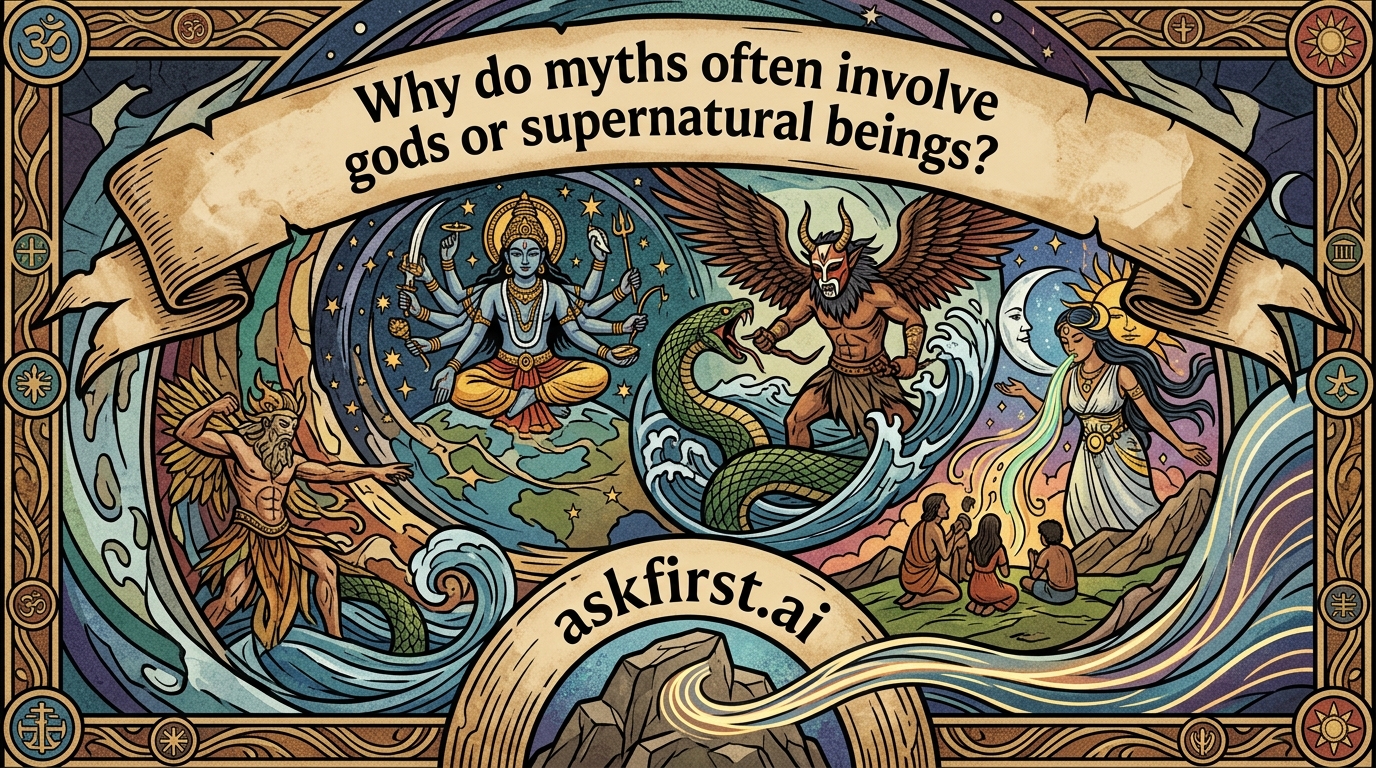
Myths are not merely stories; they are the foundational blueprints of human cognition and social organization. Across every culture—from the Vedic traditions of ancient India to the oral histories of the Haudenosaunee in North America—the presence of gods, deities, and supernatural forces is ubiquitous. This is not a coincidence of storytelling, but a functional necessity. Myths involve supernatural beings because these figures provide the only logical framework through which early humans could explain the overwhelming, often chaotic, and seemingly indifferent forces of the natural world. By projecting human-like intentions onto the environment, our ancestors transformed a terrifying, unpredictable wilderness into a meaningful, albeit complex, social landscape.
The Anthropomorphic Bridge to Reality
At the core of mythological development lies the human tendency toward anthropomorphism—the attribution of human traits, emotions, or intentions to non-human entities. As noted by the philosopher David Hume in his seminal work The Natural History of Religion (1757), humans possess a "propensity to spread on all external objects the sentiments which are internally felt."
When an ancient farmer observed a thunderstorm, they did not possess the meteorological data to understand atmospheric pressure or electrical discharge. To the human mind, which is evolutionarily wired to detect agency (the "agent detection device" theory proposed by cognitive scientists like Stewart Guthrie in Faces in the Clouds), a thunderclap is not a random event; it is an action. If it is an action, there must be an actor. By creating a character—a Zeus, a Thor, or a Tlaloc—the inexplicable becomes personal. This transition from "the storm is happening" to "the god is angry" allows humans to engage in the only strategy they possess for survival: negotiation. Through ritual, prayer, and sacrifice, the supernatural being becomes a partner in the survival of the tribe.
Providing Moral and Social Cohesion
Beyond explaining the physical environment, supernatural beings serve as the ultimate arbiters of social order. In his exhaustive study of mythology, The Hero with a Thousand Faces (1949), Joseph Campbell argues that myths function as a "pedagogical device" to align the individual with the collective.
Gods and supernatural entities act as the "super-witnesses" to human behavior. When a society creates a deity, that deity often embodies the idealized values of the culture. For example, the Egyptian goddess Ma’at represented truth, balance, and cosmic order. By centering the mythic narrative on a being who demands ethical behavior, the myth transforms social norms into cosmic imperatives. Breaking a law is no longer just a violation of a tribal agreement; it is a violation of the divine will. This elevates the stakes of human conduct, ensuring that social cohesion persists even in the absence of centralized legal enforcement.
The Resolution of Existential Paradoxes
Human life is defined by contradictions that are impossible to reconcile with logic alone: we are biological beings who are aware of our own inevitable death; we are capable of profound love and horrific violence; we exist in a world that is both life-sustaining and destructive. Claude Lévi-Strauss, the father of structural anthropology, argued in Myth and Meaning (1978) that the primary purpose of myth is to provide a logical model capable of overcoming these contradictions.
Supernatural beings exist outside the constraints of time, biology, and death. Because they are "immortal," they can bridge the gap between life and death. Because they are "all-powerful," they can explain why the innocent suffer and why the wicked prosper. Consider the Greek myth of Persephone: her descent into the underworld and subsequent return provides a narrative structure to understand the cycle of the seasons—a phenomenon that is otherwise a cycle of death (winter) and rebirth (spring). The gods allow humans to frame these terrifying existential transitions as part of a larger, intentional design.
The Narrative Utility of the Supernatural
From a purely literary and cognitive standpoint, supernatural beings are functional shorthand. In the absence of scientific nomenclature, gods act as "explanatory variables." If a culture needs to explain the origin of fire, the complexity of the stars, or the sudden onset of a plague, they do not need to write a textbook; they need to tell a story about a trickster god or a vengeful spirit.
As Mircea Eliade explains in The Sacred and the Profane (1957), the presence of the supernatural marks a space or an event as "sacred," differentiating it from the "profane" or mundane reality. By involving gods, myths create a hierarchy of importance. They tell the listener: "This is not just a story about a mountain; this is a story about the home of the gods." This distinction is crucial for memory retention and cultural transmission. Stories involving the supernatural are more memorable, emotionally resonant, and easier to pass down through generations than abstract philosophical treatises.
Conclusion
The prevalence of gods and supernatural beings in mythology is a testament to the human mind’s tireless effort to manufacture meaning in a vast, indifferent universe. By populating the world with deities, our ancestors were able to externalize their fears, codify their morals, and find comfort in the face of death. Myths are not "falsehoods" in the modern sense; they are sophisticated cognitive tools that allowed humanity to navigate the complexities of existence. As long as humans continue to grapple with the mystery of their own consciousness and the unpredictability of the natural world, the gods—or whatever modern surrogates we choose—will remain at the center of our stories.