Understanding Ultrafiltration: The Advanced Membrane Separation Technology
Ultrafiltration (UF) represents a sophisticated pressure-driven membrane separation process that serves as a cornerstone in modern water treatment, food processing, and pharmaceutical manufacturing. At its core, ultrafiltration acts as a precise physical barrier, utilizing a semi-permeable membrane to remove suspended solids, colloidal matter, bacteria, viruses, and high-molecular-weight organic compounds from fluid streams. Unlike traditional sand filtration, which relies on depth filtration, UF operates through size exclusion, providing a consistent and reliable barrier that does not depend on the quality of the influent water.
The Mechanics of Ultrafiltration Membranes
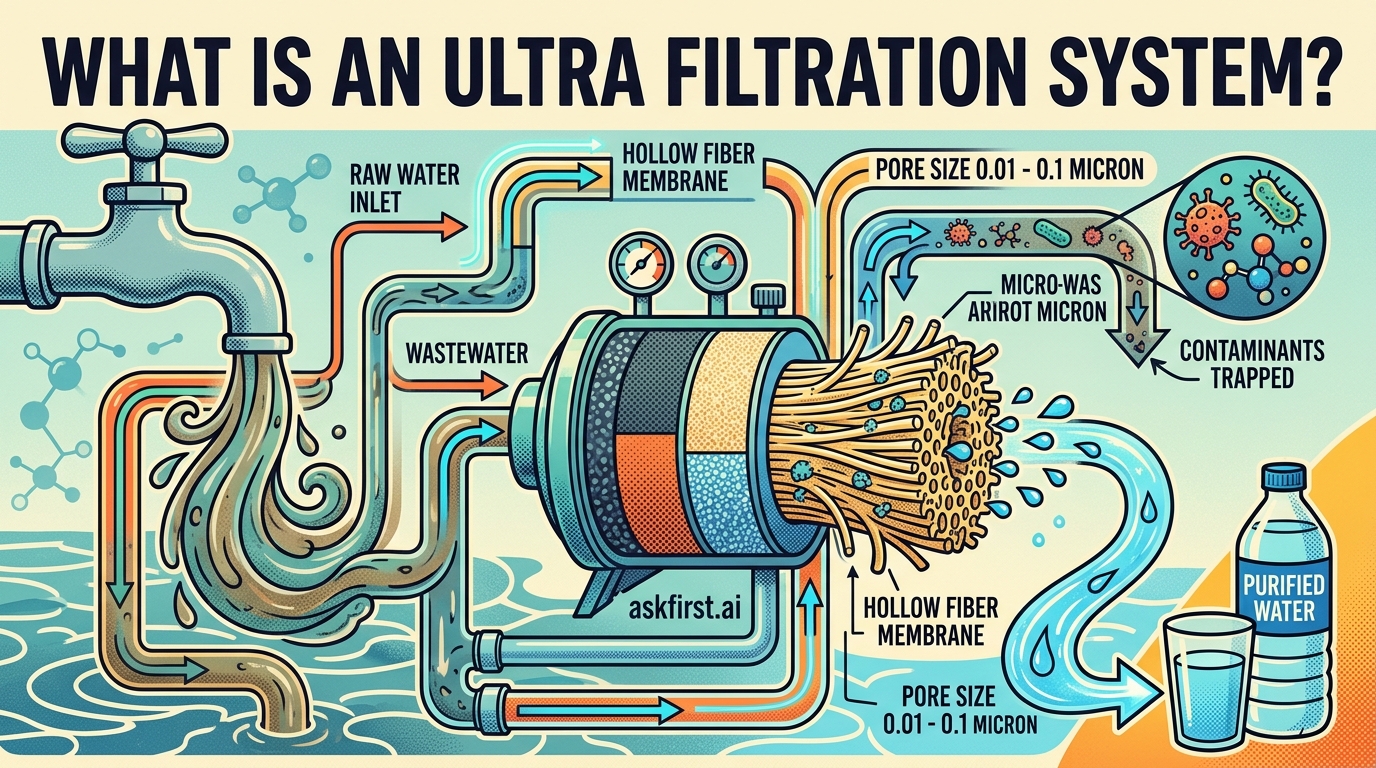
The technical efficacy of an ultrafiltration system is defined by its pore size, typically ranging from 0.01 to 0.1 micrometers (µm). This specific range allows water molecules, dissolved salts, and small minerals to pass through while effectively rejecting larger particles.
- Asymmetric Membrane Structure: Most modern UF membranes are manufactured as asymmetric structures. This means they possess a very thin, dense "skin" layer on the surface where the actual separation occurs, supported by a highly porous, sponge-like substructure that provides mechanical strength without adding significant resistance to flow.
- Material Composition: Membranes are typically constructed from robust synthetic polymers such as Polyethersulfone (PES), Polyvinylidene Fluoride (PVDF), or Polysulfone (PS). These materials are chosen for their chemical resistance, thermal stability, and ability to withstand the mechanical stress of backwashing.
- Configuration: The systems are usually configured as hollow-fiber modules. In this setup, hundreds or thousands of tiny, straw-like fibers are bundled together. Water flows either from the inside to the outside (inside-out) or from the outside to the inside (outside-in), depending on the specific application requirements.
Operational Principles and System Design
An ultrafiltration system functions under relatively low pressure, typically between 10 to 100 psi (0.7 to 7 bar). This makes it significantly more energy-efficient than Reverse Osmosis (RO), which requires much higher pressures to overcome osmotic pressure.
- Dead-End Filtration: In this mode, all the feed water passes through the membrane. While efficient, it requires frequent backwashing to prevent the buildup of a "filter cake" on the membrane surface.
- Cross-Flow Filtration: Here, the feed water flows parallel to the membrane surface at high velocity. This creates a scouring effect that keeps the membrane surface clean, making it ideal for high-solids applications.
- Backwashing and Cleaning: To maintain flux (the rate of water passage), systems must undergo periodic backwashing. This involves reversing the flow of water through the membrane to dislodge accumulated particles. Periodically, "Chemically Enhanced Backwashes" (CEB) are performed using mild concentrations of chlorine or caustic soda to remove stubborn organic foulants.
Real-World Applications and Industrial Impact
Ultrafiltration has revolutionized water purification because it produces high-quality permeate regardless of fluctuations in raw water quality.
- Municipal Drinking Water: Large-scale UF plants are increasingly replacing conventional coagulation-flocculation-sedimentation processes. As noted in Water Treatment: Principles and Design by MWH (Montgomery Watson Harza), UF is highly effective at removing Cryptosporidium and Giardia cysts, which are resistant to traditional chlorine disinfection.
- Wastewater Reclamation: UF is a primary component of Membrane Bioreactors (MBR). In these systems, UF membranes are submerged directly into an activated sludge tank, replacing the traditional secondary clarifier. This process, detailed by C.F. Judd in The MBR Book: Principles and Applications of Membrane Bioreactors for Water and Wastewater Treatment, allows for the production of high-quality effluent suitable for irrigation or industrial reuse.
- Food and Beverage Industry: UF is indispensable for the concentration of proteins in dairy processing (such as whey protein isolation) and the clarification of fruit juices, where it removes haze-forming compounds without the need for chemical additives.
Advantages and Limitations
The primary advantage of ultrafiltration is its absolute physical barrier. Because the pores are smaller than the pathogens they are meant to remove, the system provides a predictable level of safety that is difficult to achieve with chemical disinfection alone. Furthermore, the small footprint of UF systems makes them ideal for facilities with limited space.
However, the technology is not without its limitations. Membrane fouling—the accumulation of organic matter, inorganic scales, or bio-growth—remains the greatest challenge. If not managed through rigorous maintenance and pre-treatment (such as screening or pH adjustment), fouling can permanently damage the membrane fibers and necessitate costly replacements.
Conclusion
Ultrafiltration is a high-performance, versatile technology that sits at the intersection of environmental engineering and industrial efficiency. By leveraging the physical laws of molecular exclusion, it provides a robust defense against contamination in both drinking water supplies and complex industrial processes. As global water scarcity necessitates the reuse of wastewater and the treatment of more challenging water sources, the reliance on ultrafiltration systems will undoubtedly continue to grow. Whether it is ensuring a city's drinking water safety or facilitating the concentration of essential nutrients in the food industry, UF remains an essential pillar of modern fluid separation technology.