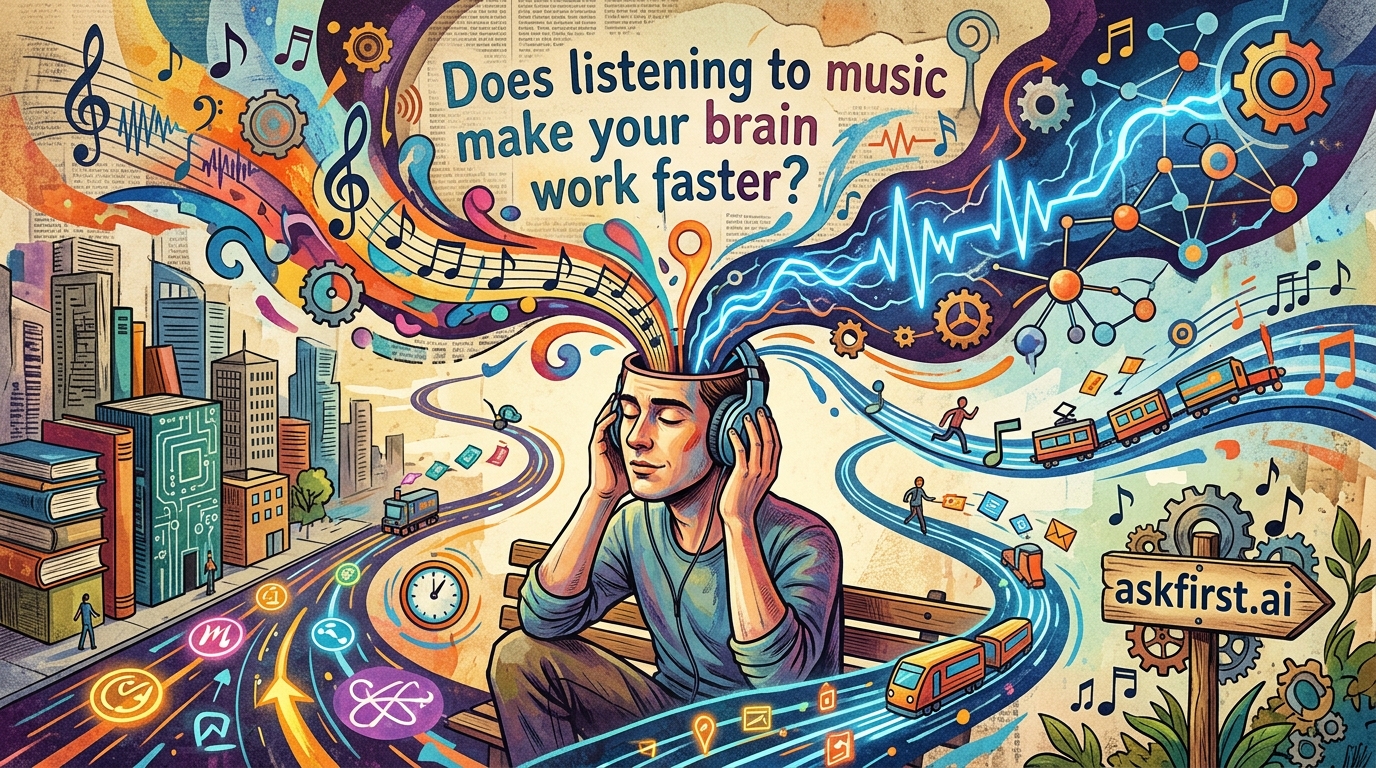
The Neurological Symphony: Does Music Accelerate Cognition?
The inquiry into whether music serves as a cognitive accelerator touches upon one of the most fascinating intersections of psychology and neuroscience. While the popular concept of the 'Mozart Effect' suggests that simply listening to complex compositions can heighten intelligence, the reality of how auditory stimulation impacts neural velocity is far more nuanced, intriguing, and scientifically sophisticated. Rather than acting as a binary 'on-off' switch for speed, music functions as a complex environmental modulator that influences focus, memory retrieval, and emotional regulation.
The Mechanisms of Neural Synchronization
At the core of how music interacts with the brain is the concept of entrainment. The brain possesses a remarkable tendency to synchronize its internal rhythmic patterns—specifically brainwaves—with external rhythmic stimuli. When an individual listens to music with a steady, driving tempo, neural oscillations often align with the beat. This synchronization facilitates communication between different regions of the brain. Studies indicate that music activates nearly every part of the brain simultaneously, creating a widespread network of connectivity that few other human experiences can replicate.
- Frontal Lobe Engagement: Responsible for planning and executive function.
- Hippocampus Integration: Involved in the formation and retrieval of memories.
- Cerebellum Activation: Managing timing, precision, and physical coordination.
Busting the Myth: The 'Mozart Effect' Reality
In the 1990s, research famously posited that listening to Mozart could temporarily boost spatial-temporal reasoning. While public perception seized this as a 'get smart quick' scheme, scientific consensus has clarified the findings. It is not necessarily the 'genius' of the composer that accelerates the brain, but rather the Arousal-Mood Hypothesis. If a piece of music elevates an individual’s mood and alertness, cognitive performance improves as a direct consequence of that state. In essence, music works as an arousal tool. If the brain is bored or fatigued, stimulating music increases alertness, effectively 'waking up' the faculties necessary for rapid processing. If the music is too complex or chaotic, however, it may distract from the task at hand, creating a 'cognitive load' that actually slows down processing speed.
The Impact of Tempo and Complexity on Processing Speed
Research suggests that the tempo of music acts as a regulator for work-related speed. High-tempo music—specifically in the range of 60 to 120 beats per minute (BPM)—has been linked to increased productivity in repetitive, logic-based tasks. This tempo often mirrors the heart rate during a focused state, creating a flow condition.
- Low Complexity (Ambient/Lo-Fi): Best for tasks requiring heavy concentration, such as coding or writing. It provides a background constant that prevents the brain from drifting toward internal distractions.
- High Complexity (Classical/Jazz): Excellent for spatial reasoning and problem-solving, as the brain must work to interpret the changing patterns and melodic shifts, keeping neural pathways active.
- Lyrical vs. Instrumental: For most individuals, lyrics act as a major cognitive impediment. Because the brain’s language centers are engaged when processing speech, listening to music with vocals can cause 'linguistic interference' during reading or analytical writing tasks. Instrumental tracks, by contrast, offer the benefits of rhythm without the interference of syntax.
Music as a Tool for Neural Plasticity
Beyond immediate performance, music acts as a long-term architect of the brain. Regular engagement with music—particularly the act of playing an instrument, though also through deep, active listening—strengthens the corpus callosum, the bridge between the left and right hemispheres of the brain. A stronger corpus callosum allows for faster transfer of information across the brain, which inherently supports higher cognitive speed and better integrated thinking. This is not about a temporary boost; it is about building a more efficient neural infrastructure.
Practical Application: Finding Your 'Cognitive Tempo'
To leverage music for accelerated thinking, one must identify the 'sweet spot' of stimulation:
- Match the task to the rhythm: Choose high-energy music for physical or repetitive tasks; choose rhythmic, wordless music for deep cognitive work.
- Prioritize consistency: Use familiar music to minimize the brain’s need to analyze the novelty of the sound, allowing more energy to be diverted to the task.
- Monitor the response: If you find yourself tapping your feet or humming, you are likely in a state of high synchronization. If you find yourself unable to focus, lower the volume or switch to more predictable, ambient soundscapes.
Conclusion
Does listening to music make the brain work faster? The answer is a qualified 'yes,' but with the caveat that it is a tool of enhancement rather than a magic enhancement. Music functions as a bridge that connects emotional state, arousal levels, and neurological synchronization. By selecting the correct auditory environment, individuals can calibrate their brain's internal rhythm to match the requirements of their tasks, effectively unlocking a higher gear for cognitive processing. Ultimately, music transforms the brain from a passive receiver into a highly tuned, rhythmic instrument of thought.