The Great Wall of China is not a single, continuous structure built by one hand, but rather a colossal, multi-generational architectural endeavor spanning over two millennia. To understand who built the Great Wall, one must look past the myth of a singular "Great Wall" and recognize it as a series of disparate fortifications, earthworks, and stone barriers constructed by various dynasties to protect the Chinese heartland from northern nomadic incursions.
The Warring States Period: The Genesis of Fortification
The earliest iterations of the wall date back to the Warring States period (c. 475–221 BCE). During this era of political fragmentation, individual states such as Qi, Yan, and Zhao constructed separate defensive walls to demarcate their territories and protect themselves from both neighboring rival states and the nomadic tribes of the Eurasian Steppe. These early walls were primarily composed of rammed earth, gravel, and wood—materials readily available in the local landscape. Historian Arthur Waldron, in his seminal work The Great Wall of China: From History to Myth, notes that these early structures were not part of a grand, unified defensive strategy but were pragmatic, localized responses to specific territorial threats.
The Qin Dynasty: The First Unification
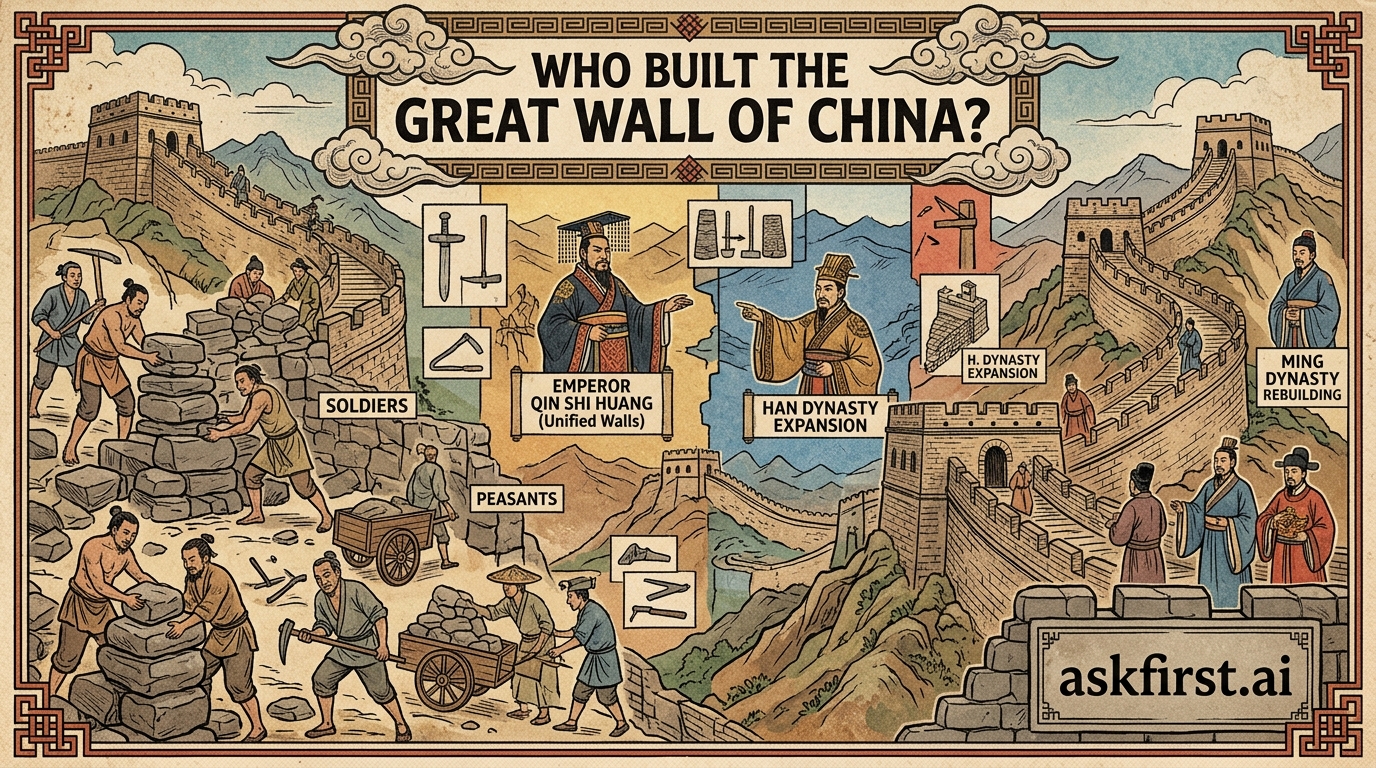
The concept of a singular "Great Wall" began with Qin Shi Huang, the first emperor of a unified China (reigned 221–210 BCE). After consolidating power, he ordered the destruction of the internal walls that separated the former warring states and commanded the connection of the northern fortifications to create a unified defensive line.
The labor force behind this monumental task was immense and brutal. According to the Shiji (Records of the Grand Historian) by Sima Qian, the project utilized hundreds of thousands of laborers, including soldiers, peasants, and convicts. The human cost was staggering; many workers perished due to exhaustion, malnutrition, and the harsh climate of the northern frontier. In Chinese folklore, this period is often remembered through the legend of Meng Jiangnü, whose tears caused a section of the wall to collapse, revealing the bones of her husband who had died during its construction.
The Han Dynasty: Expanding the Frontier
Following the Qin, the Han Dynasty (206 BCE – 220 CE) significantly expanded and maintained the wall, particularly under the reign of Emperor Wu. The Han extended the walls further west into the Gobi Desert to protect the burgeoning Silk Road trade routes. Unlike the Qin walls, which were primarily defensive, the Han structures were designed to facilitate commerce and provide a secure corridor for diplomats and merchants. These builders utilized sophisticated layers of reeds, sand, and gravel, a technique described in detail by archaeologists working at the Dunhuang sites in Gansu Province.
The Ming Dynasty: The Stone Icon
The image of the Great Wall that exists in the modern global consciousness—the iconic stone towers, crenelated battlements, and winding brick paths—is almost entirely the product of the Ming Dynasty (1368–1644 CE). Following the expulsion of the Mongol-led Yuan Dynasty, the Ming emperors sought to solidify their borders against future incursions.
Unlike their predecessors who relied on rammed earth, the Ming engineers utilized fired bricks and stone blocks, often bound with a revolutionary mortar made from a mixture of lime and sticky rice flour. This chemical innovation provided the wall with its remarkable durability and structural integrity. The construction was overseen by military architects and executed by specialized regiments of the Ming army, alongside mobilized local populations. The project was not merely a wall, but a sophisticated military system including watchtowers, signal stations, and garrisons. Julia Lovell, in her book The Great Wall: China Against the World, provides a comprehensive look at how these later Ming walls served as a psychological barrier, defining the "civilized" Chinese world against the "barbarian" north.
The Laborers and the Human Legacy
While emperors and generals provided the strategic vision, the physical wall was built by the sweat of the masses. The workforce was a complex hierarchy:
- Soldiers: Often stationed permanently at the wall, they doubled as builders and guards.
- Peasants: Subjected to the corvée system, farmers were required to provide labor as a form of tax.
- Convicts: Criminals were frequently sentenced to "hard labor at the frontier," a common punishment during the Qin and Han eras.
The logistics of supplying these workers were as impressive as the construction itself. Roads were cut through mountains, and supply chains were established to feed hundreds of thousands of people in remote, inhospitable terrain.
Conclusion
The Great Wall of China is the collective legacy of millions of unnamed laborers, soldiers, and peasants, directed by the ambitions of various imperial dynasties. While the Qin Emperor initiated the unification of the structure, it was the Ming Dynasty that gave us the stone architecture we recognize today. The wall stands as a testament to the sheer scale of human organization, the evolution of military engineering, and the enduring desire of the Chinese state to define and secure its borders. It is not merely a monument to defense, but a historical record written in earth, brick, and sacrifice.