The Temporal Paradox: Why Time Accelerates with Age
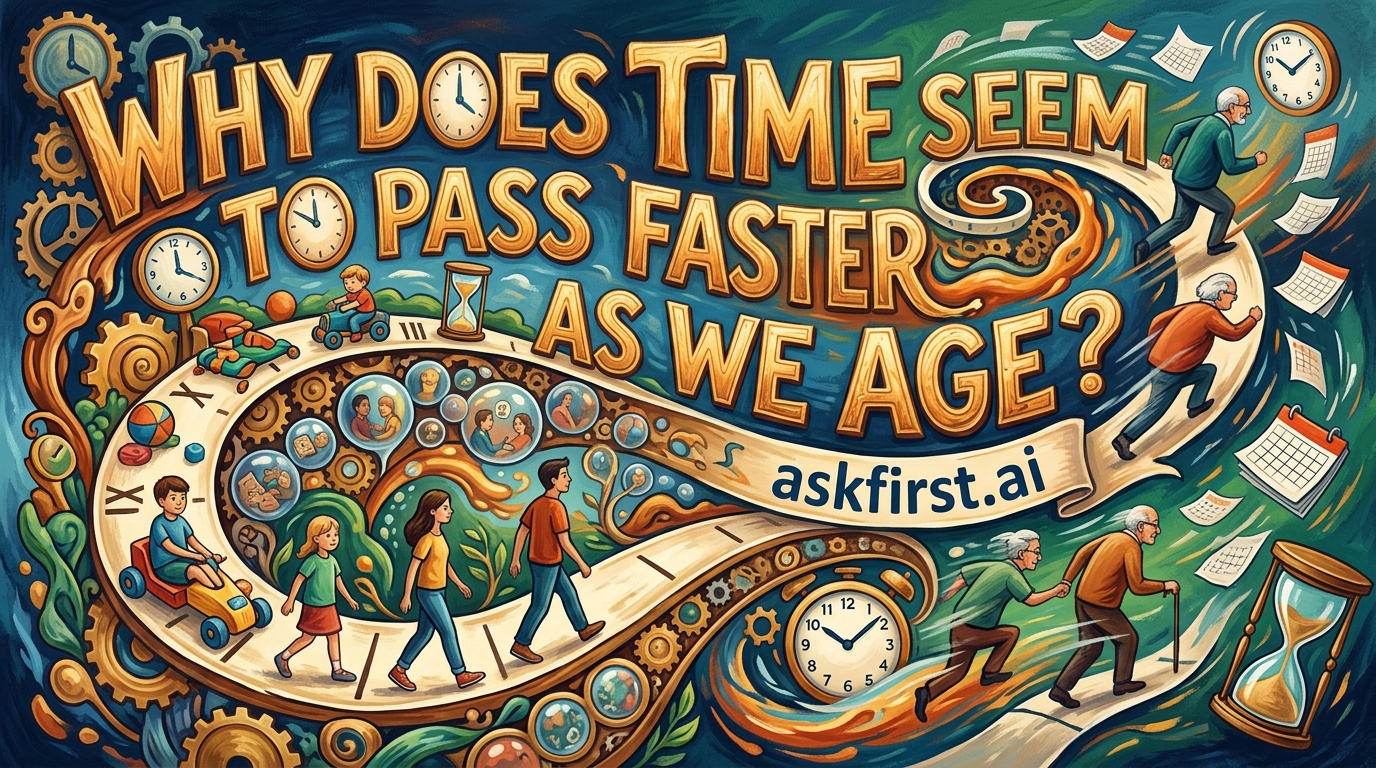
The subjective perception that time moves faster as we grow older is one of the most pervasive psychological phenomena of the human experience. While a clock ticks with the same rhythmic precision for a child as it does for an octogenarian, the human brain processes these intervals through vastly different cognitive filters. This phenomenon, often termed the "Holiday Paradox" or the "Proportional Theory," suggests that our internal clock is not a mechanical device, but a dynamic, memory-dependent construct that shifts based on how we encode experience.
1. The Proportional Theory: The Mathematical Perspective
One of the most widely cited explanations for this phenomenon is the Proportional Theory, first proposed by French philosopher Paul Janet in 1877. Janet posited that our perception of time is relative to the total length of time we have already lived.
To a five-year-old child, a single year represents 20% of their entire existence. The sheer volume of new information, milestones, and physical growth packed into that year makes it feel like an epoch. Conversely, to a fifty-year-old, a single year represents only 2% of their life. Because the brain perceives a year as a smaller fraction of the whole, it is mentally "discounted" as a shorter interval. In The Illusion of Time, physicist Richard Hammond explores how this mathematical scaling impacts our narrative structure of life, suggesting that as our "sample size" of life increases, each new unit of time carries less weight in our overall history.
2. The Role of Novelty and Neural Encoding
Beyond mathematics, the biological mechanism of novelty detection plays a critical role in how we experience duration. When we are young, the world is a landscape of "firsts." Our brains are constantly creating new neural pathways to store unfamiliar information—first days of school, first travel experiences, learning to ride a bike.
Neuroscientist David Eagleman, in his work The Brain: The Story of You, explains that the brain consumes more energy and focuses more attention when processing novel stimuli. Because the brain is working harder to encode these new memories, it creates a "denser" experience. When we look back on a period filled with new experiences, our brain perceives it as having taken a long time because there is a high volume of data stored in memory.
As we age, we often fall into routines. We commute the same way, eat similar meals, and interact with familiar colleagues. Because these experiences are predictable, the brain shifts into "autopilot" mode. It doesn't need to dedicate as much energy to encoding these familiar events, leading to a "thinner" memory bank. When we look back on a year of routine, the brain finds fewer unique "data points," causing the period to feel as though it vanished in an instant.
3. The "Holiday Paradox" and Cognitive Retrospection
The Holiday Paradox is closely linked to the distinction between "prospective" and "retrospective" time. Prospective time is how we feel time passing in the moment, while retrospective time is how we estimate the duration of an event after it has passed.
Psychologist Claudia Hammond, in her book Time Warped: Unlocking the Mysteries of Time Perception, notes that when we go on a new holiday, the first few days feel long because of the sheer volume of new sensory input. However, looking back weeks later, the trip feels like it flew by because the brain has streamlined the memories. In daily life, as we age, we spend more time in the retrospective mode. We are constantly looking back at the week, the month, or the year. Because our adult lives are less punctuated by the intense novelty of childhood, our retrospective assessment is that time is accelerating.
4. The Influence of Biological Rhythms
Some researchers, such as Adrian Bejan, a professor of mechanical engineering at Duke University, argue that the slowing of our internal "frame rate" contributes to this feeling. Bejan suggests that as we age, the physical degradation of our neural pathways—specifically the increase in the time it takes for electrical signals to travel through the brain—means we process fewer "frames" per second.
Just as a movie camera capturing fewer frames per second makes the action on screen appear faster when played back, Bejan argues that the physical slowing of our neurological processing makes the external world seem to move more quickly. Our eyes and brain capture fewer discrete images of the world per unit of time, leading to the subjective sensation that time is rushing past us.
Conclusion: Reclaiming the Clock
The acceleration of time is not an inevitable decline, but a consequence of how we engage with the world. To combat this temporal compression, experts suggest actively seeking out novelty. By breaking routines, learning new skills, traveling to unfamiliar places, and forcing the brain to move out of its automated state, we can increase the density of our memories. By intentionally creating "firsts" throughout our adult lives, we effectively slow down our perception of time, ensuring that the years feel as rich and substantial as they did in our youth. The clock may never stop, but the way we inhabit the seconds remains, to a significant extent, within our own control.