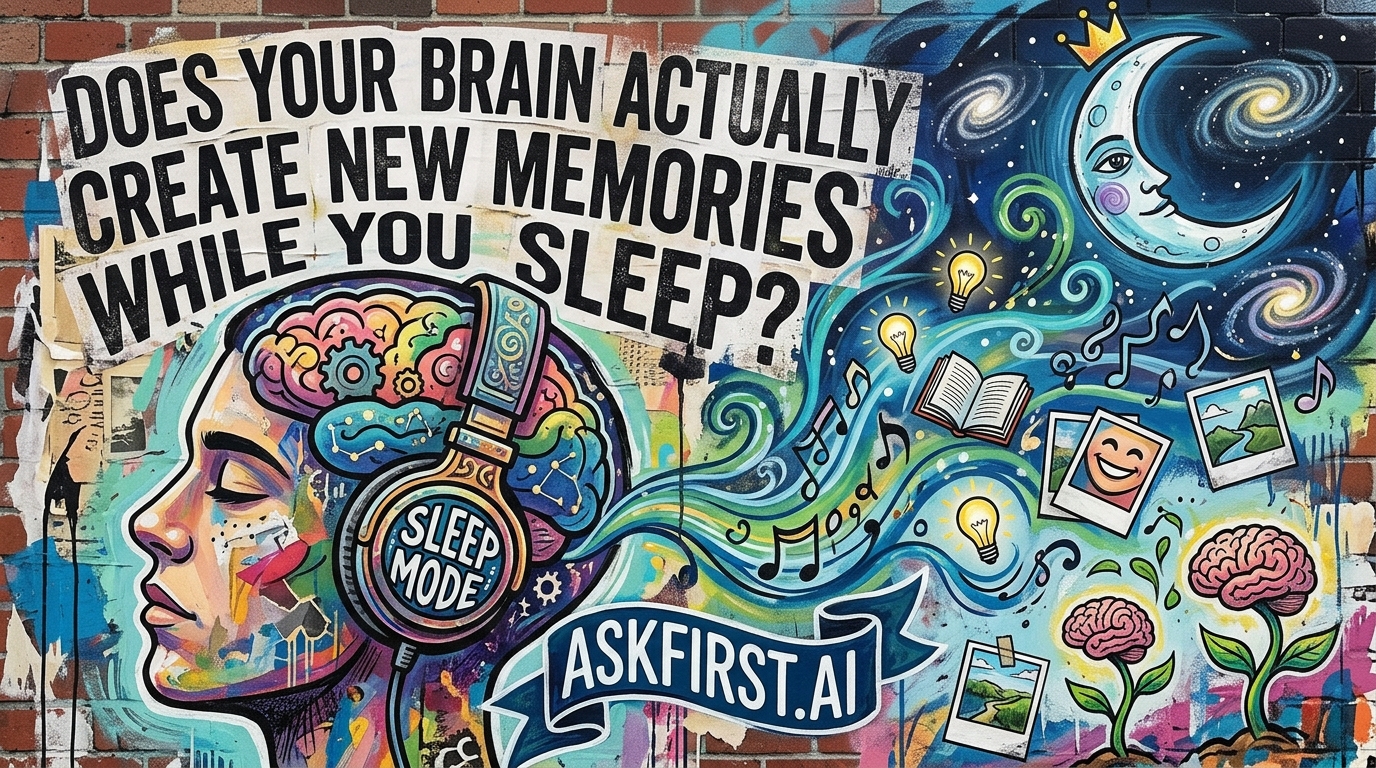
The Nocturnal Architect: Memory Consolidation During Sleep
It is a pervasive myth that sleep is merely a period of biological downtime, a static state where the body recovers while the mind powers down. However, modern neuroscience reveals a radically different reality: while the body rests, the brain embarks on a sophisticated, high-energy reconstruction of personal history. The question of whether the brain creates new memories while sleeping requires a nuanced understanding of memory processing. While the acquisition of sensory data generally occurs during waking hours, the brain undergoes a process called memory consolidation during sleep that transforms fleeting experiences into long-term knowledge.
The Three Pillars of Memory Processing
To understand sleep-based memory, one must distinguish between three essential phases of information storage:
- Encoding: The initial registration of sensory stimuli while awake.
- Consolidation: The process of stabilizing and strengthening a memory trace after initial acquisition. This is the primary function of sleep.
- Retrieval: The process of accessing stored information during waking states.
During the day, the hippocampus, a brain region critical for learning, functions like a notebook, rapidly logging new experiences. However, the capacity of this "notebook" is limited. When the individual falls asleep, the brain begins the task of "offloading" information from the hippocampus to the neocortex, a process akin to archiving digital files from a temporary cache to long-term storage. This process does not just preserve memories; it fundamentally refines them.
The Role of Sleep Cycles in Memory
Sleep is not a uniform state. It oscillates between Non-Rapid Eye Movement (NREM) sleep and Rapid Eye Movement (REM) sleep, each playing a distinct, irreplaceable role in memory architecture.
1. Slow-Wave Sleep (Deep NREM): During the deepest stages of NREM sleep, the brain exhibits synchronized, rhythmic electrical activity known as 'slow-wave oscillations.' These oscillations act as a broadcast signal, allowing the hippocampus to 'replay' the neural firing patterns established during the day. As the neurons fire in the same sequence during sleep as they did while the individual was learning a task, the connections between neurons—known as synapses—are strengthened. This is the physiological manifestation of learning.
2. REM Sleep: REM sleep is famously associated with vivid dreaming, but it also serves as a critical stage for procedural memory (the learning of tasks and motor skills) and emotional regulation. During REM, the brain dissociates memories from their intense emotional context, allowing for a more stable, objective understanding of past events. It is during this stage that the brain performs 'associative learning,' connecting new information with existing neural networks.
Busting Myths: Can We Learn New Facts While Sleeping?
The notion of 'sleep learning'—such as playing an audio lecture while sleeping to learn a new language—is largely regarded by the scientific community as ineffective. While studies have shown that targeted memory reactivation (TMR) using specific sounds or odors can reinforce existing memories during sleep, the brain cannot simply acquire and store complex new information from scratch while unconscious. The brain needs the engagement of sensory inputs during the wake state to form the initial synaptic structure. Sleep serves to fix, integrate, and optimize what has already been introduced.
Why the Brain Needs Sleep for Intellectual Growth
The most profound aspect of sleep-dependent memory processing is system consolidation. Scientists have observed that during sleep, the brain identifies 'gist' or common themes across various experiences, effectively extracting rules and strategies from disparate pieces of data. This explains why an individual might wake up with a solution to a problem that seemed insurmountable the night before. The brain has spent hours reorganizing the neural map, prioritizing relevant details, and pruning away the noise.
Clinical and Practical Implications
Research from institutions like the Sleep and Neuroimaging Laboratory suggests that sleep deprivation severely impairs the hippocampal ability to encode new memories the following day. When one skips sleep, the brain's ability to 'save' information is akin to trying to write on a hard drive that is already full and corrupted. Without the cleaning and reorganization cycles of deep sleep, the brain remains in a state of high interference, making it nearly impossible to form stable new memory traces.
In conclusion, the brain does not simply 'create' memories out of thin air while sleeping. Instead, it performs the far more vital work of a curator. It sorts, edits, strengthens, and integrates the chaos of daily life into the cohesive narrative of our knowledge. Sleep is the bridge between temporary experience and enduring wisdom; without this nightly architect, the learning process would remain incomplete, unstable, and quickly forgotten. Understanding this mechanism underscores that sleep is not a passive activity, but the engine of human intelligence.