The Proportional Theory of Time
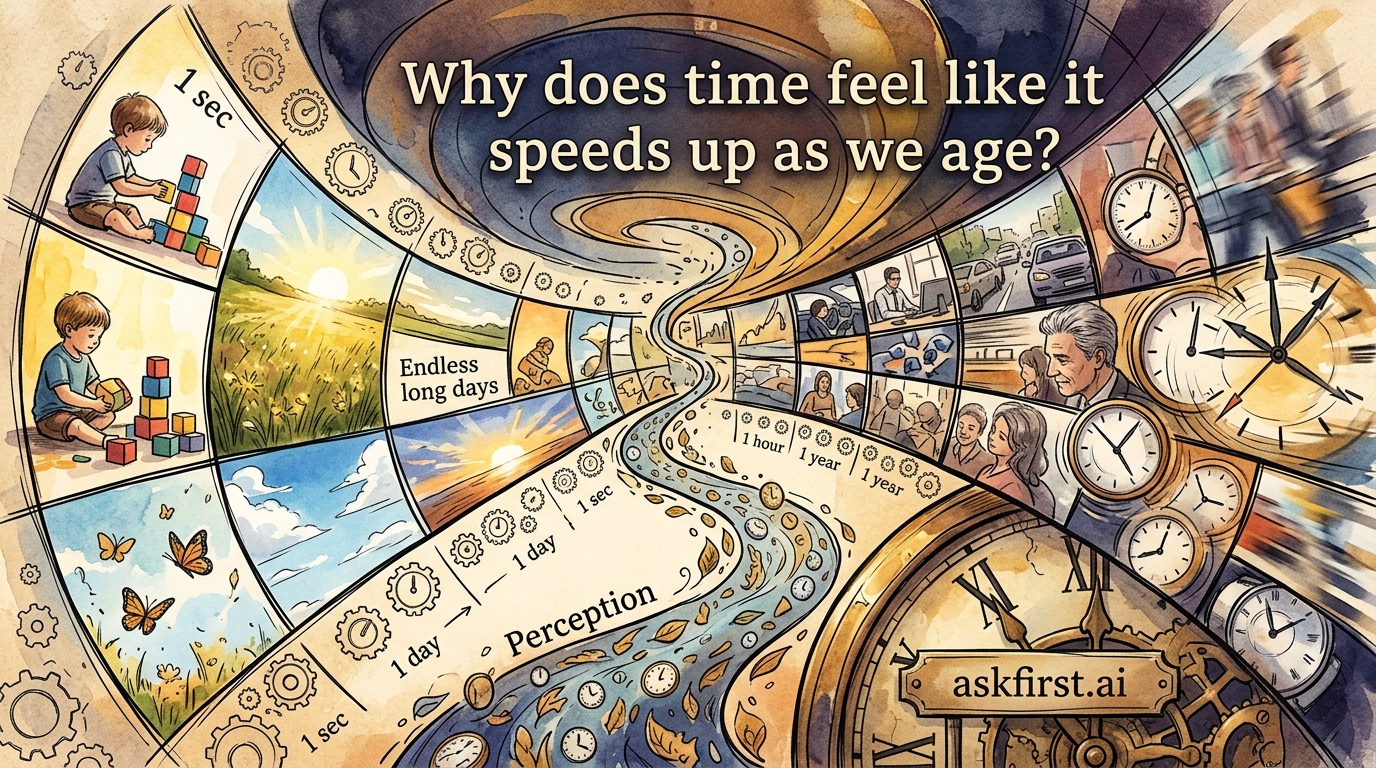
One of the most prominent explanations for the perception of accelerating time is the Proportional Theory, first proposed by French philosopher Paul Janet in 1877. This theory posits that as humans age, each unit of time represents a smaller fraction of the total life lived. For a five-year-old child, one year constitutes 20% of their entire existence. By contrast, for a fifty-year-old adult, a single year represents only 2% of their life. Because our brains process time in relative terms rather than objective clock-ticks, the perceived length of a year shrinks as our total lifespan grows. This psychological phenomenon creates an inherent bias where the past feels longer during childhood and significantly shorter during middle and late adulthood.
The Role of Novelty and Memory Encoding
Beyond simple proportions, the Neural Basis of Time Perception provides a biological explanation rooted in how the brain encodes new information. Novelty is the key driver of memory density. During childhood and adolescence, almost every experience is fundamentally new: the first day of school, learning to ride a bike, or the first trip to a new city. The brain consumes immense energy to encode these 'first-time' experiences, creating deep, intricate neural pathways. As these memories are rich in detail, they take up more 'space' in our subjective timeline, making childhood feel exceptionally long.
In contrast, as adults, we fall into established routines. We commute the same paths, perform the same work tasks, and follow predictable schedules. When the brain encounters familiar experiences, it enters a state of 'automaticity' or heuristic processing. It does not need to allocate significant energy to encode these moments because it has seen them before. Consequently, memories of these mundane periods are sparse and compressed. When we look back at a year filled with routine, we have very few distinctive mental 'bookmarks,' causing the brain to collapse the timeline and perceive it as having passed in a flash. This is often referred to as the Holiday Paradox: a week on a new adventure feels long because of the sheer volume of new information, while a week of office work feels like a single afternoon.
Psychological Factors and Mindfulness
There is also a significant psychological component related to emotional arousal and engagement. Time perception is closely linked to our level of attention. When we are intensely engaged in a task—the state often called 'Flow'—we lose track of time. Conversely, when we are bored, time seems to drag. However, the paradox of aging is that even if a boring month feels long in the moment, it fails to leave a lasting trace in the memory. By the end of the year, that time vanishes from our retrospective reflection because the brain failed to store anything of note.
- Active Engagement: Pursuing hobbies or learning new skills creates more 'anchor points' for the brain to attach to.
- Mindfulness Practices: By practicing mindfulness, individuals force themselves to observe the present moment without judgment or habitual shortcuts, which effectively slows down the sensation of life passing by.
- Novelty Seeking: Intentionally breaking routines forces the brain to move out of the 'automatic pilot' mode, requiring it to process more information and therefore creating a denser, more memorable history.
Biological Clocks and Cognitive Decline
While neurobiological changes like a slowing metabolism or subtle shifts in dopamine levels have been investigated, most experts agree that the structural change in how we categorize experiences is the primary driver of perceived temporal acceleration. As we age, the brain prioritizes efficiency. It becomes a master of pattern recognition, allowing us to navigate the world with less cognitive effort. While this makes us more efficient survivors, it creates a side effect where the richness of our daily perception feels diminished. To fight this feeling, many cognitive scientists suggest that the most effective remedy is to treat life like a tourist: stay curious, learn continuously, and ensure that every season contains at least one experience that challenges the brain to build new, complex, and lasting memories. By consciously increasing the 'data density' of our lives, we can effectively extend our subjective lifespan.