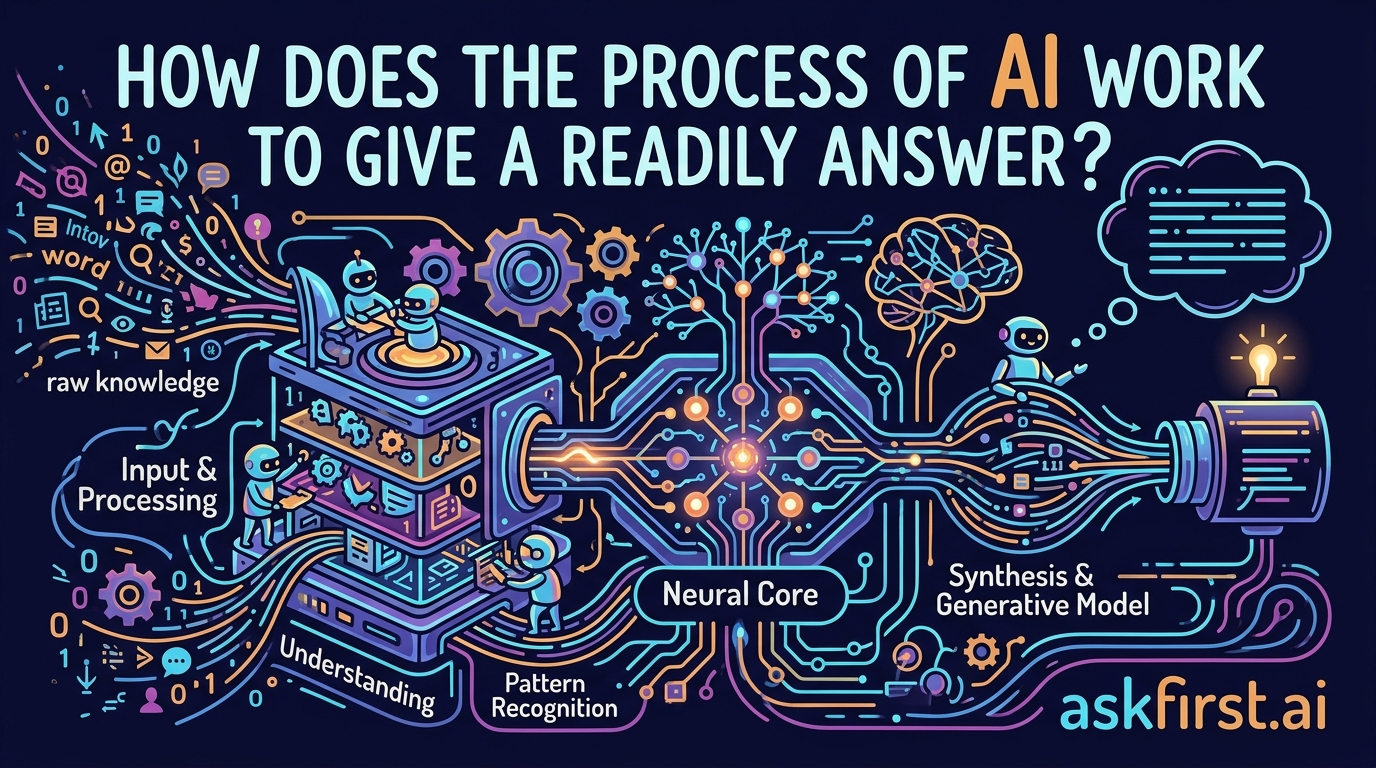
The Mechanics of Instant Intelligence: How Large Language Models Generate Answers
The ability of modern systems to provide immediate, contextually relevant answers to complex questions is not a product of "thinking" in the human sense, but rather the result of sophisticated probabilistic processing. At its core, the technology relies on the architecture of the Transformer, a deep learning model introduced by Vaswani et al. in their seminal 2017 paper, "Attention Is All You Need." This architecture revolutionized how machines process sequential data, moving away from older, slower methods toward a parallelized, attention-based mechanism.
The Foundation: Tokenization and Vectorization
Before a system can provide an answer, it must first translate human language into a format it can compute. This process begins with tokenization. Text is broken down into "tokens," which can be words, parts of words, or even individual characters. For instance, the word "encyclopedia" might be split into "encyclo" and "pedia."
Once tokenized, these units are converted into embeddings—high-dimensional vectors in a mathematical space. In this space, words with similar meanings are positioned closer together. As noted by researchers like Christopher Manning in his Stanford University course CS224N: Natural Language Processing with Deep Learning, these vectors capture semantic relationships. For example, the vector for "king" minus "man" plus "woman" results in a vector very close to "queen." This geometric representation allows the model to understand the nuance of language, such as synonyms, antonyms, and context-dependent meanings.
The Mechanism of Attention: Contextual Understanding
The most critical innovation in modern AI is the Self-Attention Mechanism. In traditional models, a computer might struggle to understand that the word "it" in a sentence refers to a specific noun mentioned earlier. The Transformer solves this by assigning "attention scores" to every word in a sequence relative to every other word.
When a query is processed, the model calculates the relevance of each token to the others. If you ask, "What is the capital of France, and why is it famous?", the attention mechanism ensures the model maintains a link between "it" and "Paris" throughout the generation process. This allows the system to generate coherent, long-form answers that remain focused on the user's initial intent. This concept is extensively detailed in the work of Jay Alammar, specifically his influential blog series, The Illustrated Transformer, which provides the definitive breakdown of how these layers interact to maintain context.
Probabilistic Prediction: The Generation Phase
Once the model has analyzed the input, it does not "search" a database in the way a traditional search engine does. Instead, it predicts the most likely next token based on the patterns it learned during its pre-training phase.
Imagine a system that has read billions of pages of text. During training, it is tasked with predicting the next word in a sentence. Through billions of iterations, it adjusts its internal weights—parameters that quantify the strength of connections between neurons in its neural network. When you ask a question, the model generates the answer one token at a time. It calculates a probability distribution over its entire vocabulary for the next word. If the prompt is "The sky is...", the model assigns a high probability to "blue" and a low probability to "bicycle." This process continues iteratively until an "end-of-sequence" token is generated.
Reinforcement Learning and Human Alignment
A machine that simply predicts the next word based on raw internet text might produce incoherent or biased content. To ensure the answers are helpful and safe, developers utilize Reinforcement Learning from Human Feedback (RLHF). This method, popularized by researchers at OpenAI in papers like Training language models to follow instructions with human feedback (Ouyang et al., 2022), involves humans ranking different model outputs.
By training a "reward model" on these human preferences, the AI learns to prioritize clarity, accuracy, and helpfulness. This is why modern systems can adopt different "personas" or provide structured, encyclopedic responses rather than just rambling text. It is the bridge between raw statistical pattern matching and functional, human-centric utility.
Limitations and Conclusion
While the speed of these systems feels like intelligence, it is important to recognize the inherent limitations. The model is a stochastic parrot, as described by Emily Bender and Timnit Gebru in their 2021 paper On the Dangers of Stochastic Parrots. It does not have access to an objective "truth"; it has access to a compressed, statistical representation of human knowledge. If the training data contains errors or biases, the model will likely reflect them.
In summary, the process of providing a "readily answer" is a high-speed journey through a multi-layered neural network that tokenizes input, maps it into semantic vector space, applies attention to maintain context, and predicts the most statistically probable response, all refined by human feedback. This blend of massive-scale computation and human-guided fine-tuning allows for the instantaneous synthesis of information that defines the current state of artificial intelligence.