The Illusion of Simultaneity: How the Brain Lags Behind Reality
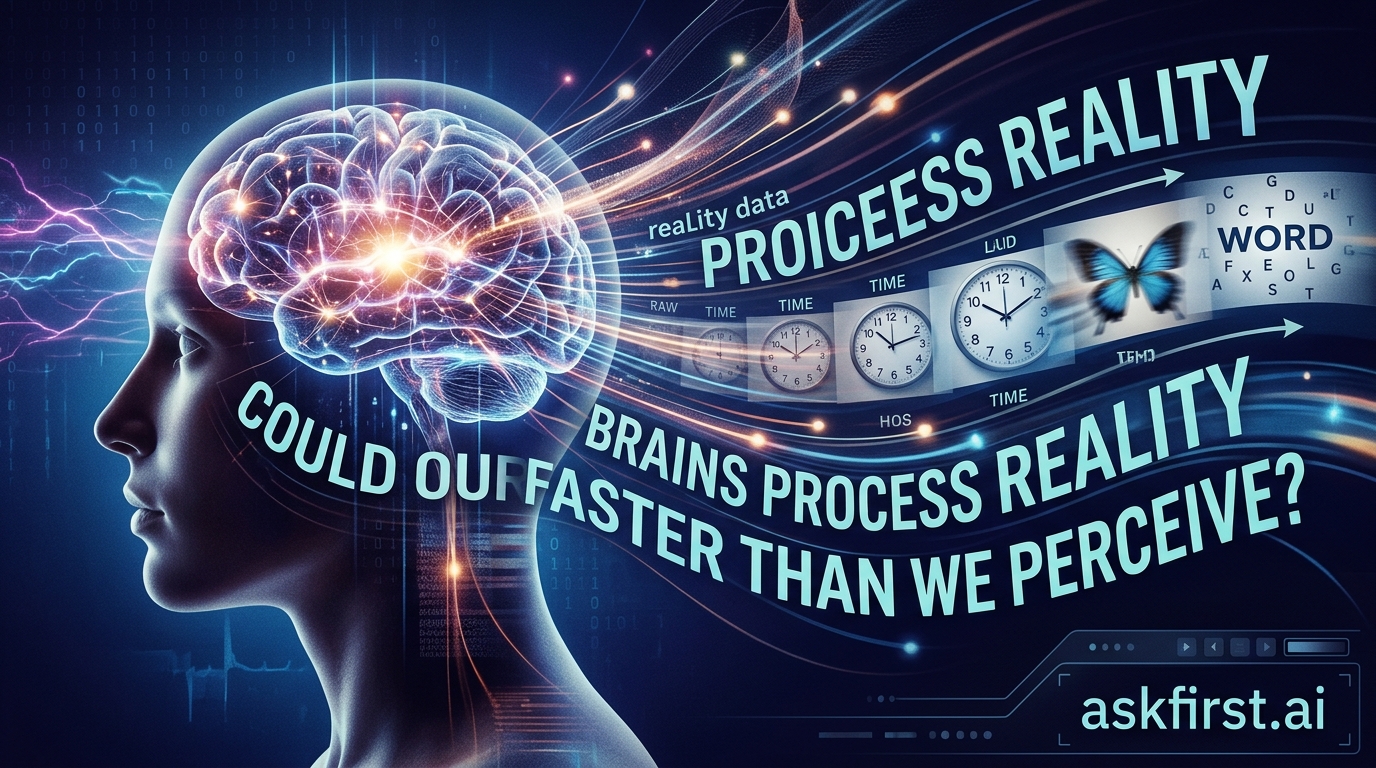
It is a common assumption that our experience of the world is instantaneous—that when a car honks or a friend smiles, we see and hear it the exact millisecond it occurs. However, neuroscience suggests a much more complex, delayed narrative. The human brain is not a transparent window to the world; it is an active interpreter that requires significant time to process sensory information. Research suggests that we are, in effect, living in the past.
The Latency of Sensory Processing
Information reaching our eyes and ears must travel through biological hardware before reaching the conscious mind. Photons hit the retina and convert into electrical signals, which then traverse the optic nerve to the visual cortex. This journey, alongside the complex process of binding colors, shapes, and motions into a cohesive object, takes roughly 80 to 100 milliseconds. While this duration seems negligible, in the world of high-speed reactions—such as professional sports or emergency braking—this delay is significant. If humans were purely reactive machines, the world would feel like a stuttering, laggy projection.
Brain Mechanisms for Temporal Integration
How do we avoid feeling this lag? The brain utilizes sophisticated predictive processing and temporal integration to bridge the gap. Rather than waiting for the final assembly of all sensory inputs, the brain actively predicts the next state of the world based on learned patterns and rapid feedback loops. If the brain perceives that a sound and a sight are meant to go together (like a hammer hitting a nail), it can adjust the timestamps of these perceptions so that they align seamlessly in our subjective experience. This mechanism is known as the perceptual present window, which acts as a buffered reality buffer of roughly 80 milliseconds.
The Evidence of Temporal Reordering
Perhaps the most fascinating proof that reality is processed after the fact is the phenomenon of flash-lag. If a participant looks at a moving object and a stationary object appears at the same moment, the moving object will consistently appear to be further along its trajectory than the stationary one. The brain accounts for the motion by predicting the future position of the moving object to compensate for the processing delay. In other instances, such as the libet experiment, neuroscientists have observed that electrical activity in the brain indicating a 'choice' happens hundreds of milliseconds before the subject reports being consciously aware of making the decision. This implies that the 'feeling' of intention is a retrospective reconstruction.
Why Processing Speed Varies
It is important to understand that not all stimuli are processed at the same speed. The brain processes auditory information faster than visual information, yet we rarely experience a lack of synchronization in our daily lives. This is due to sensory realignment. Neuroplasticity allows the brain to recalibrate the timing of incoming signals to ensure a unified 'now'. Factors influencing these speeds include:
- Neurological Load: Highly complex or novel tasks consume more resources, occasionally leading to a perceived expansion of time.
- Attention States: Focused attention can tighten the perceptual window, making reactions feel sharper.
- Age and Health: Myelination in nerve fibers ensures that signals travel quickly; as these pathways mature or degrade, the perceived flow of reality can change slightly.
The Evolution of Delayed Awareness
Why would evolution favor a system that lives in the past? The answer lies in the survival utility of prediction over reaction. If the brain were forced to process every singular input in real-time, the cognitive load would be unsustainable. By creating a 'buffered' version of reality, the brain gains the time required to interpret environmental context. Evolution prioritizes the ability to predict the outcome of a threat over the ability to see the threat at the exact moment it starts. This strategy allows humans to make complex decisions rather than relying solely on reflexive, automated survival loops.
Conclusion: Living in a Buffered Present
Ultimately, the brain acts as a brilliant editor. It cuts, aligns, and color-corrects the inputs from our senses to present a polished version of the world. We are not experiencing 'now'; we are experiencing a curated synthesis of the immediate past. Recognizing this gap between reality and perception is not an indication of failure, but rather a testament to the sophistication of the human nervous system. Our perceived reality is a masterpiece of biological engineering, carefully constructed to keep us synchronized with a world that moves faster than we can natively process.