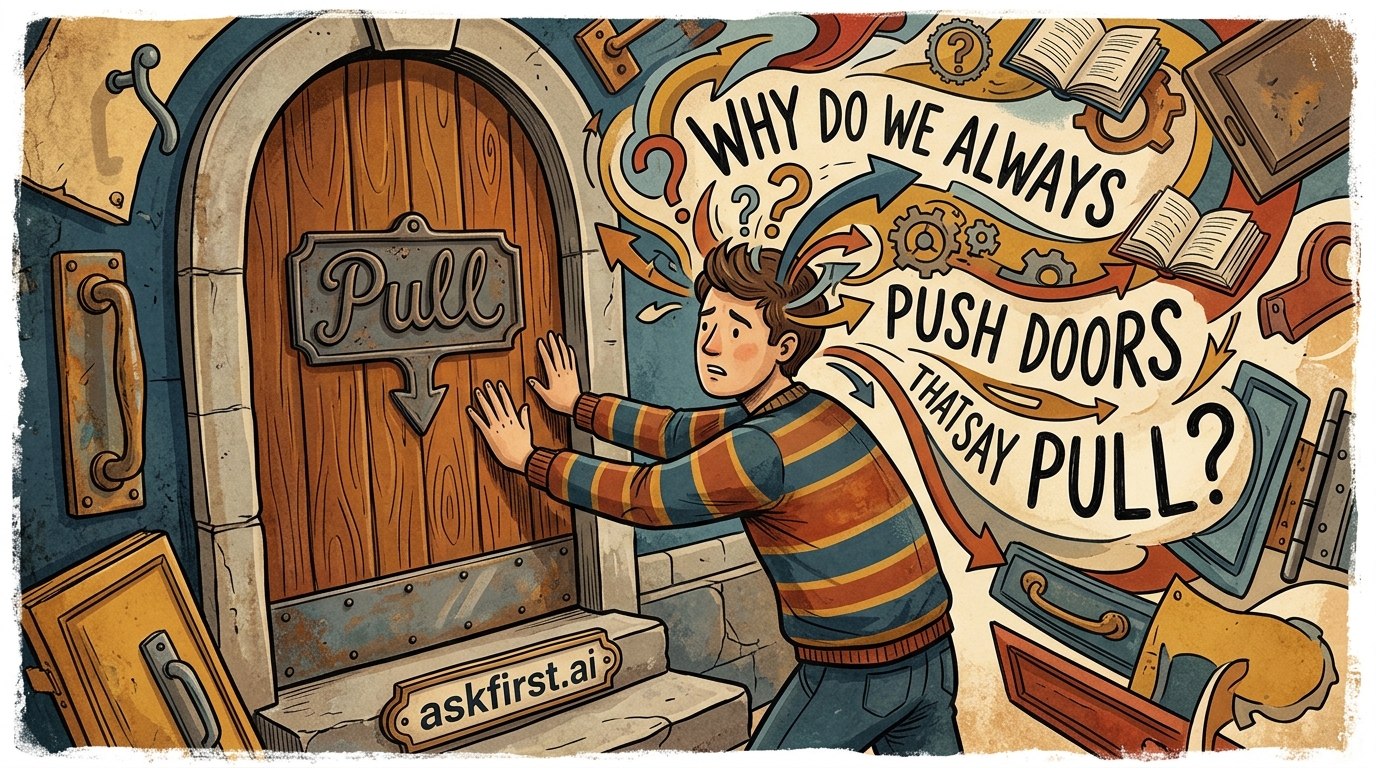
The phenomenon of pushing a door labeled 'pull' is a classic example of a 'Norman Door', a term coined by cognitive scientist Don Norman in his seminal work, The Design of Everyday Things. This behavioral error is rarely a result of a lack of intelligence or awareness; rather, it is a profound indictment of poor industrial design that ignores the nuances of human psychology. When a door is designed in a way that its physical affordances conflict with its intended usage, the human brain default mechanism—which prioritizes speed and learned behavior—takes over, often leading to these awkward social moments.
The Science of Affordances
An affordance is a property of an object that suggests how it should be used. For instance, a flat plate on a door communicates 'push' because it offers a surface for the palm to rest against. A handle or a vertical bar, however, suggests the need to grasp and pull. When a designer places a flat metal plate on a door that is meant to be pulled, they are creating a visual lie. The architecture is literally screaming 'push' while the signage quietly asks for a 'pull'. In this cognitive tug-of-war, the visual affordance almost always wins over the textual instruction because the brain processes geometric shapes and physical ergonomics faster than it processes written language.
Why the Brain Fails the Test
Human beings operate on schemata, which are cognitive frameworks that help organize and interpret information. Through years of navigating the physical world, individuals build a schema where 'vertical handles = pull' and 'flat plates = push'. When a person approaches a door, the brain runs a split-second scan to predict the necessary motor action. If the visual cues are contradictory, the brain falls back on the dominant schema rather than pausing to read the sign. This is known as automatic processing. Because reading requires conscious effort and active engagement of the prefrontal cortex, the brain often skips this step to conserve metabolic energy, especially in familiar environments.
The Design Paradox: When Form Fails Function
Many buildings prioritize aesthetics over usability. Designers may choose a sleek, flat handle that matches the lobby’s decor even if it is counterintuitive to the door's function. This leads to several psychological factors:
- Top-Down Processing: The expectation of how a door should operate influences the perception of the door itself.
- Attentional Blindness: In a distracted state, the brain ignores peripheral cues like small 'pull' stickers in favor of the primary mechanical affordance of the handle.
- Cognitive Load: When individuals are busy, stressed, or rushing, their capacity for high-level reasoning drops, forcing them to rely on the 'muscle memory' of past experiences.
How to Fix the 'Push-Pull' Problem
Great design—often called Human-Centered Design—seeks to eliminate the need for instructions entirely. If a door needs a sign, the design is already failing. To create intuitive access, experts suggest:
- Eliminate Ambiguity: If a door must be pulled, it should have a handle that cannot be mistaken for a surface to be pushed.
- Visual Consistency: Standardize hardware across a building. If all internal doors use a specific type of lever, users will naturally adapt their behavior.
- Use Structural Cues: A push-door should provide a clear, flat surface for the hand to push, whereas a pull-door should offer a grip that cannot physically be pushed.
The Evolutionary Perspective
From an evolutionary standpoint, the ability to react quickly to stimuli is a survival advantage. Humans evolved to react to the shape, texture, and movement of objects in their environment much longer before they learned to read. Therefore, the visual-motor loop remains deeply rooted in our biology. We are 'hardwired' to interact with the physical world through touch and visual perception. When a man-made environment conflicts with these ancient survival mechanisms, the error isn't in the human, but in the interface.
Ultimately, the next time you find yourself pushing a pull-door, do not blame yourself. You are merely a victim of a design that ignored the beautiful, complex, and highly efficient way your brain processes the world around you. By understanding these principles, we can move toward a future where our environments are not just beautiful, but intuitively built for the human mind.