The Intersection of Consciousness and Cosmology
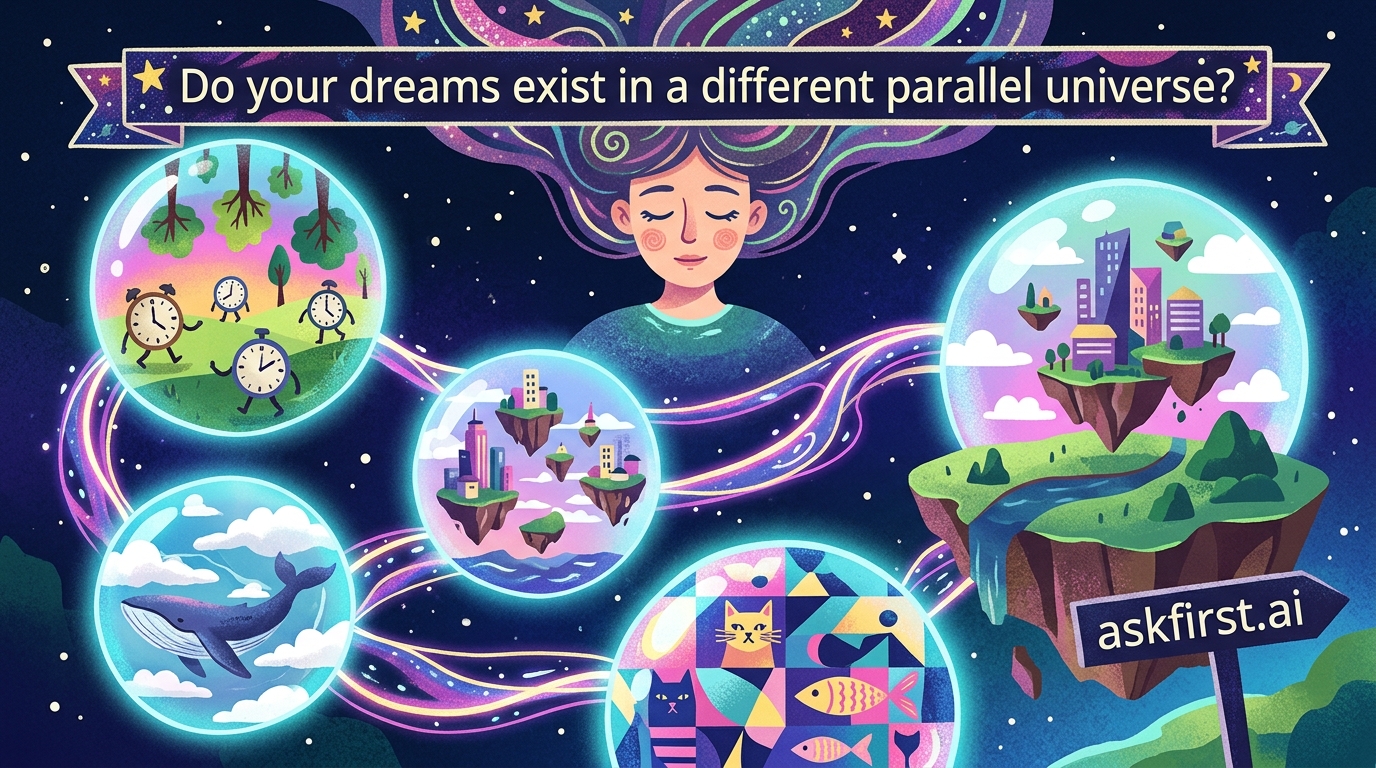
The notion that human dreams might serve as windows into parallel universes is a concept that bridges the gap between theoretical physics, neurobiology, and philosophical speculation. While the scientific community often characterizes dreams as the byproduct of neuronal activity during Rapid Eye Movement (REM) sleep, the sheer vividness and subjective reality of these nocturnal experiences have led many to wonder if consciousness interacts with dimensions beyond our immediate perception. This exploration delves into the scientific theories surrounding the multiverse and the biological foundations of dreaming to determine if a bridge exists between them.
The Science of the Multiverse
In modern theoretical physics, the 'Many-Worlds Interpretation' (MWI) of quantum mechanics, proposed by Hugh Everett III, suggests that all possible alternate histories and futures are real, each representing an actual 'world' or branch of reality. According to this framework, every time a quantum event has more than one possible outcome, all of them occur, each in a newly branching universe. If such an expanse of reality truly exists, the question arises: can the human brain perceive or 'tune into' these parallel branches during sleep?
- Quantum Cognition: Some researchers explore the theory that brain microtubules might facilitate quantum processing. If the brain functions at a quantum level, the boundaries between the 'observer' and the 'observed' become porous, theoretically allowing for the leakage of information across states.
- The Problem of Decoherence: Critics of this crossover theory point to quantum decoherence, which explains why macroscopic objects (like the brain) do not exhibit quantum behavior. Large systems lose their quantum states rapidly due to environmental interactions, making it physically improbable that biological memories could remain coherent across dimensional boundaries.
Neurobiology: The Architect of Reality
From a neuroscience perspective, dreaming is a complex synthesis of memory consolidation and emotional regulation. During REM sleep, the prefrontal cortex—the part of the brain responsible for logical reasoning and self-awareness—becomes significantly less active, while the limbic system, which manages emotions, remains highly stimulated. This shift explains why dreams often feel like distinct, alternate realities, even when they defy the laws of physics.
- Memory Consolidation: The hippocampus replays events from the day, effectively reorganizing data. This 'data shuffling' can create scenarios that feel like entirely new universes, even if they are merely fragments of memory rearranged in novel ways.
- Creative Synthesis: The brain creates complex environments as a simulated rehearsal for real-world interactions. This suggests that the 'parallel world' is actually a highly efficient internal simulator designed for survival, rather than a cosmic doorway.
The Philosophical and Esoteric Connection
Beyond the empirical, many ancient traditions suggest that the dream state is as real as the waking state. In various schools of thought, the 'Astral Plane' or the 'Dreamtime' is viewed as a dimension of existence that exists independently of the material body.
- Subjectivity of Experience: Because science defines reality based on measurable, external data, it inherently excludes the subjective 'qualia' of the dream experience. If reality is defined as that which is perceived, then a dream is a valid, existing reality—just not one bound by the same spatial-temporal constraints as our waking life.
- Jungian Archetypes: Carl Jung posited the existence of a 'collective unconscious,' a reservoir of shared human experiences and symbols. One could argue that when we dream, we are not visiting a physical parallel universe, but rather accessing a universal, non-local network of collective consciousness that transcends individual time and space.
Bridging the Gap: Is It Possible?
While there is no verifiable evidence that dreams transmit data from parallel universes, the mystery remains one of the most compelling frontiers of human knowledge. The convergence of 'Quantum Biology' and 'Consciousness Studies' suggests that our current understanding of sleep may be incomplete. Whether dreams are biological data processing or glimpses into a multiverse, they undeniably demonstrate that the human mind is capable of creating and experiencing complex, autonomous universes.
In conclusion, while the theory that dreams occur in parallel universes remains in the realm of speculative hypothesis rather than confirmed fact, it serves as a powerful metaphor for the vast, unexplored potential of human consciousness. As research into quantum biology matures, humanity may eventually uncover whether the boundaries between our 'real' lives and our dream-worlds are truly as solid as they appear. Until then, the dream remains a profound, personal odyssey into the infinite landscape of the mind.