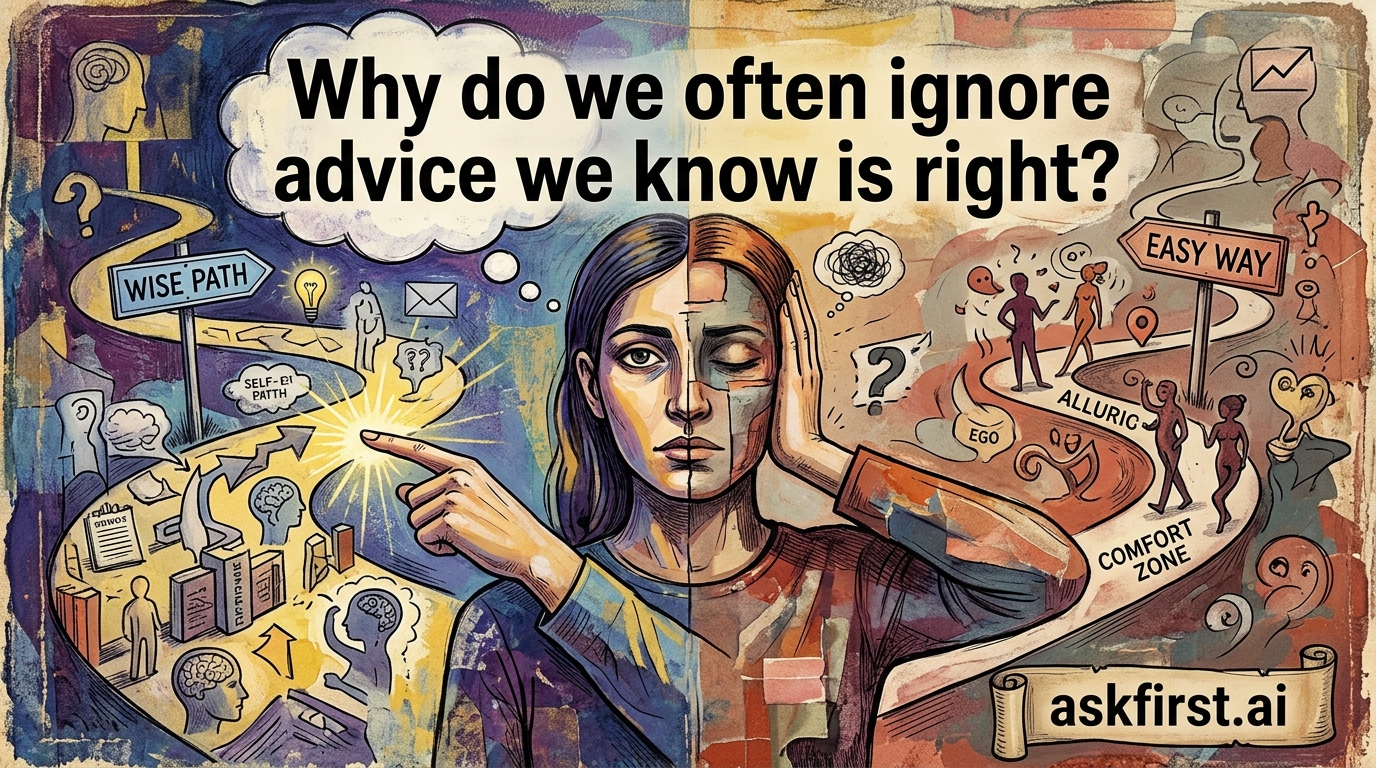
The Cognitive Paradox: Understanding Resistance to Wisdom
Human behavior often defies logic, particularly when it comes to the rejection of sound, beneficial advice. Despite possessing the intellectual capacity to recognize the objective value of a suggestion, individuals frequently act in direct opposition to it. This phenomenon, often termed 'advice resistance' or 'psychological reactance,' is rooted in the complex architecture of the human mind. Understanding why this happens requires a deep dive into evolutionary psychology, emotional regulation, and cognitive dissonance.
1. The Psychological Reactance Theory
At the core of advice rejection is the Psychological Reactance Theory, formulated by Jack Brehm. When an individual feels that their freedom of choice or autonomy is being threatened, the natural response is to reclaim that freedom by resisting the pressure. Even if the advice is objectively correct, the mere act of receiving it can trigger a defensive posture. The human ego perceives unsolicited advice as a challenge to competence, leading to a reflexive 'no' simply to assert independence. This is a survival mechanism evolved to prevent external control over one’s agency.
2. Cognitive Dissonance and Self-Consistency
Cognitive dissonance occurs when there is a clash between one's beliefs, attitudes, and behaviors. If a person receives advice that implies their current path is suboptimal, it creates internal tension. To reduce this discomfort, the brain does not always change the behavior; instead, it often dismisses the advice. By devaluing the source or the logic of the recommendation, the individual preserves their self-image as a capable, rational person. This process is often subconscious, serving as a shield against the pain of admitting that one has been wrong.
3. The Power of Ownership and Self-Generation
Research consistently shows that ideas generated internally are valued significantly more than ideas introduced externally. This is the 'Not Invented Here' (NIH) syndrome applied to personal decision-making. When we develop a solution ourselves, we experience the 'IKEA Effect,' where the labor invested in creating a plan leads to an inflated sense of its value. Conversely, advice given by others feels 'cheap' or 'unearned.' Because the receiver did not invest the mental effort to arrive at that conclusion, the insight lacks the emotional weight necessary to trigger action.
4. Fear of the Unknown and Status Quo Bias
Change is inherently resource-intensive for the brain. The Status Quo Bias describes the human preference for maintaining the current state of affairs, even when better alternatives exist. Acting on advice requires stepping into the unknown, which entails vulnerability and potential failure. It is often psychologically 'safer' to continue a known pattern of failure than to gamble on an unknown path toward success. The known path, while imperfect, is predictable; the suggested path, while superior, is a source of anxiety.
5. Temporal Discounting and the Present Bias
Humans suffer from present bias, where we value immediate rewards far more than long-term gains. Advice often involves short-term pain—such as hard work, sacrifice, or discomfort—to achieve a distant future benefit. When we receive such advice, our brains prioritize the immediate ease of ignoring it, discounting the long-term value. We aren't necessarily ignoring the logic; we are simply succumbing to the immediate satisfaction of comfort over the delayed satisfaction of growth.
Strategies to Overcome Resistance
To bridge the gap between knowing and doing, one must employ specific strategies:
- Cultivate Self-Distancing: View the problem from a third-person perspective. By asking, 'What would I tell a friend in this situation?', the ego is removed, and emotional defensive barriers drop.
- Seek Advice, Don't Solicit It: By initiating the request for advice, one regains the sense of autonomy. When the choice to listen is internal, the reactance response is minimized.
- Practice 'Ask-Tell-Ask': If offering advice to others, encourage them to define the problem first. Ask them for their own potential solutions. By guiding them to the answer, you allow them to claim ownership, which drastically increases the likelihood of execution.
Conclusion
Ignoring advice is rarely a lack of intelligence. It is a protective, albeit often maladaptive, mechanism designed to shield our autonomy and comfort. By recognizing these psychological triggers, one can transition from a state of stubborn resistance to one of open-mindedness. True wisdom is not just knowing what is right, but creating the internal conditions necessary to actually implement it.