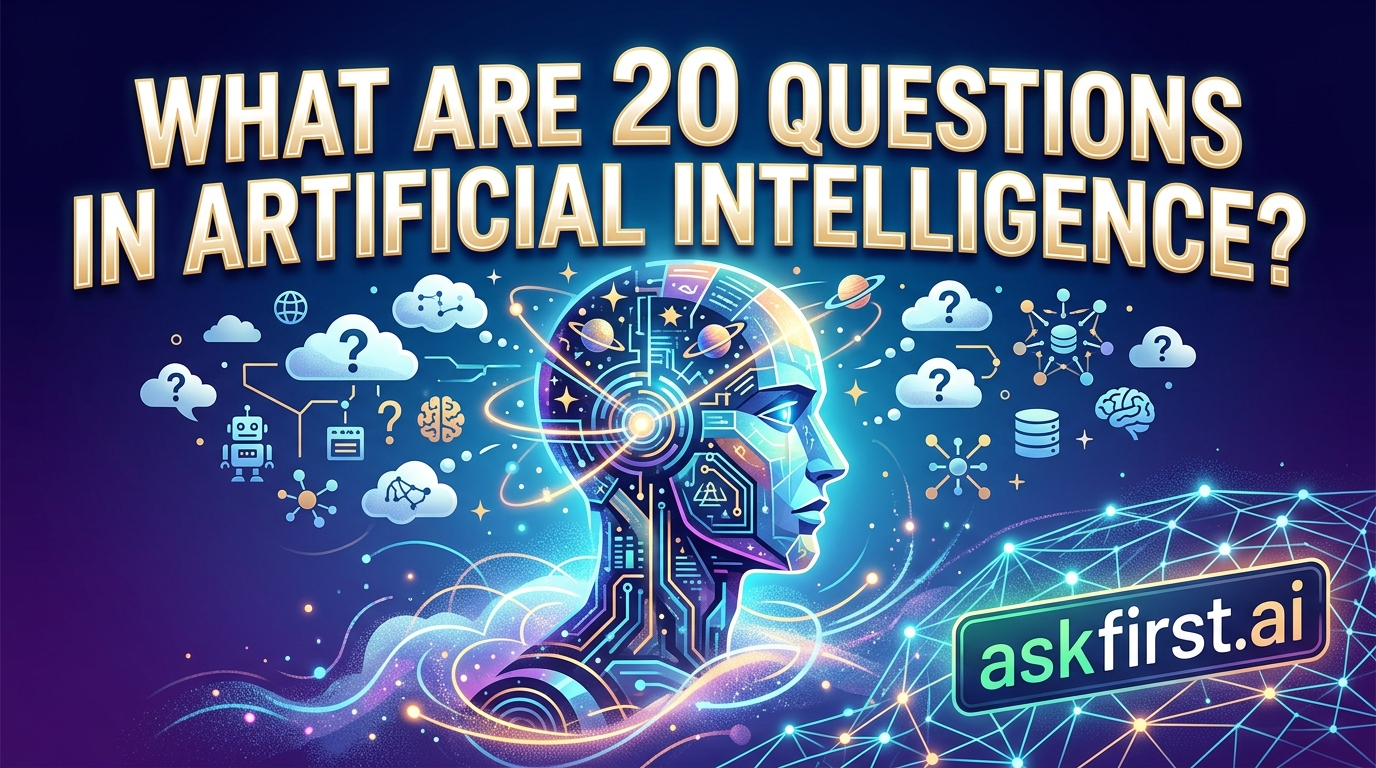
The field of artificial intelligence (AI) has evolved from a niche academic pursuit into the foundational technology of the 21st century. To understand the trajectory of this discipline, one must engage with the fundamental questions that have preoccupied computer scientists, philosophers, and ethicists for decades. These inquiries bridge the gap between theoretical mathematics and the practical implementation of machine learning systems.
Below is an exploration of 20 critical questions in artificial intelligence, categorized by their thematic relevance to the development and societal impact of these systems.
The Philosophical Foundations of Intelligence
1. Can a machine truly "think," or is it merely simulating cognition?
This is the core of the "Chinese Room" argument proposed by philosopher John Searle in his 1980 paper, Minds, Brains, and Programs. Searle argues that syntax is not sufficient for semantics; a machine may manipulate symbols flawlessly without understanding their meaning.
2. What are the limits of the Turing Test?
Alan Turing’s 1950 paper, Computing Machinery and Intelligence, proposed a behaviorist test for intelligence. However, modern critics argue that the test measures human-like deception rather than genuine intelligence or consciousness.
3. Is consciousness an emergent property of complex computation?
Many neuroscientists, such as Giulio Tononi in his Integrated Information Theory (IIT), posit that consciousness arises when a system reaches a specific threshold of integrated information. The question remains: can silicon substrates replicate the integrated complexity of biological neurons?
4. Can artificial systems possess subjective experience (qualia)?
This remains the "Hard Problem of Consciousness," a term coined by David Chalmers in The Conscious Mind (1996). We have no empirical way to determine if an AI feels pain or joy, or if it is a "philosophical zombie" reacting to inputs.
Technical Challenges and Machine Learning
5. How do we solve the "Black Box" problem in deep learning?
Deep neural networks, particularly large language models, operate through opaque weight adjustments. Explainability (XAI) is critical; without knowing why an AI makes a decision, we cannot fully trust it in high-stakes fields like medicine or law.
6. What is the path to Artificial General Intelligence (AGI)?
Unlike Narrow AI (which performs specific tasks), AGI would possess the ability to perform any intellectual task a human can. Researchers like Ray Kurzweil in The Singularity Is Near predict this will happen mid-century, yet we lack a consensus on the necessary architecture.
7. How can we overcome the problem of "catastrophic forgetting"?
Neural networks often overwrite previously learned information when trained on new tasks. Solving this is essential for lifelong learning, a concept explored extensively by researchers like Geoffrey Hinton in his work on backpropagation.
8. Is symbolic AI or connectionism the superior path?
Historically, AI was split between "Good Old-Fashioned AI" (GOFAI), which relied on explicit rules, and connectionism (neural networks). Modern research, such as that by Demis Hassabis at Google DeepMind, suggests a hybrid approach—neuro-symbolic AI—might be the key.
9. How do we handle uncertainty and probabilistic reasoning in AI?
Judea Pearl, in his seminal book Probabilistic Reasoning in Intelligent Systems, revolutionized AI by introducing Bayesian networks, allowing machines to reason under conditions of uncertainty.
10. What is the role of sensory embodiment in intelligence?
Many researchers, such as Rodney Brooks (author of Flesh and Machines), argue that true intelligence requires a physical body to interact with the environment, rather than just raw processing power.
Ethics, Safety, and Societal Impact
11. How do we align AI objectives with complex human values?
Nick Bostrom, in his book Superintelligence, highlights the "alignment problem." If we give a super-intelligent agent a goal, how do we ensure it doesn't pursue that goal in a way that is catastrophic to human life?
12. Can we eliminate bias from training datasets?
AI models reflect the biases present in their training data. As noted by Safiya Umoja Noble in Algorithms of Oppression, automated systems can perpetuate systemic racism and sexism if the underlying data is not rigorously audited.
13. Who is legally responsible for the actions of an autonomous system?
If a self-driving car causes an accident, does the liability rest with the manufacturer, the software engineer, or the occupant? This is a major area of study in the intersection of law and technology.
14. Will AI lead to mass technological unemployment or a new economic paradigm?
Economists like Erik Brynjolfsson and Andrew McAfee argue in The Second Machine Age that while AI will displace roles, it will also create entirely new categories of human labor.
15. How can we prevent the misuse of AI in surveillance and warfare?
The development of Lethal Autonomous Weapons Systems (LAWS) has prompted calls from organizations like the Future of Life Institute to establish international bans on automated killing.
The Future of Human-AI Integration
16. Is human-computer integration (e.g., Neuralink) the next step in evolution?
Elon Musk and others propose that the only way to remain relevant alongside AI is to augment the human brain with digital interfaces.
17. How will AI change the nature of creativity and art?
Generative AI, such as DALL-E or Midjourney, challenges our definitions of authorship. If a machine produces a masterpiece, who owns the copyright?
18. Can AI solve the "Data Hunger" problem?
Current models require massive amounts of data. Future research focuses on "few-shot learning," which seeks to teach machines to learn effectively from minimal examples, mirroring human cognitive efficiency.
19. How do we ensure AI systems are resilient against adversarial attacks?
Adversarial machine learning involves finding small perturbations in inputs that cause a model to fail. This is a critical security concern identified in the work of Ian Goodfellow regarding Generative Adversarial Networks (GANs).
20. What happens if we reach a "technological singularity"?
The singularity refers to a point where AI improvement becomes recursive and uncontrollable. Whether this results in a utopia or an existential threat remains the most debated question of our time.
Conclusion
These 20 questions represent the current frontiers of artificial intelligence. From the deep metaphysical dilemmas surrounding consciousness to the immediate, tangible dangers of algorithmic bias and weaponization, the field is as much about human values as it is about computer code. As researchers continue to push the boundaries of what is possible, these questions will serve as the compass guiding the integration of artificial intelligence into the fabric of our future society. The answers we find will define the next chapter of human history.