The Evolutionary Mechanism of Social Monitoring
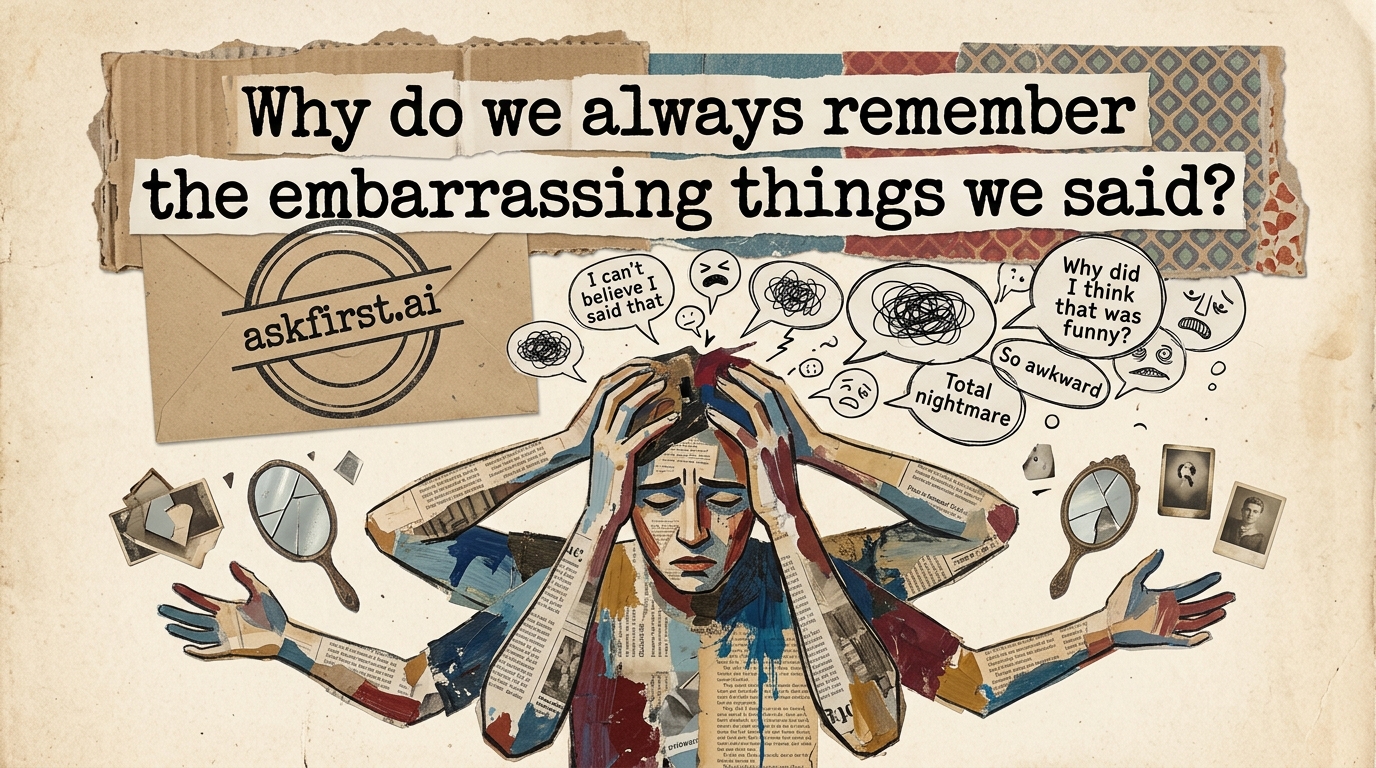
Humans are fundamentally social animals, and the persistence of embarrassing memories is a byproduct of a highly developed cognitive architecture designed for social survival. Known in psychology as the 'Spotlight Effect', this phenomenon describes the tendency of individuals to overestimate how much others notice their appearance, behavior, or mistakes. The reason these memories stick like mental glue is rooted in the Negativity Bias, a cognitive evolutionary adaptation that prioritizes negative information over positive feedback to prevent repeated survival threats.
The Role of the Amygdala and Emotional Encoding
When an embarrassing moment occurs, the brain undergoes a surge of activity. The amygdala, the emotional processing center of the brain, flags the situation as a 'high-arousal' event. Because embarrassment threatens social standing, the brain encodes this information as a warning signal. Unlike mundane memories, high-arousal experiences create stronger neural pathways. The brain essentially archives these moments in high definition to ensure that an individual does not repeat the social faux pas that could lead to ostracization from the tribe—a survival risk in ancestral environments.
The 'Spotlight Effect' and Cognitive Distortion
Research suggests that humans suffer from a persistent cognitive distortion known as the Spotlight Effect. This occurs because individuals are the center of their own universe, making it difficult to accurately assess how much attention others are actually paying to their mistakes. In reality, most people are preoccupied with their own internal monologues and perceived flaws. Despite the objective reality that observers likely forgot the embarrassing comment within minutes, the brain continues to 'replay' the tape, reinforcing the belief that the social error was monumental.
Psychological Mechanisms and Rumination
- Recursive Thinking: The brain engages in 'mental simulations' of past events to better predict future outcomes. When one experiences embarrassment, the mind continuously runs simulations of 'what if I had said X instead?' to improve future social agility.
- Self-Referential Processing: Because memories related to the self are prioritized, the brain struggles to 'let go' of information that reflects negatively on the self-image. This is known as self-referential processing, where the brain treats ego-threats as critical data points for identity maintenance.
- The Zeigarnik Effect: This principle suggests that people remember uncompleted tasks better than completed ones. An embarrassing moment often feels like an 'unresolved' social failure, causing the brain to keep the memory active in the foreground of consciousness until a sense of 'completion' or 'reconciliation' is achieved.
Breaking the Cycle of Rumination
To move past these loops, one must employ Cognitive Reframing. By recognizing that the persistence of these memories is an automated, often outdated biological alarm, one can consciously choose to downgrade the importance of the memory.
Strategies to mitigate intrusive embarrassment include:
- Perspective Taking: Consciously visualizing the event from the perspective of an observer. Recognizing that others were likely thinking about their own upcoming meeting or dinner plans renders the internal spotlight dim.
- The Compassion Gap: Practicing self-compassion reduces the amygdala’s activation. Treating oneself with the same grace as one would treat a friend who made a similar mistake can silence the internal critic.
- Fact-Checking the Memory: Asking the question, 'Did this event actually change the trajectory of my life or my relationships?' usually yields a resounding 'no,' helping to diminish the weight of the memory.
The Future-Oriented Perspective
Ultimately, these memories are not signs of weakness but evidence of a functioning social brain. The persistence of these memories is a sign that the brain cares about social cohesion. By understanding that embarrassment is merely a 'social feedback loop,' individuals can transform these moments from sources of shame into tools for personal growth. The brain is effectively scanning for bugs in the social interface; once the lesson is learned, the 'warning' can be acknowledged and archived without the emotional weight of shame. Learning to laugh at the absurdity of the spotlight effect is often the most effective method for stripping these memories of their power to disrupt daily life.