The Anatomy of Political Parties: Foundations, Functions, and Evolution
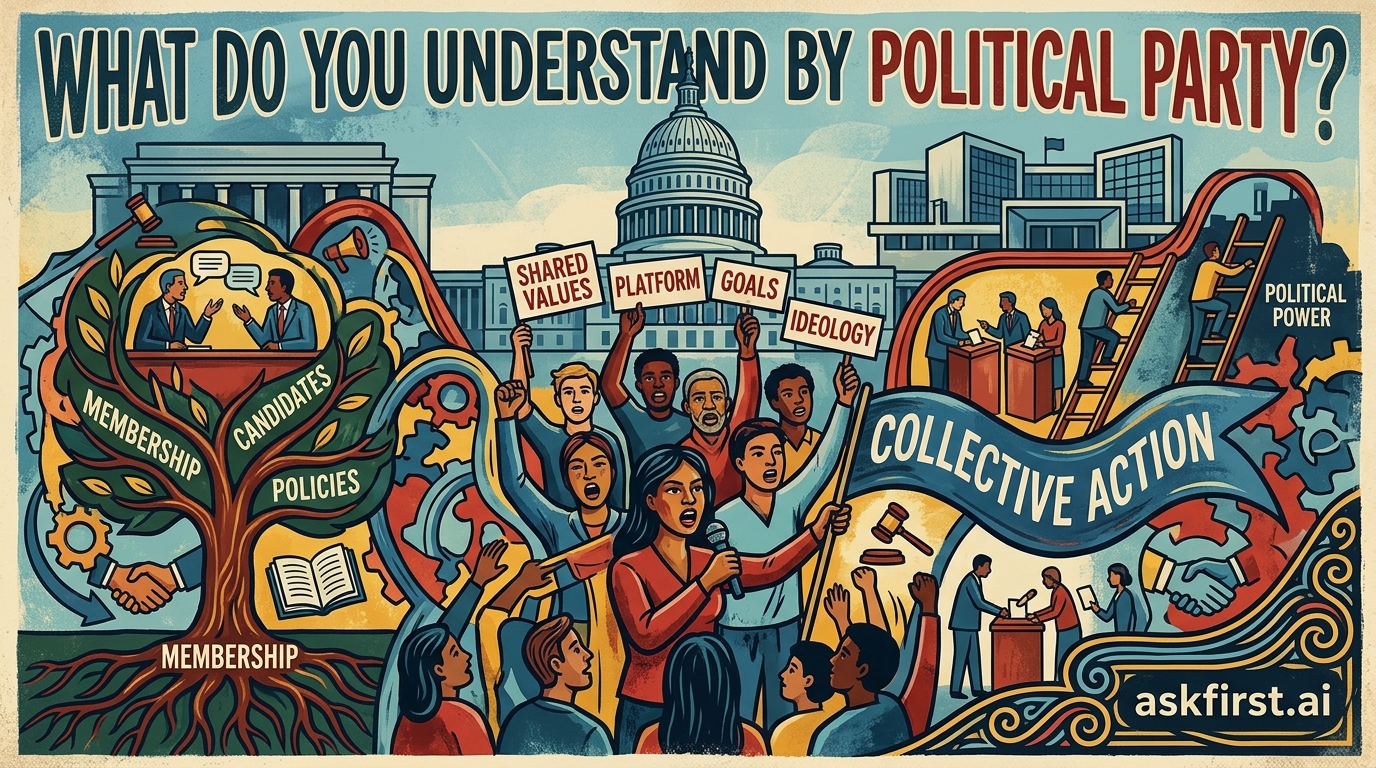
A political party is a formally organized group of individuals who share similar political ideologies, principles, and policy preferences, united with the primary objective of capturing and exercising government power through constitutional means. Unlike interest groups, which typically seek to influence policy from the outside, political parties are structured specifically to place their members in legislative and executive positions. They act as the essential bridge between the citizenry and the complex machinery of the state, transforming the raw, often chaotic preferences of the public into coherent governance strategies.
The Core Functions of Political Parties
Political parties are not merely vehicles for elections; they perform several vital functions that stabilize democratic systems. As noted by political scientist E.E. Schattschneider in his seminal work, Party Government (1942), "Modern democracy is unthinkable save in terms of the parties." His perspective remains the bedrock of political science theory, emphasizing that parties serve as the primary mechanism for organizing the chaos of public opinion.
- Aggregation of Interests: In any society, citizens hold thousands of disparate views on issues ranging from taxation to environmental protection. Parties aggregate these into a manageable platform, allowing voters to choose between broad, coherent visions for the country rather than thousands of individual policies.
- Mobilization and Recruitment: Parties identify, train, and promote candidates for public office. By vetting individuals, they provide a "brand name" that helps voters navigate the electoral landscape. In the United States, for instance, the Democratic and Republican parties function as massive infrastructure networks that facilitate voter registration and get-out-the-vote campaigns.
- Governance and Accountability: Once in office, parties provide a framework for cooperation within the legislature. They organize committees, whip votes, and ensure that the government can pass budgets and enact laws. When a party fails to govern effectively, the electorate has a clear target for retribution at the next ballot box, thereby ensuring a baseline of democratic accountability.
Types of Party Systems
The structure of a political party system is often dictated by a nation’s electoral laws. Maurice Duverger, in his foundational text Political Parties (1951), formulated "Duverger’s Law," which posits that plurality-rule elections (like those in the U.S. or U.K.) tend to result in a two-party system, while proportional representation systems tend to foster multi-party systems.
- The Two-Party System: Characterized by the dominance of two major parties that capture the vast majority of seats. These systems prioritize stability and moderate politics, as both parties often compete for the "median voter." However, they can lead to polarization and limited choices for the electorate.
- The Multi-Party System: Common in many European nations, such as Germany or the Netherlands, these systems require parties to form coalitions to govern. This encourages compromise and ensures that a wider spectrum of political views is represented in the legislature, though it can sometimes lead to government instability if coalitions are fragile.
- The Dominant-Party System: In some nations, one party remains in power for decades, winning successive elections despite the presence of opposition parties. This is often seen in developing democracies or in nations where one party has successfully captured the national narrative, such as the Liberal Democratic Party (LDP) in Japan for much of the post-WWII era.
The Modern Transformation: Technology and Polarization
In the 21st century, the nature of political parties is undergoing a radical shift. The traditional "mass party" model—characterized by large, dues-paying memberships—is being replaced by "digital parties" or "cartel parties," a term coined by Richard Katz and Peter Mair in their 1995 article, Changing Models of Party Organization.
Modern parties increasingly rely on sophisticated data analytics, micro-targeting, and social media engagement to bypass traditional media gatekeepers. While this allows for more efficient communication, it also contributes to extreme political polarization. By targeting specific demographic slices with tailored messaging, parties can energize their bases but often at the cost of national unity. In countries like the United States and Brazil, the rise of populist movements has seen parties move away from traditional ideological platforms toward personality-driven, anti-establishment models that challenge the very institutions they seek to lead.
Conclusion
A political party is far more than a label on a ballot; it is an indispensable institution that structures the democratic process. Whether operating within a strict two-party system or a complex multi-party coalition, parties provide the necessary organization to turn public will into legislative action. While they face unprecedented challenges from digital fragmentation and rising populism, their role as the primary link between the people and the state remains unchallenged. As societies evolve, so too must these organizations, adapting to new technologies and the changing expectations of a globalized electorate, while ultimately remaining the guardians of the mechanisms of power. Understanding the party is, in essence, understanding the mechanics of modern self-governance.