The Psychology of Social Mortification
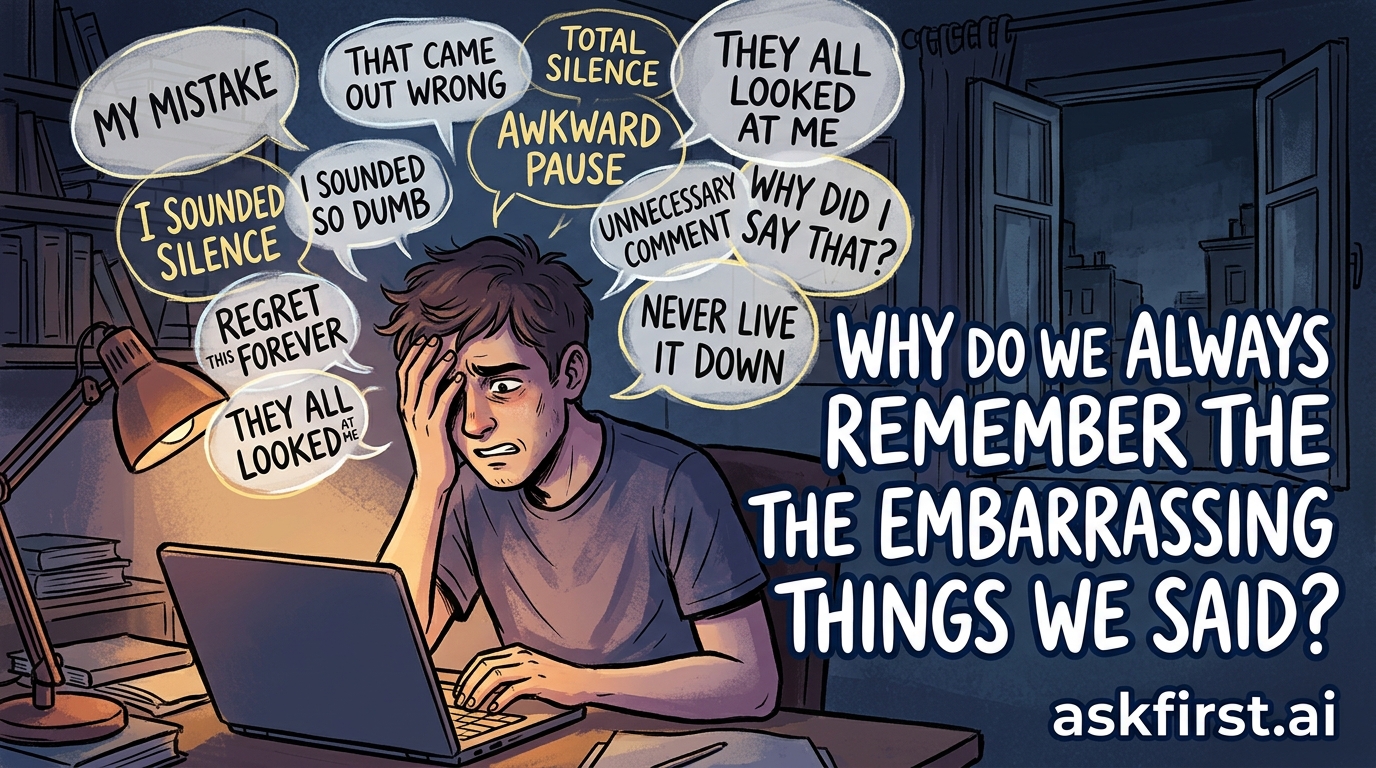
The phenomenon of ruminating on past social blunders is a deeply ingrained human experience often described as the 'spotlight effect' coupled with specific cognitive biases. The brain is not merely a recorder of events but an active evaluator of social survival strategies. When a person says something perceived as embarrassing, the brain processes this as a threat to social standing, triggering a memory consolidation process that makes the event disproportionately vivid.
The Spotlight Effect
Psychologists Thomas Gilovich and Kenneth Savitsky coined the term 'spotlight effect' to describe the tendency for individuals to overestimate how much others notice their appearance or behavior. Most people walk through life believing they are the protagonist in a movie, with everyone else in the audience paying close attention to every line of dialogue. In reality, others are usually preoccupied with their own internal thoughts or their own spotlight effect, meaning that the 'cringe-worthy' moment was likely forgotten by others long before it left the mind of the speaker.
Evolutionary Survival and Social Capital
From an evolutionary standpoint, early humans relied heavily on group cohesion for survival. Being cast out of the 'tribe' could have been fatal. Therefore, the brain developed a robust mechanism to monitor social performance. Embarrassment functions as a psychological alarm bell. When an individual commits a social error, the brain experiences a dip in perceived social capital. By forcing the mind to replay the event, the brain is attempting to simulate a better version of the interaction—a process known as 'counterfactual thinking'—to ensure the same social 'mistake' is not repeated in the future.
The Role of Rumination and Cognitive Biases
- Negativity Bias: Humans are evolutionarily hardwired to pay more attention to negative information than positive information. A single awkward comment can weigh more heavily on the mind than ten instances of social grace.
- Rumination Loops: When an embarrassing memory is triggered, the brain initiates a loop. The more one thinks about the memory, the stronger the neural pathway becomes, making it easier to recall in the future. This is the physiological basis of the 'cringe' experience.
- The Intentionality Gap: People often judge their own past behavior by their internal intentions, while judging others by their external actions. Because one is privy to their own internal embarrassment, they assume others are analyzing that same internal state, which is impossible.
Breaking the Cycle: Strategies for Mental Relief
Understanding the biology of memory can help dismantle the power of embarrassing thoughts. Consider the following techniques to mitigate the pain of past social slips:
- Perspective Taking: Actively remind yourself that most people are 'the heroes of their own stories.' Everyone is too busy managing their own social anxieties to maintain a permanent file on your accidental social slip-ups.
- Radical Acceptance: Recognize that perfection is not a prerequisite for connection. In many cases, displaying vulnerability actually increases likeability, a psychological principle often called the Pratfall Effect. When high-performing individuals show minor flaws, their overall appeal to others often increases rather than decreases.
- Cognitive Reframing: Rather than focusing on the embarrassment, focus on the lesson. Ask: 'What did this teach me about my values or communication style?' Moving from self-punishment to self-improvement shifts the neural focus from the limbic system (emotional center) to the prefrontal cortex (executive center).
Why This Memory Persists
Finally, the vividness of these memories is tied to the Amgydala's role in memory retention. Experiences coupled with strong emotional surges—whether positive or negative—are prioritized for storage by the hippocampus. Because embarrassment is a high-arousal emotional state, the memory becomes 'sticky.' The brain catalogs this as a high-priority lesson in social navigation. While it feels uncomfortable, this mechanism is essentially a high-tech survival tool that has simply become overactive in the modern, low-stakes social environment. Accepting that these memories are merely 'glitches' in a survival system that is trying to protect you can strip them of their power. By reframing these intrusions as an attempt by the brain to ensure social optimization, one can view them with detached curiosity rather than personal shame.