The Construction of Oneiric Reality
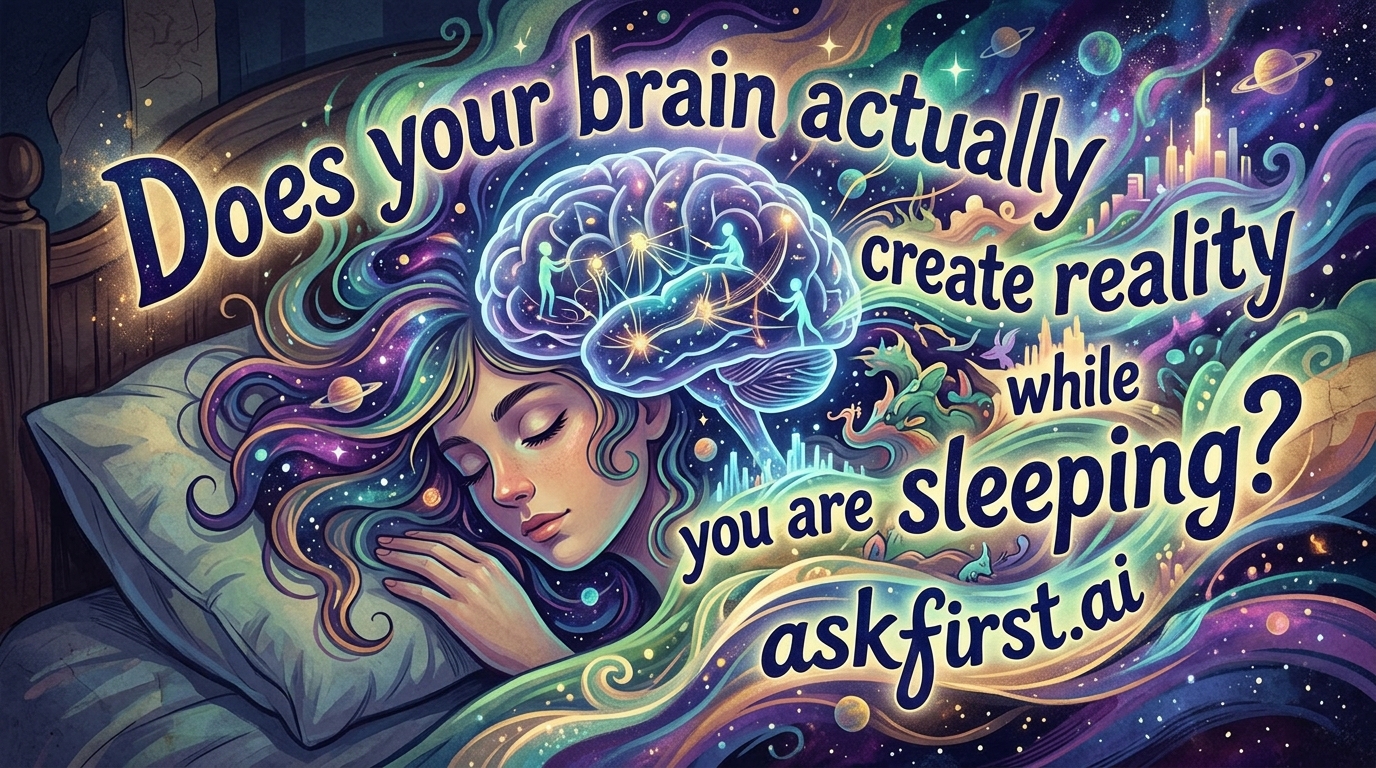
When the body descends into sleep, the brain does not merely 'switch off.' Instead, it initiates an incredibly sophisticated, autonomous process of world-building that rivals the complexity of waking life. Far from being a static playback of memories, sleep—particularly during Rapid Eye Movement (REM) phases—functions as a sophisticated simulation engine. The brain essentially acts as a hyper-active creator, synthesizing past experiences, sensory fragments, and emotional residues into a coherent, albeit surreal, experiential reality.
The Neurobiology of the Dream State
During sleep, the primary sensory inputs—such as light hitting the retina or sound waves reaching the eardrum—are largely gated or blocked. However, the internal mechanisms of the brain remain highly active. The thalamus, which acts as the relay station for sensory information, disconnects from the outside world. Simultaneously, the cortex continues to process information based on internal activations. This is the physiological origin of the 'reality' experienced in dreams.
- The Hippocampus: Continues to replay sequences of events, which contributes to the narrative structure of dreams.
- The Amygdala: Often exhibits heightened activity, which explains why dream experiences are frequently charged with intense emotion, even when the logic of the narrative is fragile.
- The Prefrontal Cortex: Notably dampened during REM sleep, this area—responsible for logic, self-reflection, and executive control—explains why individuals rarely question the often-bizarre physics or events occurring within a dream.
The Simulation Hypothesis of Dreams
Many neuroscientists argue that dreaming is a form of 'offline' learning. By simulating challenging social scenarios, threats, or complex problem-solving tasks in a safe environment, the brain refines its response mechanisms for waking reality. This process, often called 'Threat Simulation Theory,' suggests that dreaming serves an evolutionary purpose: it keeps the brain's decision-making architecture sharp without the risks associated with the waking world.
From this perspective, the brain does not 'perceive' reality while sleeping; it projects it. It populates an internal theater where the laws of physics are flexible, allowing the mind to explore possibilities that would be impossible, dangerous, or impractical to test while awake. This is a manifestation of the brain's incredible plasticity, proving that the perception of 'reality' is fundamentally a construct of neural firing patterns rather than a strictly objective recording of the external environment.
Can We Distinguish Between Waking and Dreaming?
Psychologically, the demarcation between 'real' and 'dream' is narrower than often assumed. Both states rely on predictive processing—a theory in cognitive science suggesting that the brain is constantly generating a hypothesis of what is happening around it and updating that hypothesis based on incoming signals. When sleeping, the incoming signal stream is absent, so the brain relies entirely on its internal predictions.
Consider these key factors that define the subjective experience of reality:
- Temporal Coherence: In dreams, time feels subjective because the brain's internal clock is uncoupled from external temporal cues.
- Spatial Mapping: The brain uses the same neural grids (place cells and grid cells) to construct the environments in dreams as it does when navigating physical space.
- Sensory Depth: Dreamers often report tactile sensations, sounds, and visuals that are neurologically indistinguishable from those produced by waking external stimuli.
The Philosophy of Conscious Experience
If the brain can generate a reality as vivid as the waking state without any external input, it challenges our fundamental assumptions about the nature of the physical world. This phenomenon supports the philosophical notion of phenomenal realism, which argues that all human experience is technically an internal interpretation. Whether one is walking down a city street or flying through a neon sky in a dream, the conscious experience itself is generated by the same neural machinery.
Conclusion: The Ever-Changing Mind
In essence, the brain never ceases its duty as a reality-architect. It spends the day curating a model of the objective world and the night remixing that model to foster emotional regulation, memory consolidation, and cognitive resilience. Dreams are not merely accidents of biological upkeep; they are the evidence of the brain’s permanent engagement with existence. By constructing its own realities while the body lies dormant, the mind proves that reality is not something we simply 'watch,' but something we actively and continuously create. Understanding this helps us appreciate the fluidity of the human condition and the extraordinary power of the neural networks housed within our skulls.