The Evolutionary Paradox of Loss Aversion
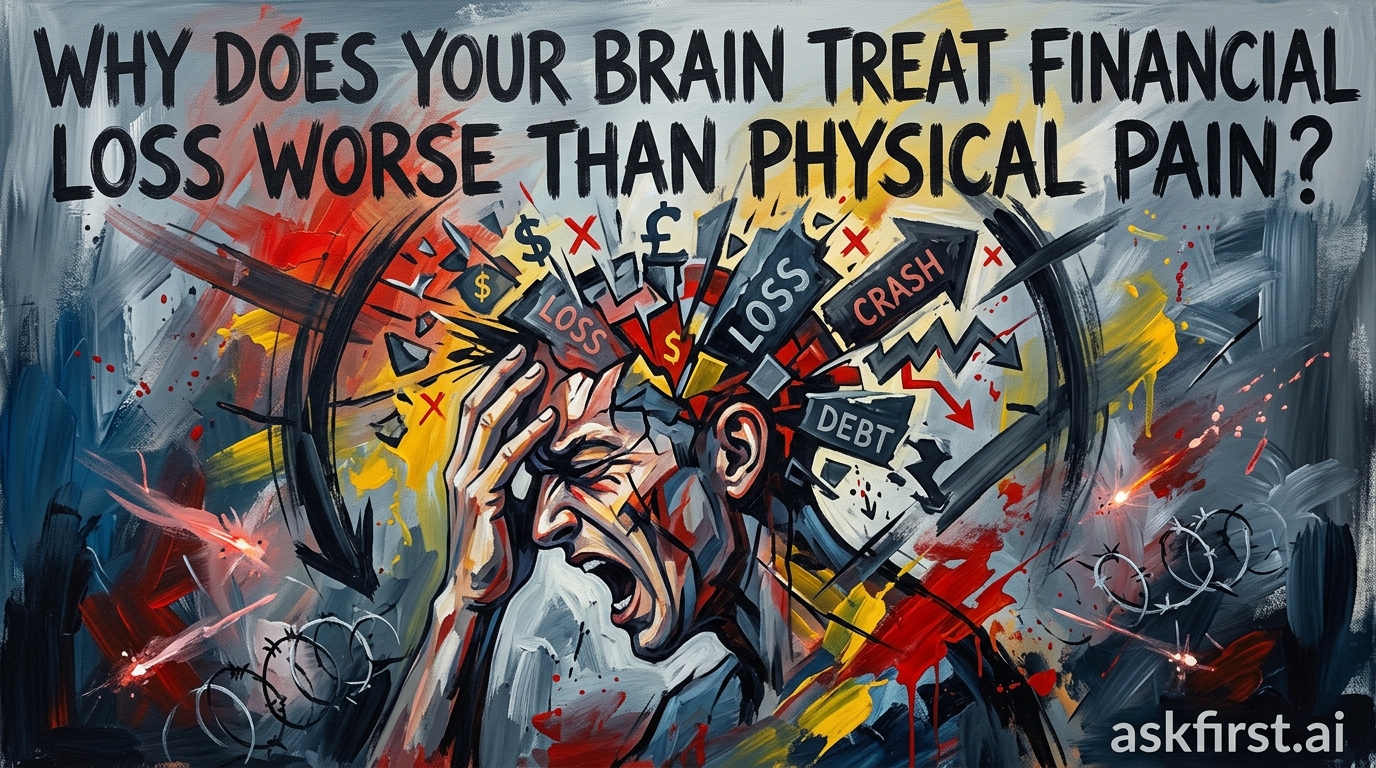
Human beings possess a complex neurological architecture that often prioritizes the avoidance of loss over the acquisition of equivalent gains. This psychological phenomenon, known as loss aversion, suggests that the pain of losing is psychologically about twice as powerful as the pleasure of gaining. When examined through the lens of evolutionary biology, this trait served a critical purpose for our ancestors: in a landscape defined by scarcity, failing to secure a meal or a resource could mean literal starvation. Consequently, the brain evolved to treat financial risks as existential threats.
The Neurobiology of Financial Regret
Research utilizing functional Magnetic Resonance Imaging (fMRI) has mapped how the brain processes monetary loss. Surprisingly, the areas of the brain that light up when we lose money—specifically the amygdala and the insular cortex—are the same regions responsible for processing physical pain and disgust.
- The Amygdala: This almond-shaped cluster acts as the brain’s alarm system. It is hyper-sensitive to threats, and in modern financial settings, it fails to distinguish between the loss of a hunting spear and the drop of a stock portfolio.
- The Insular Cortex: This region is associated with the physical sensation of disgust. When one sees a sharp decrease in personal wealth, the brain essentially registers this as 'toxic' or 'unhealthy,' leading to a physical aversion reaction that mirrors how one might recoil from rotten food.
Prospect Theory and the Value Function
Economist Daniel Kahneman and psychologist Amos Tversky pioneered Prospect Theory, which mathematically describes why we avoid risk. The 'Value Function' they developed shows that the curve for losses is steeper than the curve for gains. This means that losing $100 feels significantly more intense than winning $100. This is not a logical error; it is a hardwired bias. In our ancestral environment, if a primate lost a cache of berries, they were closer to death. If they found an extra cache, they were merely safer, but not 'twice as alive.' Therefore, natural selection favored the organism that protected what it had at all costs.
Why Money Triggers Physical Pain Responses
Financial loss is an abstract concept that the brain struggles to process in the absence of physical consequences. However, because modern society relies on currency for survival, the brain equates money with survival utility. When capital is lost, the brain triggers a stress response, releasing cortisol and adrenaline. These hormones are intended to help a body fight or flee a predator. When there is no predator to fight, the stress chemicals linger, causing tension, elevated heart rates, and cognitive tunneling—the same symptoms one would experience during a physical injury.
Modern Consequences of an Ancient Brain
This evolutionary mismatch has profound implications for modern life:
- Investor Panic: Many investors sell assets during market downturns, locking in losses, because their brains are signaling a life-or-death emergency. They are literally reacting to 'financial pain' as if it were a physical wound.
- Status Anxiety: Because we live in a status-driven society, money is also linked to social standing. Losing money threatens one's status, which triggers neural pathways associated with social rejection—a state the brain also interprets as a survival threat.
- Inertia and Avoiding Change: Loss aversion often leads people to stick with bad jobs or failing financial plans simply because the 'fear of losing' the current state outweighs the potential gain of moving to a better one.
Overcoming the Neural Bias
Understanding that this reaction is a biological relic is the first step toward better decision-making. By applying cognitive reframing, individuals can decouple financial decisions from the emotional alarm system:
- Long-Term Contextualization: Regularly reviewing long-term data rather than short-term fluctuations helps quiet the amygdala.
- The 'Outside View': Making decisions by asking how an objective observer would act can help move the task from the emotional centers of the brain to the prefrontal cortex, which handles logic and reasoning.
- Separating Self from Capital: Recognizing that financial assets are merely tools rather than extensions of the self can significantly reduce the physiological distress associated with volatility.
Ultimately, the brain is not broken; it is merely functioning exactly as it was designed to function in a world that no longer exists. By acknowledging that financial loss feels like physical pain, one can take control of these reflexive impulses and make more calculated, rational choices that bypass the ancient, alarmist instincts of the prehistoric mind.