The Psychology of Persistent Embarrassment: Why the Brain Holds Grudges Against Itself
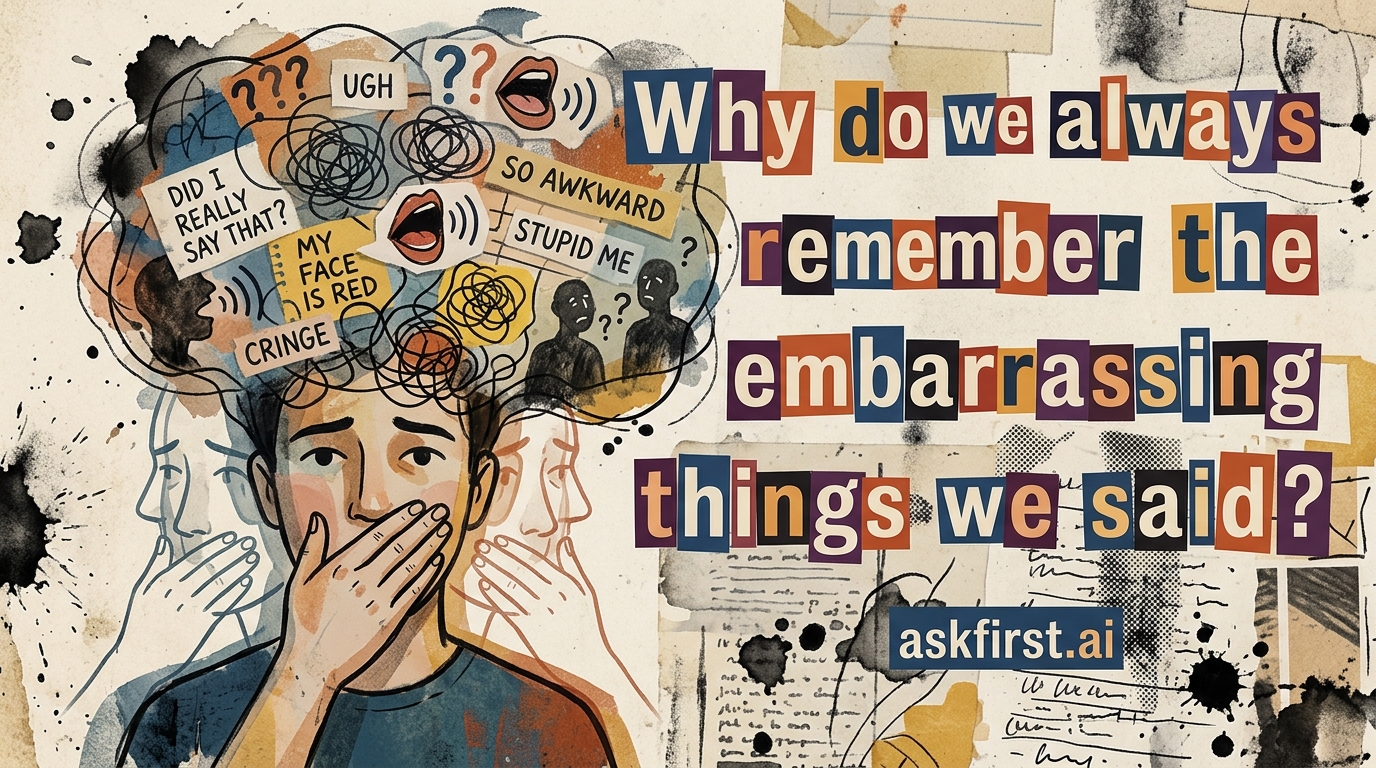
Human memory is not a recording device; it is a reconstruction engine designed primarily for survival. The phenomenon where the brain compulsively replays moments of social blunder—often long after others have forgotten them—is known in psychology as the 'Spotlight Effect' coupled with the 'Negativity Bias.' Understanding why these memories persist requires exploring the evolutionary, cognitive, and social functions of human thought.
The Evolutionary Survival Mechanism
From an ancestral perspective, human beings were obligatorily social creatures. Belonging to a tribe was synonymous with physical survival. Being exiled or ostracized meant death. Consequently, the brain developed a highly sensitive alarm system for social rejection. Embarrassment acts as a 'social pain' signal, functioning much like physical pain to deter behavior that might result in exclusion. The brain prioritizes memories of social errors not to torture the individual, but to ensure that such 'maladaptive' social behaviors are never repeated. This is a heuristic safeguard that, in the modern world, often malfunctions by over-indexing on minor verbal slips.
The Spotlight Effect and Egocentrism
Psychological studies pioneered by Thomas Gilovich demonstrate the Spotlight Effect, a cognitive bias where individuals overestimate the extent to which their actions and appearance are noted by others. The brain assumes that if a mistake felt catastrophic internally, it must have been equally catastrophic externally. In reality, most observers are preoccupied with their own internal dialogues. The memory remains vivid because the brain is erroneously recording the event as a major social breach, failing to realize that the 'audience' has long since moved on to their own concerns.
The Negativity Bias: Why 'Bad' Sticks
Brains are biologically wired to pay more attention to negative stimuli than positive ones—a concept called Negativity Bias. This is an ancient survival trait; noticing a predator in the bushes is more vital than noticing a beautiful flower. When an embarrassing moment is committed, the amygdala—the brain's emotional processing center—tags the memory with high intensity. This emotional tagging ensures that the memory is encoded more deeply than neutral memories, making it 'sticky.' Neuroscience shows that negative information triggers more neural activity than positive information, leading to the intrusive nature of these recollections.
The Ruminative Loop: Trying to Solve the Unsolvable
When an embarrassing memory surfaces, the brain often enters a state of Rumination. Rumination is the process of repeatedly analyzing the past to understand 'why' it happened or to practice a 'better' response. It is a form of mental rehearsal. While this can be a tool for personal growth, it frequently becomes a circular trap. By focusing on the shame of the past, the brain attempts to correct the perceived social error, yet because the past cannot be changed, the brain continues to loop the memory, reinforcing the neural pathway of shame each time.
Strategies to Mitigate the Mental Replay
Understanding the mechanics of these memories is the first step toward dampening their impact. Consider the following evidence-based approaches to managing social regret:
- Cognitive Reframing: Consciously remind yourself that others likely did not notice or do not care. Shift the focus from your own 'performance' to the external environment.
- The 'Third-Person' Perspective: Research suggests that visualizing an embarrassing event from a fly-on-the-wall perspective reduces the emotional intensity of the memory. It moves the event from an emotional experience to a factual one.
- Self-Compassion: Acknowledging that imperfection is a universal human experience can reduce the threat response. Embracing the 'humanity' of the blunder lowers the emotional charge stored in the amygdala.
- Acceptance and Commitment: Recognize that the memory is merely a stray thought. Labeling it as 'just a thought' rather than a 'truth about one's identity' helps to break the loop of rumination.
The Myth of Social Perfection
Many believe that a polished, error-free social persona is the goal of human interaction. Science suggests the opposite: individuals who display minor vulnerabilities are often perceived as more 'likable' and 'approachable'—a phenomenon known as the Pratfall Effect. The embarrassing memory that causes sleepless nights is, to the outside world, a signal of authenticity. By viewing these moments as data points for social learning rather than evidence of incompetence, the brain can begin to categorize these memories as neutral history rather than emotional threats. Ultimately, the persistence of these memories is a testament to the high value the brain places on human connection, reflecting our deepest need to belong to the collective.