The Psychology of Social Anxiety and Memory Persistence
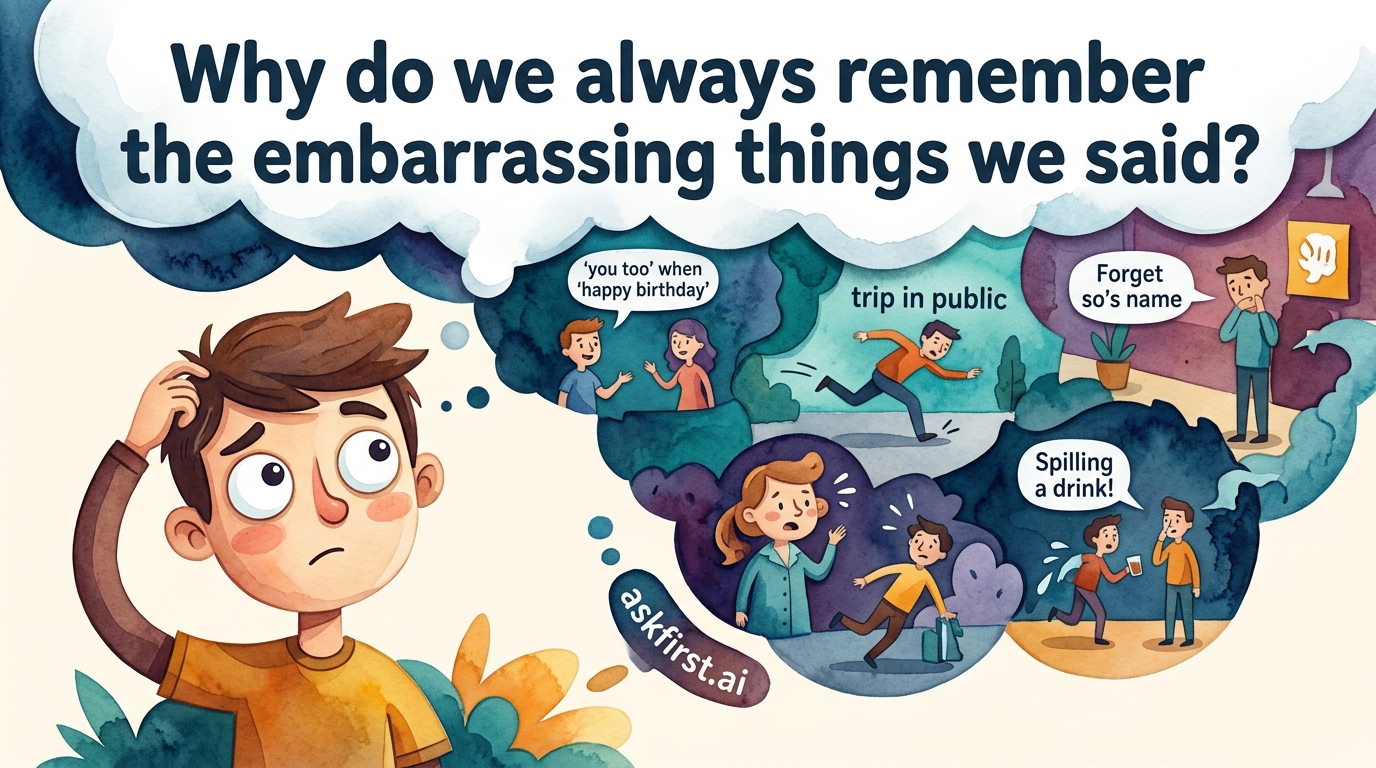
Human memory is not a perfect recorder of objective reality. Instead, it acts as a selective filter, heavily influenced by emotional weight and social survival instincts. The phenomenon known as the 'spotlight effect' combined with 'ruminative memory' often leaves individuals haunted by awkward social faux pas long after everyone else has forgotten them. This cognitive bias serves a specific purpose in the human evolutionary framework, though it often feels like a glitch in our psychological software.
The Evolutionary Survival Mechanism
From an evolutionary perspective, human ancestors relied heavily on group cohesion for survival. Being ostracized from a tribe often meant a death sentence. Consequently, the brain developed a high-sensitivity warning system for social rejection. Embarrassment serves as a social regulatory emotion—an 'internal alarm' designed to signal that a specific behavior violated a group norm. When we recall an embarrassing moment, the brain is effectively performing a 'rehearsal' to ensure that we do not repeat the behavior that triggered the social disapproval, thus preserving our standing within our community.
The Role of Negative Bias
Psychologically, the human brain possesses a profound negativity bias. It is significantly more attentive and responsive to negative information than positive or neutral information. This is because, historically, missing a threat (like a predator or a social blunder leading to exile) carried higher consequences than missing a benefit. Therefore, memories linked to shame or social discomfort are 'tagged' with high emotional arousal, making them harder to suppress and more likely to be retrieved during idle moments of introspection.
The Spotlight Effect and Cognitive Distortion
Psychologists Thomas Gilovich and Kenneth Savitsky identified the spotlight effect, which describes the tendency for individuals to overestimate how much others notice their appearance or behavior. In reality, most observers are far more concerned with their own inner dialogues and social anxieties than they are with the minor slips of others. When we ruminate, we assume our embarrassing moment was the center of everyone's attention, inflating the magnitude of the event in our memory. This distortion is further fueled by:
- High Self-Monitoring: Individuals who pay close attention to social cues often fall into the trap of over-analyzing their interactions.
- Rumination Cycles: Repeating the memory keeps the neural pathways associated with that shame 'warm,' effectively strengthening the memory through frequent retrieval.
- The Zeigarnik Effect: This principle suggests that we remember uncompleted or interrupted tasks better than finished ones. A social interaction that 'felt wrong' remains psychologically 'unresolved' in the brain, driving the mind to revisit it as it searches for a closure that never arrives.
How the Brain Processes Social Failure
Modern neuroscience suggests that the Anterior Cingulate Cortex (ACC)—an area involved in social pain and conflict monitoring—lights up when we think about these embarrassing moments. Interestingly, the brain processes social pain in a strikingly similar way to physical pain. When we recall a cringeworthy moment, the brain experiences a 're-living' of the emotional discomfort. Because the amygdala (the brain's emotional center) perceives this as a threat to our social status, it floods the recall process with intense focus, making the memory feel as fresh today as it did years ago.
Strategies to Mitigate Recurrence
Understanding why the brain clings to these moments is the first step toward letting them go. To break the cycle, one can implement several cognitive strategies:
- Cognitive Reframing: Consciously remind yourself that others are rarely as focused on your errors as you are. Replace the 'spotlight' narrative with the reality of 'everyone-is-the-protagonist-of-their-own-movie.'
- Self-Compassion: Research in positive psychology demonstrates that self-kindness reduces the ruminative feedback loop. Treating the memory as a learning experience rather than a character flaw mitigates the intensity of the emotional sting.
- Active Distraction: Since rumination strengthens neural pathways, engaging in demanding tasks or mindfulness exercises can force the brain to allocate resources elsewhere, effectively weakening the intensity of the specific 'shame memory' over time.
In conclusion, while the persistent nature of embarrassing memories feels burdensome, it is a byproduct of a sophisticated, if over-eager, social monitoring system. By recognizing the mechanics of the spotlight effect and the negativity bias, we can detach from the sting of these memories and recognize them for what they truly are: artifacts of a brain that is trying, in its own primitive way, to keep us connected to our peers.