The Illusion and Reality of Empathetic Understanding
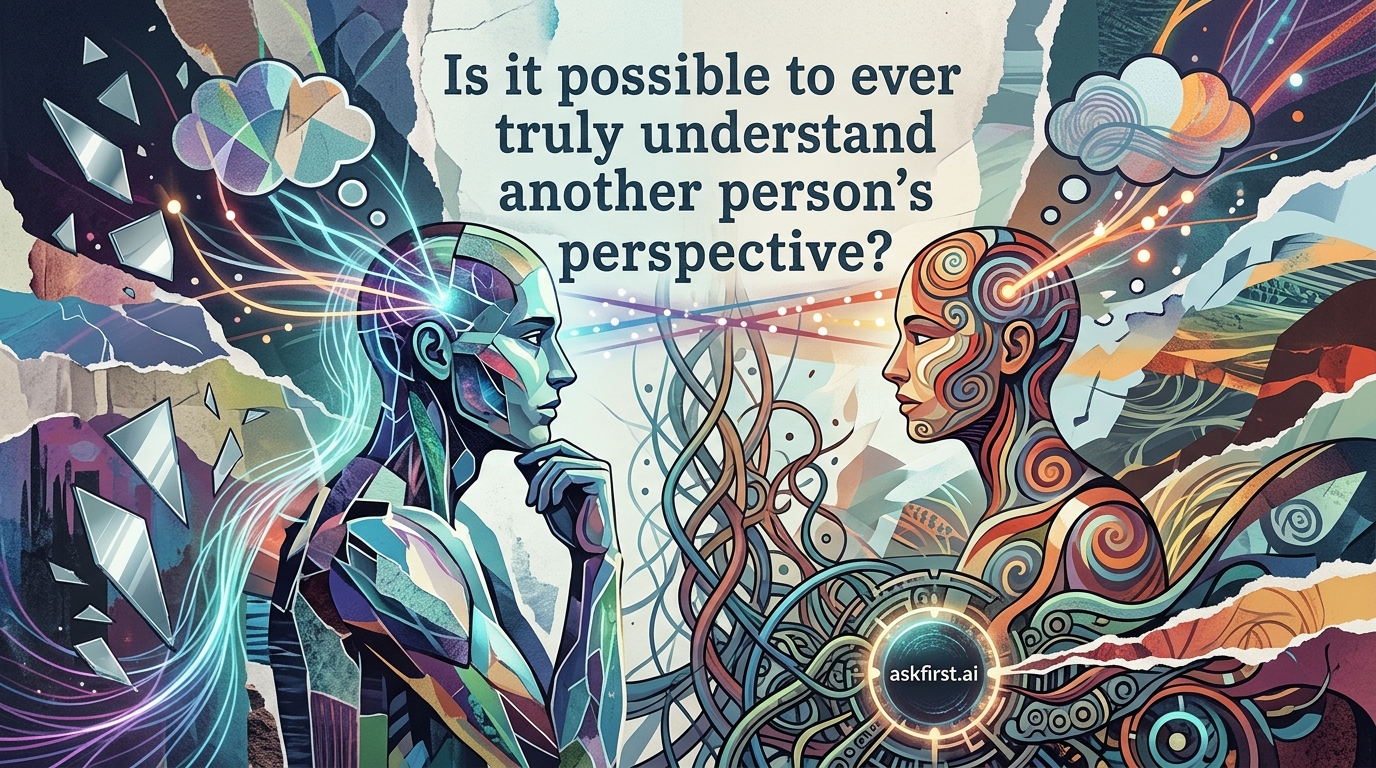
The fundamental challenge of human existence is the inherent isolation of the individual consciousness. Every person operates from a unique neural architecture shaped by distinct biological inheritance, developmental milestones, and personal experiences. This phenomenon, known in philosophy as the 'Problem of Other Minds,' posits that while one can observe behavior, one can never directly access the subjective experience—the 'qualia'—of another. Consequently, achieving a perfect, 100% accurate alignment with another person’s perspective remains theoretically impossible, yet the pursuit of this goal serves as the bedrock of human civilization, intimacy, and cooperation.
The Neurobiology of Perspective-Taking
The brain is equipped with specialized systems for social navigation, primarily involving the Theory of Mind (ToM) network. This includes the medial prefrontal cortex and the temporoparietal junction. These areas allow individuals to simulate what others might be thinking or feeling. When someone observes another person in distress, the brain’s mirror neuron system activates, firing similar patterns to what the person might experience if they were undergoing the same event. However, this is a simulation—a representation—not an identical copy. It is an interpretation filtered through one’s own memory banks and emotional history.
Why Perfect Understanding Remains Elusive
Language as a Filter: Language is an imperfect vessel for subjective states. Describing the intensity of pain, the euphoria of achievement, or the nuance of grief often falls short. Words carry different connotations based on individual histories, ensuring that a description never carries the exact internal resonance for the listener as it does for the speaker.
The Curse of Knowledge: Humans suffer from cognitive biases that prevent objective perspective-taking. Once an individual knows a piece of information or holds a specific belief, they find it nearly impossible to ignore that information when predicting the reactions or thoughts of others who do not have that knowledge. This gap creates a perpetual misunderstanding.
Projection Bias: People consistently project their own current emotional state or future preferences onto others. If someone feels hungry, they assume others are hungry; if they are calm, they underestimate the agitation of someone under pressure. This bias creates a 'self-centric' distortion of the other's perspective.
Strategies for Deep Empathetic Bridge-Building
Despite these limitations, understanding is not an impossible feat; it is a skill that can be developed. It functions not as a destination, but as a continuous practice of iteration. Several techniques help close the gap between minds:
Active Listening (Non-Judgmental Presence): This requires setting aside the desire to reply or solve problems. By focusing entirely on the speaker’s narrative, one can observe the emotional cadence and the logic behind their reasoning, which often reveals the 'why' behind the 'what.'
Radical Curiosity: Instead of assuming knowledge about another’s motives, adopt a posture of investigative wonder. Ask open-ended questions like, 'How does that experience feel in your daily life?' or 'What are the assumptions guiding this decision?' This shifts the dynamic from projection to inquiry.
Emotional Granularity: Research by psychologists suggests that people who can distinguish between complex emotional states (e.g., differentiating 'frustration' from 'anxiety' or 'resentment') are better at perspective-taking. By expanding one's own vocabulary of emotions, one becomes more sensitive to the nuanced states of others.
The Value of the Attempt
Paradoxically, the realization that true, total understanding is impossible is the most important step toward becoming more empathetic. When one accepts the limits of their own perspective, they stop assuming they know what another person thinks. This humility creates a vacuum that the other person can fill with their authentic experience. When the pressure to 'fully understand' is removed, the listener can focus on validation. Validation does not require agreement; it requires acknowledging that the other person's reality is internally consistent for them, given their unique history and biological context.
Conclusion: The Collaborative Reality
True understanding is not a static state, but an active, shared process. It is a collaborative construction where two minds weave their experiences together to create a new, shared context. While the barrier between individual subjectivities remains intact, the attempt to bridge it through deep listening, curiosity, and humble acknowledgment creates the strongest form of human connection. The beauty of human interaction lies not in identical perceptions, but in the harmonious coordination of two distinct realities working toward a shared outcome. The effort is not a failure because of its limits; the effort is the success itself.