The Myth of Post-Mortem Growth: Biological Reality vs. Optical Illusion
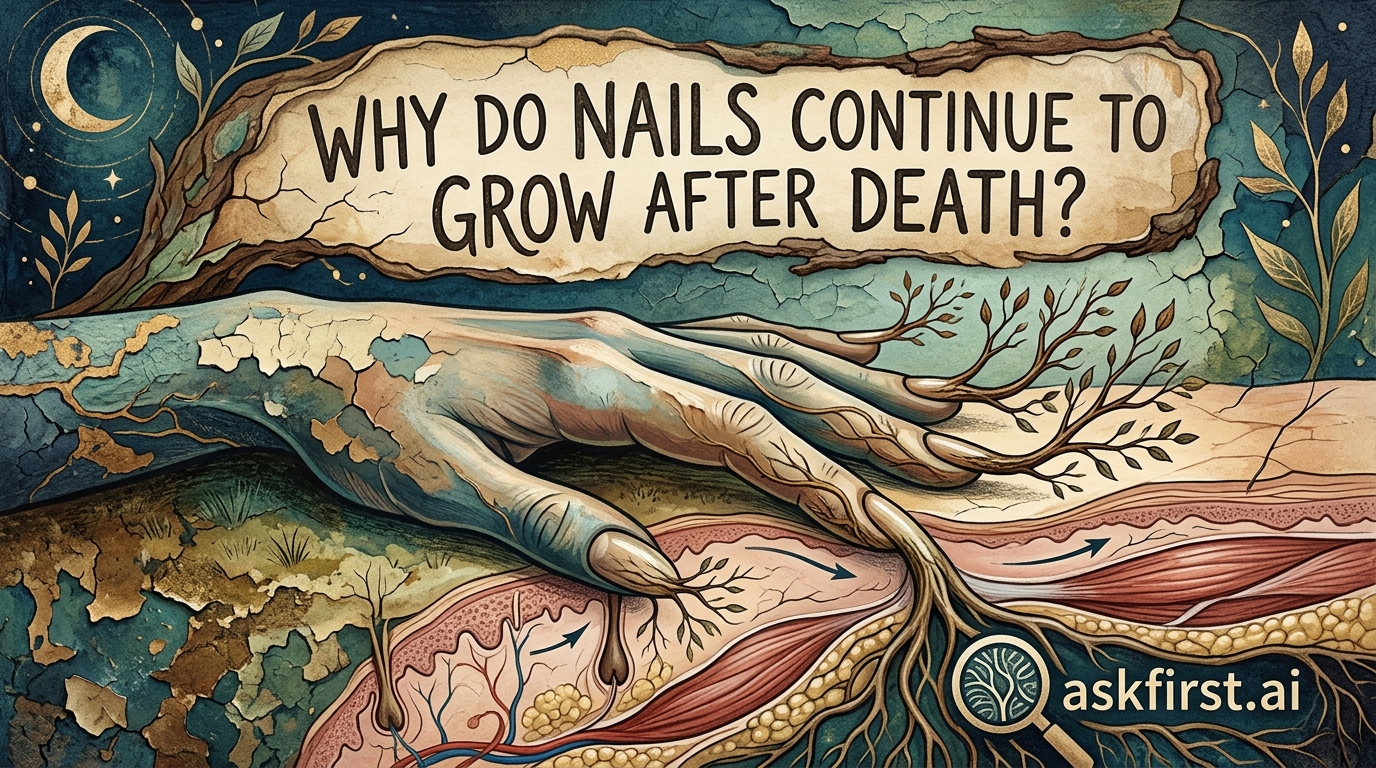
The notion that fingernails and toenails continue to grow after a person has passed away is one of the most persistent and macabre myths in modern folklore. It has been referenced in literature, television dramas, and urban legends for generations. While the visual evidence observed by morticians and forensic pathologists often suggests that nails have lengthened, the biological reality is far more sobering. Nails do not actually grow after death; rather, the body undergoes a series of complex physical transformations that create a convincing, albeit false, appearance of continued biological activity.
The Mechanics of Nail Growth: A Living Process
To understand why nails appear to grow, one must first understand what is required for actual growth. According to The Biology of the Skin by Dr. R.K. Freinkel and Dr. D.T. Woodley, nail growth is a metabolic process driven by cell division within the nail matrix—a specialized area of living tissue located beneath the cuticle. This process requires a continuous supply of oxygen, glucose, and nutrients delivered via the bloodstream.
In a living human, the matrix produces keratinocytes, which harden and push forward to form the nail plate. When the heart stops beating, cellular respiration ceases almost immediately due to the lack of oxygenated blood. Without this energy supply, the biological machinery required for mitosis (cell division) in the nail matrix shuts down. Simply put, there is no biological mechanism available to generate new nail tissue once the circulatory system has failed.
The Dehydration Effect: Why Nails Appear Longer
If growth is impossible, why do morticians and forensic investigators frequently report seeing longer nails on cadavers? The answer lies in the process of post-mortem desiccation, or dehydration.
Following death, the soft tissues of the body—including the skin surrounding the fingers and toes—begin to lose moisture rapidly as they are exposed to the environment. As the skin dries out, it loses its turgor and volume, causing it to shrink and retract. This retraction is particularly pronounced at the fingertips, where the skin pulls back toward the knuckles.
As the skin recedes, the nail plate, which is composed of dead, hardened keratin, does not shrink at the same rate. The keratin is relatively stable compared to the water-rich living tissue of the epidermis and dermis. As the surrounding flesh pulls away, more of the nail plate is exposed. To the casual observer, this shift in the skin’s position creates the optical illusion that the nail has extended. Forensic pathologists, such as those cited in Knight's Forensic Pathology by Pekka Saukko and Bernard Knight, emphasize that this is a purely mechanical change in the body’s topography, not a sign of cellular vitality.
The Role of Decomposition and Taphonomy
Beyond simple dehydration, the stages of decomposition play a significant role in how the body’s extremities appear over time. In the field of taphonomy—the study of how organisms decay and become fossilized—researchers observe that the skin often undergoes "degloving" or sloughing during the later stages of decomposition.
As the body enters the putrefaction stage, gases build up and the skin begins to separate from the underlying structural tissues. This separation often starts at the extremities. As the skin of the fingers separates and begins to pull away from the nail bed, the nail may appear to be lifting or protruding further than it did during life. In some cases, the nail may even detach entirely. These changes are frequently mistaken by laypeople for continuous growth, but they are actually symptoms of the body’s breakdown.
Historical and Cultural Misconceptions
This myth has been bolstered by the lack of public access to the realities of death. In the Victorian era, the rise of the funeral industry led to a greater separation between the general public and the deceased. When families finally viewed their loved ones in a casket, the physical changes caused by dehydration were often misinterpreted as signs of continued life.
Literature has further cemented this misunderstanding. For instance, in Erich Maria Remarque’s All Quiet on the Western Front, the author describes the horrific reality of the battlefield, where the perception of growing nails and hair on decaying bodies is used to emphasize the grotesque nature of death. While these literary descriptions are evocative, they should be treated as artistic interpretation rather than biological fact.
Conclusion: Distinguishing Science from Folklore
The perception that nails grow after death is a testament to the power of observation without scientific context. While it is true that the visual appearance of a body changes significantly in the hours and days following death, these changes are the result of dehydration, skin retraction, and tissue decomposition. Once the heart ceases to function, the metabolic pathways required for nail production are permanently severed.
Understanding the biological reality of post-mortem changes is essential for dispelling these myths. By relying on forensic science and dermatological studies, we can appreciate the body’s processes—both in life and in the final stages of physical decay—with clarity and accuracy. The nails do not grow; rather, the body, in its final transformation, reveals more of what was already there.