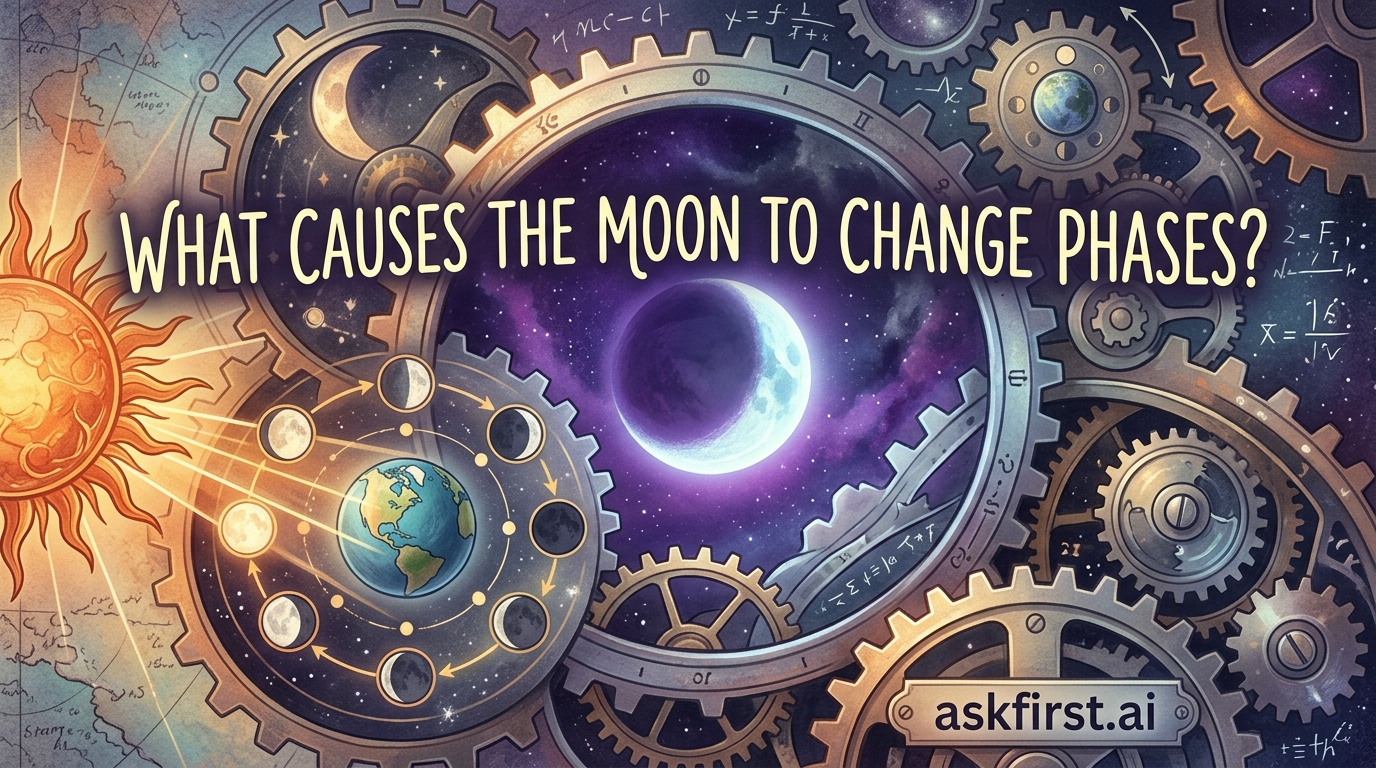
The Celestial Dance: Understanding Lunar Phases
The phenomenon of the Moon’s changing phases is one of the most observable and consistent cycles in the natural world. For millennia, humanity has looked to the night sky to track these shifts, using them to calibrate calendars, plan agricultural cycles, and navigate the seas. Contrary to common misconceptions, the Moon does not change its shape, nor is it being consumed by shadows cast by the Earth (an event reserved exclusively for lunar eclipses). Instead, the cycle of lunar phases is a direct consequence of the Moon's orbital motion around Earth and its specific orientation relative to the Sun.
The Geometry of Illumination
To understand why the Moon appears to change, one must first recognize that the Moon is a non-luminous body. Like the Earth, it is a sphere illuminated by the Sun. At any given moment, exactly half of the Moon is bathed in sunlight, while the other half remains in darkness. From our vantage point on Earth, the "phase" we observe is simply the portion of that sunlit hemisphere that happens to be facing toward us.
As the Moon orbits the Earth—a journey that takes approximately 27.3 days to complete relative to the stars, but 29.5 days to return to the same phase (the synodic month)—the angle between the Earth, the Moon, and the Sun constantly shifts. This changing geometry dictates how much of the daylight side we can perceive. As noted by Neil deGrasse Tyson in his seminal work Astrophysics for People in a Hurry (W.W. Norton & Company, 2017), the phases are a manifestation of our perspective from a rotating, orbiting platform looking out at a satellite that is also in motion.
The Progression of the Lunar Cycle
The cycle begins at the New Moon, a phase where the Moon is positioned between the Earth and the Sun. In this alignment, the side of the Moon reflecting sunlight is facing away from us, rendering it invisible against the backdrop of the night sky. As the Moon continues its counter-clockwise orbit, it moves out of this alignment, allowing a thin sliver of the illuminated side to become visible from Earth. This is the Waxing Crescent.
As the Moon reaches a 90-degree angle relative to the Sun and Earth, we see the First Quarter moon. Despite the name, we are seeing exactly half of the Moon’s face illuminated. The term "quarter" refers to the fact that the Moon has completed one-quarter of its orbit around the Earth. The illumination continues to grow during the Waxing Gibbous phase until the Moon reaches the "opposition" point—directly opposite the Sun in the sky. This is the Full Moon, where the entire visible face is illuminated by the Sun, creating a bright, circular disk.
Following the Full Moon, the process reverses. The illumination begins to shrink, moving through the Waning Gibbous, Third Quarter (or Last Quarter), and Waning Crescent phases, until it eventually returns to the New Moon position, completing the cycle.
Concrete Examples and Visualizing the Perspective
A helpful way to visualize this is the "Ball and Lamp" experiment. If you hold a ball (representing the Moon) in a darkened room with a single light source (the Sun) and walk in a circle around your head (the Earth), you will observe the same phases on the ball that we see in the sky. When the ball is between you and the lamp, the side facing you is dark. As you move the ball to the side, you see a crescent. When the ball is behind you, the side facing you is fully lit.
The astronomer Galileo Galilei, in his groundbreaking 1610 treatise Sidereus Nuncius (Starry Messenger), provided the first telescopic observations that confirmed these phases were a result of physical features and shadows on a spherical body, rather than atmospheric distortions or inherent changes in the Moon's composition. His sketches of the lunar terminator—the line separating the illuminated side from the dark side—demonstrated that the Moon has a rugged, mountainous topography that catches light differently as the phase progresses.
Why We Always See the Same Face
While the phases change, it is important to note that the features of the Moon remain constant. This is due to synchronous rotation. The Moon rotates on its axis at the exact same rate that it orbits the Earth. Because of this gravitational locking, the same hemisphere of the Moon is always directed toward our planet. We never see the "far side" of the Moon from Earth, regardless of what phase the Moon is currently in. This concept is explored in great detail in The Moon: A Biography by David Whitehouse (Headline Publishing Group, 2008), which explains the tidal forces that slowed the Moon's rotation over billions of years until it became locked in this eternal gaze toward Earth.
Conclusion
The changing phases of the Moon are a rhythmic, predictable demonstration of celestial mechanics. They serve as a reminder of our place within the solar system, illustrating the constant interplay of light and shadow created by the motion of orbiting bodies. By observing the transition from a thin crescent to a brilliant full orb, we are not witnessing a change in the Moon itself, but rather a shift in the cosmic dance between the Sun, the Earth, and our singular, steadfast satellite. Understanding this cycle connects us to the same rhythms that have guided human navigation and timekeeping since the dawn of civilization.