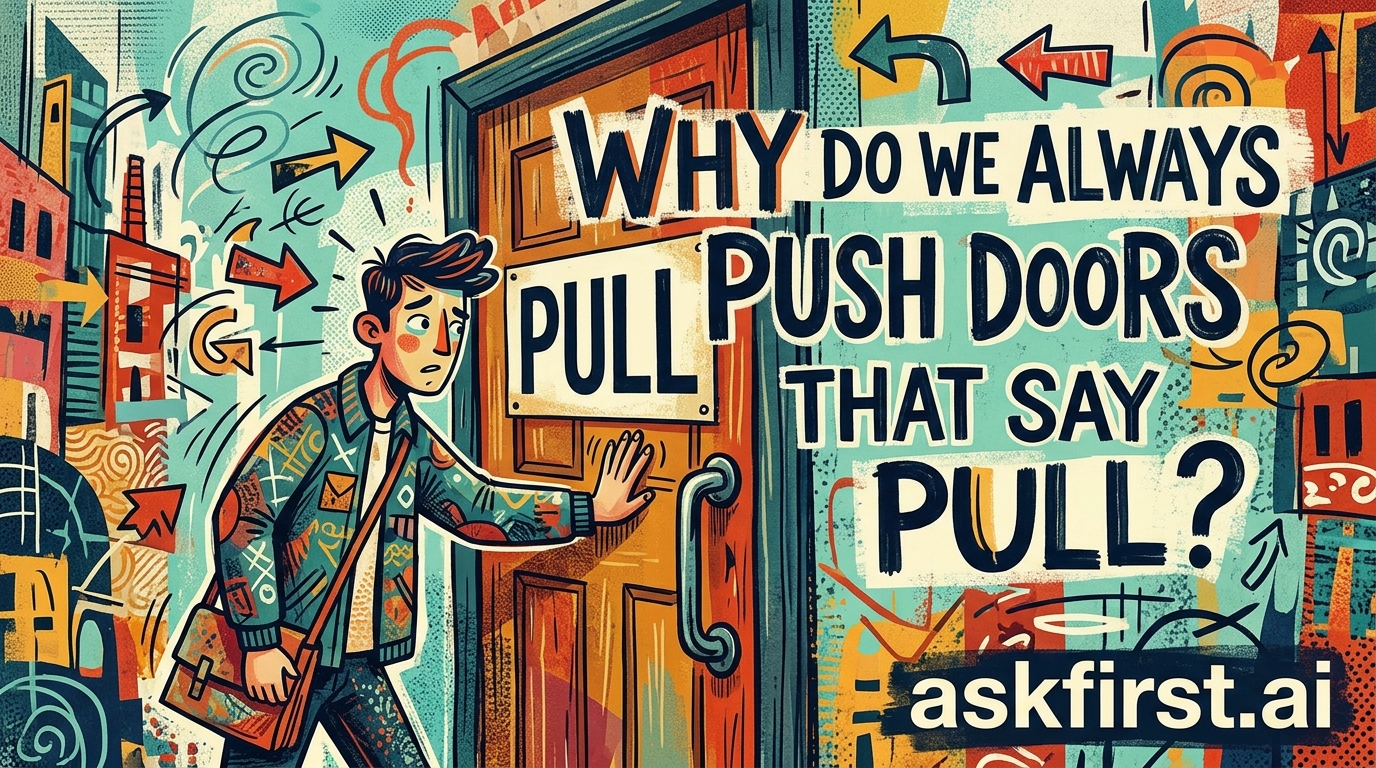
The phenomenon of people pushing doors that are clearly labeled 'pull' is a classic case of a 'Norman Door'—a term coined by cognitive scientist and design expert Don Norman in his seminal work, The Design of Everyday Things. This behavioral error is rarely a reflection of an individual’s intelligence; rather, it is a failure of industrial and environmental design. When a person approaches a door, the brain engages in a split-second heuristic evaluation. If the door features a flat metal plate, a vertical handle, or any visual cue that suggests a push, the user follows that affordance, regardless of the text printed on the glass.
The Psychology of Affordances
An 'affordance' is a term used in design to describe how an object's physical appearance suggests its function. A handle that is designed to be gripped strongly signals that it should be pulled. Conversely, a flat, flush plate signal that an object should be pushed. When a door is designed with a vertical handle on both sides, the user is presented with a conflicting message. The physical shape screams 'pull,' yet the text says 'pull.' The brain defaults to the physical signal because it is processed faster than symbolic language. This mismatch creates a cognitive dissonance where the subconscious mind prioritizes the physical geometry of the handle over the written instruction.
Mapping the Mental Model
Humans utilize 'mental models' to navigate the world. A mental model is an internal representation of how something works. If ninety-nine percent of doors in a shopping mall are push doors, a person will develop a strong expectation that the next door will also be a push door. This is known as 'habit interference.' When the environment changes—for example, if a push door is replaced by a pull door—the user’s ingrained mental model remains stuck. The brain is an efficiency-seeking organ that prefers to expend as little energy as possible. It prefers to rely on habit rather than stopping to analyze the text on every door encountered throughout the day.
The Conflict Between Text and Form
In design circles, this is often discussed as a battle between signifiers and affordances. A signifier is an indicator—like the word 'pull'—that provides information about what action to take. An affordance is the actual capability of the object. When the signifier (the word 'pull') contradicts the affordance (the vertical handle), the user experiences a lapse in logic. In emergency situations or high-traffic environments, people rely on peripheral vision and rapid-fire decision making. They are not reading the text; they are scanning for structural clues that indicate how to pass through the threshold.
How Proper Design Resolves the Error
Good design effectively eliminates the need for instructions. If a door is meant to be pulled, it should feature a handle that is only accessible from the side that needs to be pulled. If a door is meant to be pushed, it should have a plate that prevents pulling. By aligning the physical structure with the desired action, architects and engineers can prevent the 'pulling' confusion entirely. When a designer feels the need to place a sticker on a door to explain how it works, it is often a diagnostic signal that the object itself has been poorly designed.
Cultural and Environmental Factors
Furthermore, this behavior is reinforced by societal expectations. In high-density urban areas, people move quickly to maintain the flow of traffic. The pressure to conform to the walking speed of others prevents people from pausing to read signs. The environment dictates the behavior, and if that environment is built for aesthetic consistency rather than functional clarity, humans will inevitably misinterpret the visual cues provided. Understanding this cycle helps one realize that the next time a door is pushed in error, it is simply the brain attempting to interact with the world through a deeply rooted, habit-driven navigation system that prioritizes physical structure over linguistic signage.