The Neurochemistry of Attachment: How Your Brain Decides Love
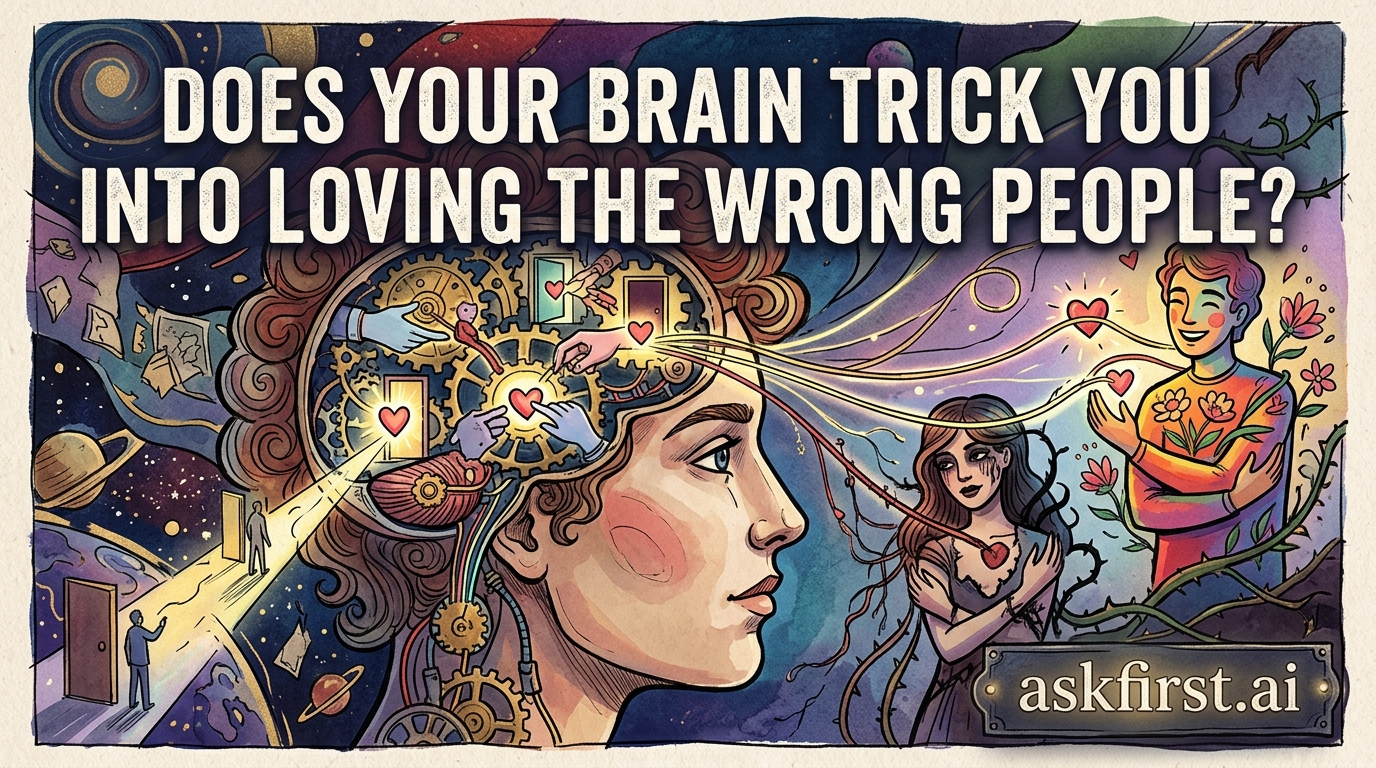
Human attraction is often perceived as a mystical, soul-stirring experience, yet beneath the surface, it is a complex biological algorithm. The sensation of 'loving the wrong person' is frequently a byproduct of evolutionary biology clashing with modern societal structures. When the brain prioritizes specific neurochemical feedback loops over long-term logical compatibility, it creates the illusion of a soulmate out of someone who may be fundamentally incompatible.
The Dopamine Reward System: The Engine of Desire
At the core of initial attraction lies the dopaminergic pathway. When a person meets a potential partner, the brain’s ventral tegmental area releases dopamine, a neurotransmitter associated with reward, motivation, and goal-directed behavior. This is not inherently about love; it is about seeking a reward. If the individual in question is unpredictable, the brain’s desire centers can become even more active. This is known as intermittent reinforcement, a psychological principle where irregular rewards create stronger neural pathways than consistent ones. The brain effectively 'tricks' the individual into pursuing a person because the pursuit itself is neurologically addictive.
The Role of Attachment Styles
Psychological research, notably the work of Bowlby and Ainsworth on attachment theory, explains why certain individuals are drawn to those who seem objectively wrong for them. If an individual possesses an anxious attachment style, they often gravitate toward those with avoidant tendencies. This dynamic is a self-perpetuating loop. The anxious individual seeks the validation of the avoidant partner, and when that validation is inconsistent, the brain interprets the struggle as 'intensity' or 'passion.' Consequently, one might mistake the anxiety triggered by a partner’s emotional unavailability for the butterflies of true love.
Evolutionary Misalignment
From an evolutionary standpoint, the human brain was not designed for modern long-term digital dating or complex career-focused lifestyle compatibility. It was designed to prioritize:
- Proximity: Being near someone triggers familiarity.
- Similarity: We often prefer those who mirror our own traits or social standing.
- Physical indicators of fitness: Evolutionary biology pushes the brain to scan for signs of health or resource acquisition.
Because these ancient biological triggers are still firing, the brain may experience a 'false positive.' It identifies someone as a high-value partner based on primitive cues, completely bypassing the higher-order functions of the prefrontal cortex, which is responsible for reasoning, long-term planning, and identifying character flaws.
The Mirroring Mechanism: Why We Fall for Familiarity
Another significant 'trick' is the unconscious drive toward familiar emotional landscapes. If a person grew up in an environment where love was contingent on performance or where emotional distance was common, the brain often labels those dynamics as 'comfortable' or 'home.' When an adult meets someone who recreates those early life dynamics, the brain creates a sense of familiarity. It is not that the person is necessarily the 'wrong' partner, but the attraction is based on a repetition compulsion rather than a genuine, healthy connection.
Cognitive Biases: The Halo Effect
One of the most powerful tools the brain uses to trick its host is the Halo Effect. This cognitive bias causes an individual to attribute positive character traits to someone based on one single positive attribute, such as physical attractiveness. If a person is perceived as attractive, the brain often automatically assumes they are also kind, intelligent, and trustworthy. This creates a powerful filter, causing the individual to ignore red flags or blatant incompatibility, effectively shielding the consciousness from the reality that the partner might be a poor match.
The Path to Conscious Love
To overcome these biological and psychological traps, one must engage the prefrontal cortex to act as a governor over the limbic system’s impulses. Awareness is the first step. By recognizing that intense, turbulent feelings can sometimes be manifestations of past conditioning or reward-seeking behaviors, an individual can begin to differentiate between infatuation and sustainable attachment.
- Observe, don't just react: Take time to analyze compatibility independent of physical chemistry.
- Identify patterns: Look for historical trends in past relationships to see if there is a cycle of choosing emotionally unavailable partners.
- Slow down the reward cycle: If someone is causing high levels of stress, that is not love; it is nervous system arousal.
In summary, the brain is an organ of survival, not necessarily a guide to optimal romantic happiness. By understanding the biological hooks—the dopamine spikes, the attachment biases, and the cognitive heuristics—individuals can reclaim their agency and make choices based on values and shared vision rather than biological illusions.