The Psychology of the 'Norman Door' Phenomenon
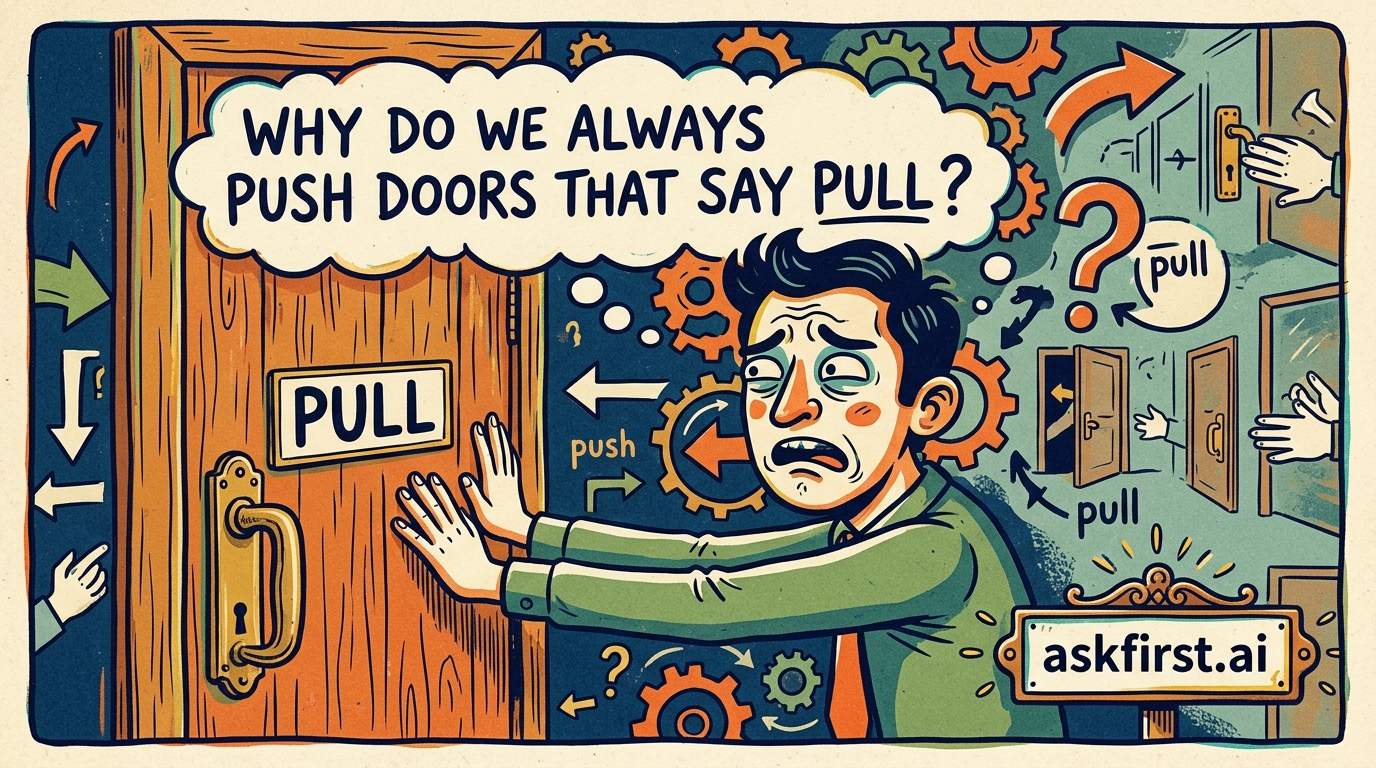
Human interaction with physical objects is governed by a set of subconscious expectations often referred to in industrial design as affordances. When a person approaches a door, the brain performs an instantaneous, split-second evaluation of the interface to determine its function. If a door features a flat vertical plate, the human brain automatically perceives it as a 'push' surface because the physical layout affords the act of pressing. Conversely, if a door has a handle or a curved bar, it is perceived as an object meant for grasping or pulling. When the visual signal provided by the door's hardware contradicts the signage or the actual mechanical requirement, the resulting cognitive dissonance leads to the 'Norman Door' error.
The Role of Cognitive Load and Habituation
Most daily navigation occurs in a state of cognitive autopilot. People rarely stop to analyze the architecture of every door they encounter. Instead, the brain relies on schemas—mental shortcuts that allow for rapid processing of familiar environments. Because most doors in modern commercial buildings are designed to swing outward for fire safety reasons, the habit of pushing becomes deeply ingrained. When a user encounters a door that requires a pull, the subconscious mind overrides the signage because the motor memory of pushing has been reinforced by thousands of successful interactions elsewhere. The visual signal of the sign is frequently ignored because it requires deliberate, slow thinking (System 2 in Daniel Kahneman’s dual-process theory), whereas physical movement is driven by fast, reflexive thinking (System 1).
Design Language and Affordance Theory
Don Norman, the cognitive scientist who popularized this concept in his seminal work, The Design of Everyday Things, argues that design should not require complex instructions. A well-designed object should communicate its function intuitively through its shape, size, and material. If a user needs a sign to understand how to operate a door, the design has fundamentally failed. A 'pull' door should ideally have no flat plate on the exterior, as a plate creates the illusion of a push surface. By replacing plates with functional, ergonomic handles, designers can align the user's physical intuition with the mechanical reality of the door, effectively eliminating the confusion that leads to the 'pushing a pull door' error.
Psychological Factors Influencing Decision-Making
Several psychological phenomena contribute to this common blunder:
- Confirmation Bias: Once a person decides a door is a 'push' door based on visual cues, they often filter out contradictory evidence, such as a 'pull' sign, until the failure occurs.
- Environmental Cues: Building entrances often share architectural themes. If one door in a hallway is a push, the brain assumes uniformity, leading the user to treat every door in that sequence as a push door.
- Social Modeling: Humans are highly observant of others. If a person sees others pushing a door, they are significantly more likely to attempt to push it as well, regardless of any instructional signage present.
The Importance of Human-Centered Engineering
Engineers and architects have a responsibility to design environments that account for human cognitive limitations rather than blaming the user for 'not reading.' In high-traffic environments, the implications of poor design go beyond mere embarrassment. Misleading door hardware can slow down egress during emergencies or frustrate patrons in retail settings. The solution lies in a shift toward Human-Centered Design (HCD), which prioritizes:
- Visibility: The function of the door should be visually obvious. If it pulls, use a handle. If it pushes, use a flat plate.
- Feedback: The door should provide immediate tactile or mechanical feedback that confirms the direction of movement.
- Consistency: Standardizing door hardware across a facility helps users build correct mental models of the environment.
Conclusion
The persistent struggle with 'push vs. pull' doors is not a reflection of human stupidity, but rather a testament to the powerful influence of design on human behavior. By understanding how the brain categorizes visual information and reacts to environmental affordances, designers can create more intuitive spaces. The next time you find yourself pushing a door that clearly states 'pull,' remember that your brain is simply relying on the most efficient path it has learned over a lifetime of interaction. The fault lies not in your perception, but in the disconnect between the object's form and its actual function.