The Cognitive Appeal of Musical Repetition and Development
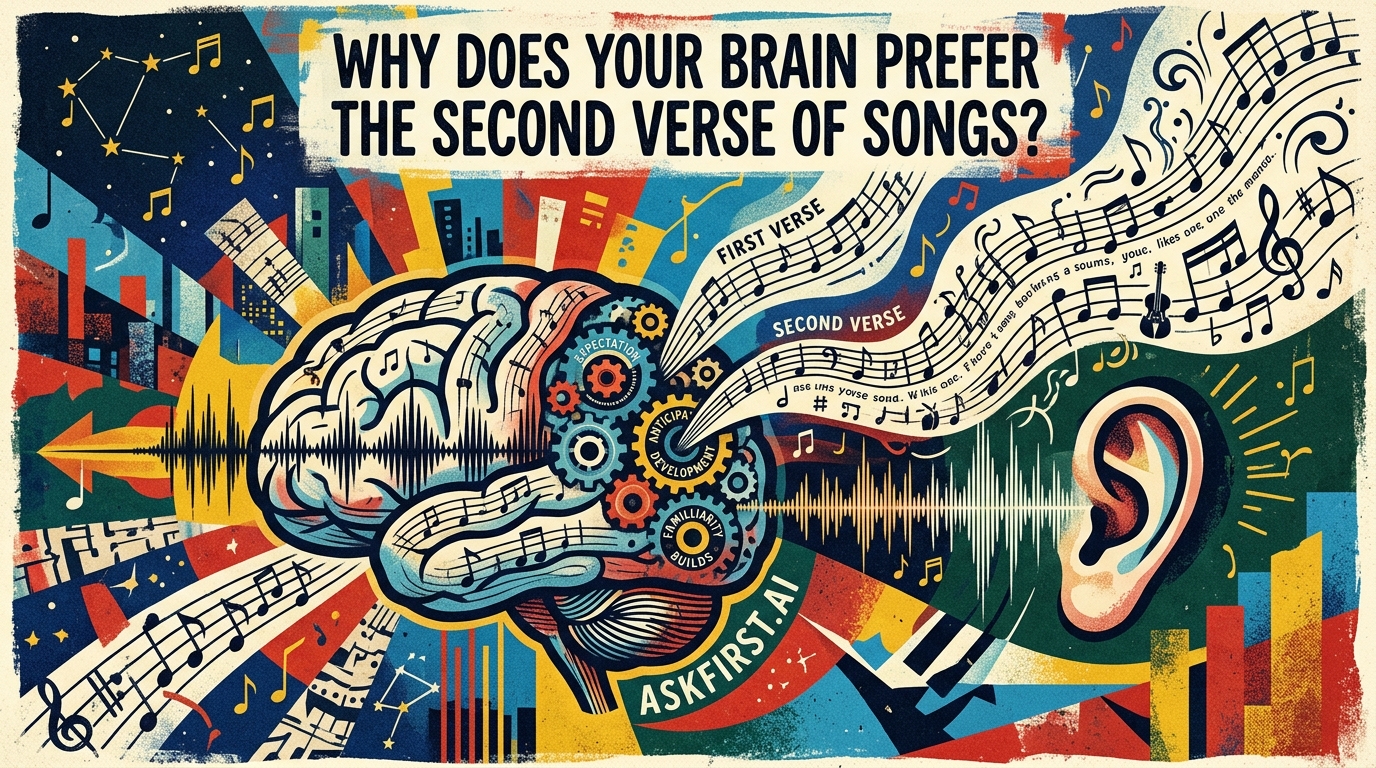
The phenomenon of preferring the second verse or the second chorus of a song over the first is a fascinating intersection of psychoacoustics, neurobiology, and structural composition. The human brain is a prediction engine, constantly seeking patterns to reduce entropy. When listening to music, the brain functions as a temporal processor that thrives on a delicate balance between predictability and novelty. The first verse acts as an introduction, requiring significant cognitive bandwidth to decode the unfamiliar chord progression, lyrical cadence, and rhythmic structure. In contrast, by the time the listener arrives at the second verse, the brain has established a internal model of the song’s syntax, allowing it to move from a state of 'active decoding' to 'pleasurable recognition'.
The Predictive Coding Framework
According to the predictive coding theory in neuroscience, the brain minimizes surprise by generating internal models. When the first verse ends, the brain has successfully encoded the fundamental rules of that specific track. As the second verse begins, the listener is no longer analyzing the song's rules; they are verifying them. This verification process triggers the release of dopamine—a neurotransmitter linked to reward and motivation. This creates a physiological sense of satisfaction known as the 'fluency heuristic'. When information is processed more easily, the brain mistakenly attributes that ease of processing to the quality or 'likability' of the stimulus itself. Because the second verse is cognitively 'cheaper' to process than the first, the brain labels it as more enjoyable.
Structural Reinforcement and The Mere Exposure Effect
Beyond basic cognitive processing, the 'Mere Exposure Effect'—a psychological phenomenon where people tend to develop a preference for things merely because they are familiar—plays a significant role. The first verse serves as the initial exposure. Upon reaching the second verse, the listener has already experienced the motif, the melody, and the instrumentation once before. This repetition lowers the psychological barrier to engagement. Furthermore, composers frequently utilize the 'dynamic expansion' technique in the second verse. While the melody often remains consistent with the first verse, producers usually add subtle layerings—a slight percussive reinforcement, an additional harmony, or a thicker bass synth. This 'familiarity with an upgrade' provides just enough novelty to stimulate interest without triggering the cognitive overload associated with entirely new stimuli.
Neural Synchrony and Rhythmic Entrainment
Music utilizes rhythmic entrainment, where neural oscillations in the listener's brain synchronize with the external rhythmic input. By the second verse, the brain has achieved a state of high-fidelity synchronization. This 'locked-in' state reduces the jitter and latency of neural responses, leading to a more seamless integration of audio data. Research in cognitive psychology suggests that the auditory cortex exhibits reduced activity when processing familiar stimuli compared to novel ones, but with increased activity in the ventral striatum, the brain's reward center. Essentially, the brain spends less energy 'listening' and more energy 'enjoying'.
Evolutionary Significance of Pattern Recognition
From an evolutionary standpoint, the ability to recognize and anticipate patterns was critical for survival. Recognizing a sequence of sounds helped ancestors identify danger or communication signals in the environment. Music leverages these deep-seated evolutionary circuits. The preference for the second verse is essentially a celebration of the brain’s successful environmental mastery. It provides a sense of temporal safety; the brain understands the song's progression, predicting the resolution of phrases, which induces a sense of calm and pleasure. This is why variations, such as a bridge or a dramatic key change after the second chorus, often feel so jarring—they break the pattern the brain had successfully mastered, forcing the listener to restart the predictive loop.
Practical Applications in Songwriting
Songwriters and producers are intuitively aware of this cognitive bias. It is standard practice to treat the second verse differently than the first to reward the listener's patience. Techniques include:
- Instrumentation layering: Introducing subtle elements that were absent in the first verse to keep the 'novelty' spike alive.
- Vocal intensity: Increasing the vocal grit or breath support to signal progression.
- Rhythmic shifts: Utilizing a more driving beat or an extra snare hit to maintain the dopamine flow.
In conclusion, the preference for the second verse is not an accident of taste but a fundamental result of how the human brain processes information. By successfully navigating the learning curve of the first verse, the listener gains the cognitive clearance to deeply inhabit the second. It is a harmonious dance between the brain’s requirement for order and its craving for a slight, sophisticated degree of growth, ultimately making the second verse the emotional and structural anchor of the musical experience.