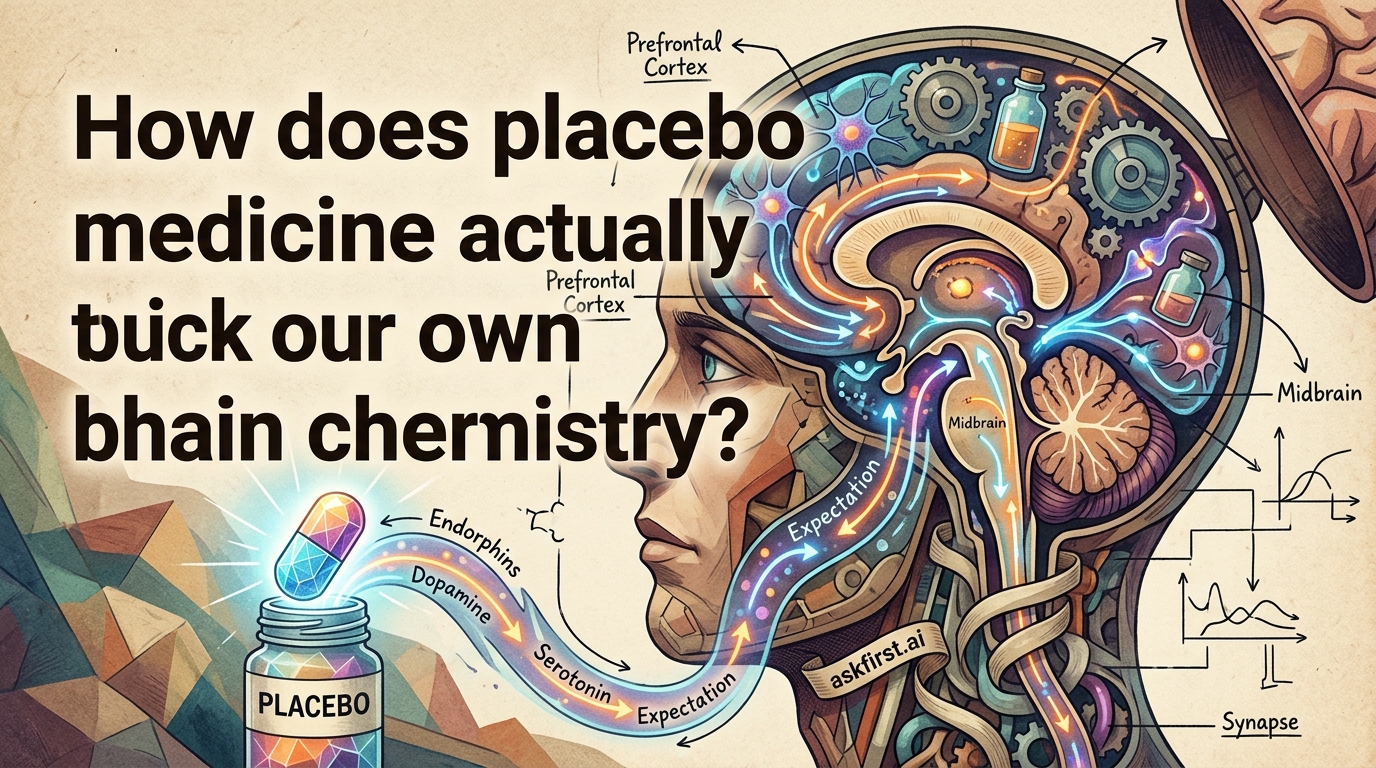
The placebo effect represents one of the most intriguing phenomena in neuroscience, where a patient experiences a perceived or actual improvement in condition after receiving a treatment that has no active therapeutic ingredient. Far from being a mere illusion or a trick played on the mind, the placebo effect is a complex, biologically measurable process rooted in the intricate connection between psychology and neurochemistry. It demonstrates that the brain possesses an innate pharmacy capable of modulating pain, hormone levels, and even motor function based on expectations and environmental cues. ## The Neurobiological Mechanisms of Expectation When a person believes they are receiving an effective treatment, the brain activates the prefrontal cortex—the region associated with high-level cognitive functions like prediction, planning, and evaluation. This activation triggers the release of endogenous opioids, which are the body’s natural painkillers. These molecules bind to the same receptors as pharmaceutical narcotics, effectively muting pain signals along the spinal cord. This is not just a 'feeling' of being better; it is a physiological downregulation of pain perception. Furthermore, the anticipation of relief activates the brain's dopaminergic reward system. Dopamine, often called the 'feel-good' neurotransmitter, is released in the nucleus accumbens, reinforcing the expectation of positive outcomes. This reward loop is so potent that it can influence autonomic functions, including heart rate and blood pressure, often bringing them closer to a homeostatic baseline. ## The Role of Pavlovian Conditioning Conditioning plays a significant role in how these internal chemical pathways are engaged. Throughout life, individuals learn that visiting a clinic, seeing a physician in a white coat, or swallowing a pill is associated with symptom relief. Over time, the brain develops a conditioned response to these 'treatment rituals.' The mere act of undergoing these rituals can serve as a subconscious trigger, prompting the brain to release healing neurotransmitters before any medicine has even entered the bloodstream. This is a classic example of Pavlovian learning applied to medicinal intake. ## The Power of the Therapeutic Ritual Research into the 'open-label' placebo—where patients are informed that they are receiving an inert substance—has revealed that the ritual itself holds immense power. Even when the deception is removed, the psychological acknowledgment of participating in a healing encounter can still yield measurable physical improvements. This suggests that the clinical setting, the authority of the practitioner, and the validation of the patient's concern all act as synergistic inputs that signal the brain to initiate self-regulation. Key factors that amplify this effect include: * The bedside manner: Higher levels of empathy from a healthcare provider correlate with stronger placebo responses. * The aesthetic of the medicine: Large pills often perform better than small ones; injections typically yield higher placebo responses than tablets due to their perceived intensity. * Cultural beliefs: The perceived prestige of a healthcare system or a specific medical tradition can influence the magnitude of the response. ## Neurological Limitations and Precision While the placebo effect is powerful, it is important to distinguish between subjective symptom relief and objective disease alteration. The brain can modulate how a person experiences pain, anxiety, and fatigue—the 'internal state'—but it generally cannot cure structural issues like deep physical trauma or advanced biological diseases on its own. For instance, while a placebo may reduce the pain caused by inflammation, it does not necessarily reduce the inflammation itself. Neuroscientific studies using functional magnetic resonance imaging (fMRI) have shown that placebo responses are highly localized, affecting specific brain regions involved in pain processing, such as the anterior cingulate cortex and the thalamus. This confirms that the brain does not operate as a single unit but as a networked system capable of precise chemical modulation. ## The Future of Medicine Understanding these mechanisms does not suggest that we should replace active medicine with sugar pills. Instead, it invites a deeper integration of 'meaning response' into clinical practice. By harnessing the patient's internal chemical potential—through better communication, evidence-based rituals, and the management of expectations—healthcare practitioners can augment the efficacy of active treatments. The study of the placebo effect proves that the brain is not just a passive receiver of medical intervention but an active, intelligent participant in the healing process. When we decode the signals that tell our brain to heal, we unlock the extraordinary capability of the human body to regulate its own suffering, pointing toward a future of medicine that values both the chemical molecule and the human psyche.

Ask First can make mistakes. Check important info.
© 2026 Ask First AI, Inc.. All rights reserved.|Contact Us