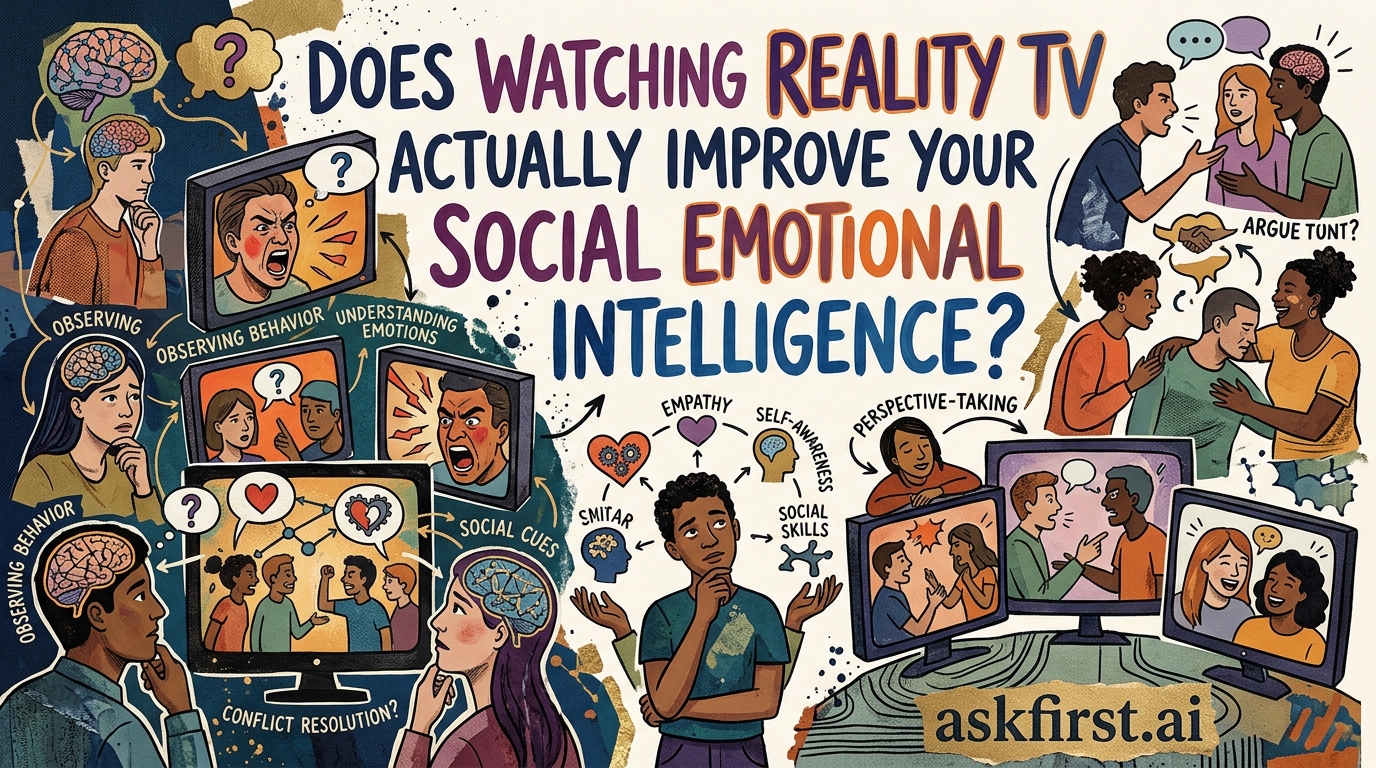
The Paradox of Reality Television and Social Cognition
Reality television has long occupied a polarizing space in the cultural landscape, often dismissed as low-brow entertainment or 'guilty pleasure' viewing. However, emerging research in media psychology suggests that these programs may act as a complex training ground for social-emotional intelligence (SEI). By observing the interpersonal dynamics, conflicts, and resolutions presented in unscripted narratives, viewers are engaging in a form of social simulation that exercises specific cognitive muscles related to empathy, social cues, and moral reasoning.
The Mechanics of Social Simulation
At its core, reality television relies heavily on human behavior under stress. When viewers watch individuals interact in competitive or high-stakes social environments, they are essentially participating in a 'social laboratory.' The primary mechanisms at play include:
- Theory of Mind Development: This involves the ability to attribute mental states—beliefs, intents, desires, and knowledge—to others. By witnessing non-verbal cues and hearing the internal monologues (often found in confessionals), viewers practice inferring motivations behind behaviors that may seem irrational or aggressive.
- Perspective-Taking: Reality TV often showcases people from diverse socioeconomic, cultural, and ideological backgrounds. Watching these individuals navigate disputes requires the viewer to step into different shoes, thereby broadening their understanding of how different personality types respond to common stressors.
- Emotion Regulation Observation: Viewers observe how cast members manage anger, sadness, or anxiety. Even when the behaviors on screen are unproductive, the viewer learns to analyze the consequences of those emotional displays, identifying what works and what fails in social resolution.
Can We Call It 'Social Training'?
Critics often argue that reality TV encourages voyeurism and shallow judgment. While this is true in many instances, psychologists note that the act of judging is itself a cognitive task. When a viewer wonders why a contestant acted a certain way, they are actively engaging in social hypothesis testing. If a viewer regularly practices identifying deceit, manipulative tactics, or genuine empathy in others, this practice can bleed over into real-world interactions. This phenomenon is supported by the concept of 'parasocial interaction,' where viewers form one-sided relationships with television figures, learning the nuances of social feedback loops through these vicarious experiences.
The Difference Between Passive and Active Viewing
The key to whether reality TV improves intelligence lies in how one consumes the content. There is a distinct difference between passive consumption and analytical viewing. Research indicates that individuals who approach these shows with curiosity about human nature—asking, 'Why did she react like that?' or 'How could this conflict have been avoided?'—are more likely to derive social benefits. This is known as 'mindful media consumption.' When the viewer is active, the brain processes the complex social cues as if they were observing actual friends or coworkers, effectively increasing the repertoire of social scripts available to them in daily life.
Critical Considerations and Limitations
While the potential for social learning exists, it is vital to acknowledge the limitations. Reality TV is often heavily edited, produced, and manipulated to maximize conflict. Reliance solely on these programs as a guide for real-world social behavior can lead to a distorted perception of social norms. Specifically, viewers might develop a heightened sense of cynicism if they assume all human interactions are as transactional or competitive as they appear on screen. Furthermore, the constant exposure to conflict can, for some, desensitize them to the nuances of healthy emotional expression.
Conclusion: A Tool, Not a Textbook
Ultimately, reality television functions like a social mirror. It does not possess inherent 'intelligence-boosting' properties in a clinical sense, but it provides the raw data that an active, observant brain can use to refine its social toolkit. By engaging with these programs critically—recognizing the artifice, studying the motivations of the participants, and evaluating the outcomes of social choices—viewers can indeed hone their ability to read others, understand social hierarchies, and develop a more nuanced theory of mind. In an age where digital interaction often replaces face-to-face connection, this form of vicarious social learning offers an intriguing, if imperfect, venue for practicing the fundamental human skill of understanding one another. Whether one is watching a documentary-style program or a high-drama competition, the social cognition lessons are there for the taking, provided the viewer stays sharp, analytical, and deeply inquisitive about the human condition.