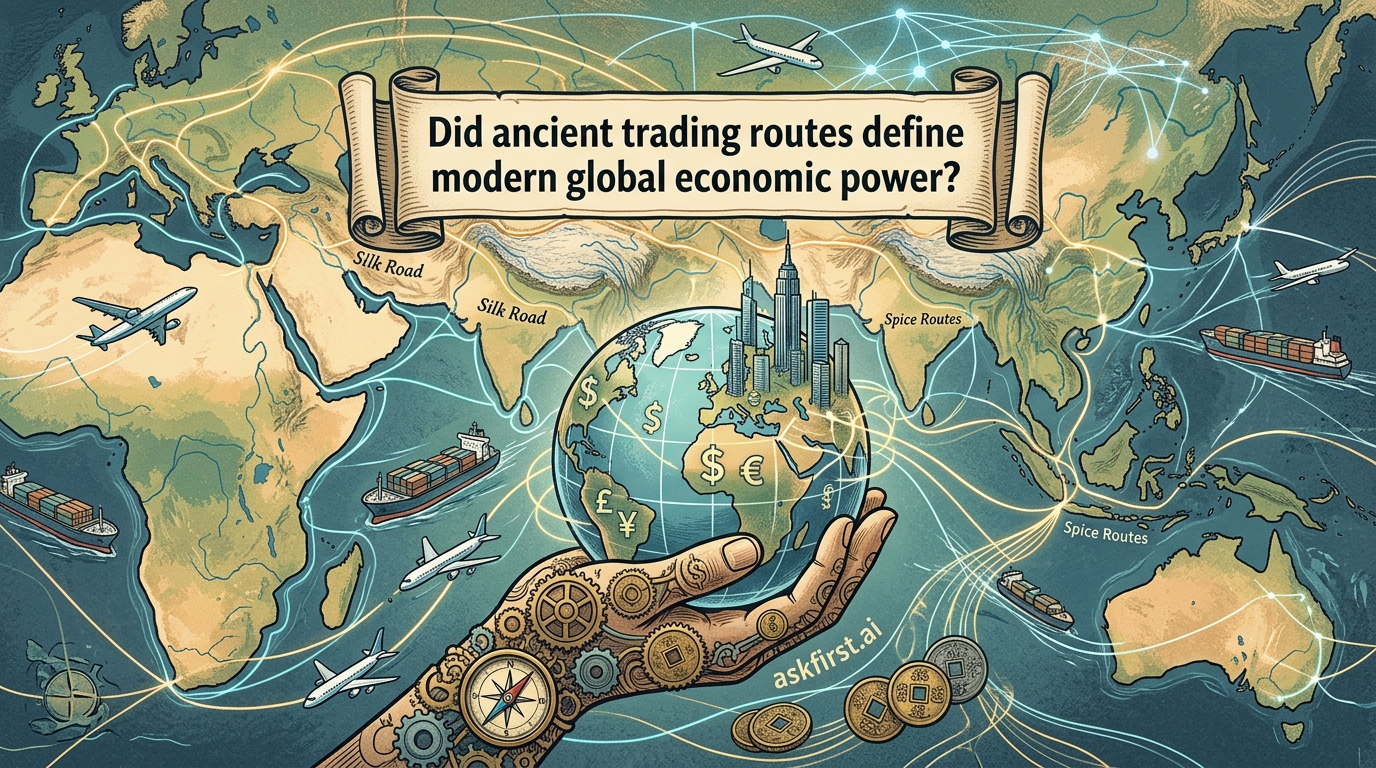
The Architectural Legacy of Commerce
When examining the current landscape of global hegemony, it is a common misconception to view modern economic power as a byproduct solely of the Industrial Revolution or the digital age. In reality, the fundamental structural foundations of wealth, geopolitical influence, and logistical dominance were laid down millennia ago through the establishment of ancient trading networks. These arterial routes—most notably the Silk Road, the Incense Route, and the Trans-Saharan networks—did more than facilitate the movement of silk, spices, and gold; they created the first international standards for finance, diplomacy, and infrastructure that still govern our world today.
The Persistence of Infrastructure
The most striking evidence that ancient routes define modern power lies in the concept of path dependency. Infrastructure is rarely built in a vacuum; it follows the path of least resistance. Coastal cities that emerged as nodes for maritime trade in the Mediterranean or the South China Sea remained optimal locations for logistics centuries later. For example, the ports of the ancient Phoenicians are often the sites of today’s most bustling container terminals. By establishing these hubs, ancient civilizations locked future generations into a geographical blueprint where wealth naturally accumulates because the logistical framework was already in place.
Finance and The Standardization of Trust
Modern global finance is built upon the requirement for trust between distant parties, a system invented by merchants thousands of years ago. Ancient traders needed reliable methods for currency exchange, credit, and insurance. The banking systems of the Italian maritime republics during the medieval period were essentially extensions of Roman and Islamic financial innovations derived from older caravan trades. Today’s global financial hubs—London, Singapore, and New York—function as the modern equivalents of Samarkand or Venice. The 'economic power' of these cities is not merely capital density; it is the institutional memory and standardized protocols that trace their lineage back to the bazaar systems where the first multinational corporations were essentially 'forged' through long-distance trading partnerships.
Geopolitical Hegemony and The Control of Chokepoints
The strategic importance of geographic chokepoints has remained almost entirely static for five thousand years. Whether it is the Straits of Malacca, the Suez Canal (built over ancient transit paths), or the Persian Gulf, control over these narrow passages has defined the rise and fall of empires throughout history. Modern naval power and trade policy are largely focused on maintaining access to these specific corridors. Because ancient states fought for, fortified, and prioritized these specific locations, they inadvertently designated the 'prize' for all subsequent eras. If an ancient trade route converged on a specific geographic bottleneck, that bottleneck remains a center of modern geopolitical friction. This is not a coincidence; it is the manifestation of deep-seated logistical reality.
The Cultural and Institutional Diffusion
Beyond physical assets, ancient routes acted as the 'internet of antiquity.' They facilitated the flow of ideas, bureaucratic structures, and intellectual property. The spread of systems of weights, measures, and written scripts helped unify vast regions, creating larger economic blocks. Modern globalized markets rely on this historical convergence of standards. Regions that were integrated into these ancient networks inherited a framework for economic complexity that less-connected regions struggled to replicate. This long-term cultural capital has translated into a persistent 'first-mover advantage' for the civilizations that successfully managed these historical networks.
Conclusion: The Persistent Ghost of History
Modern economic power is essentially a refined, digital, and hyper-accelerated iteration of an ancient blueprint. While the tools have evolved from camel caravans to autonomous shipping and algorithmic trading, the underlying dynamics—the desire for reliable access, the necessity of secure hubs, and the pursuit of efficient communication—are identical to those of the Silk Road era. By tracing the map of historical prosperity, one discovers that today's superpower status is not merely a reflection of current ingenuity, but a testament to how effectively nations utilize the inherited corridors of the ancient world. History does not just repeat itself; it provides the scaffolding upon which the future is inevitably built.