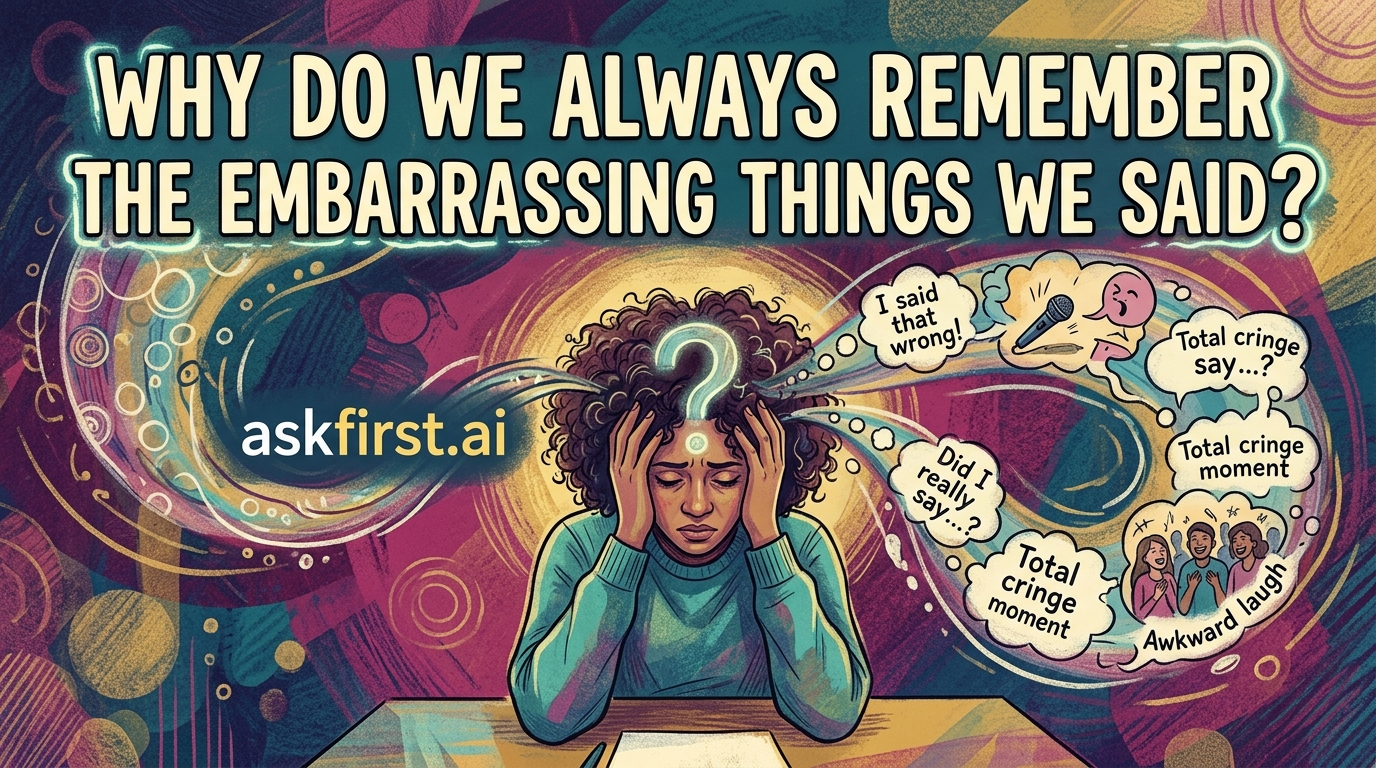
The Psychology of Lingering Embarrassment
The phenomenon of replaying an embarrassing comment in the mind, often referred to as the 'spotlight effect' or 'rumination,' is a deeply ingrained cognitive process. Humans are social animals, and for millennia, belonging to a group meant survival. Consequently, our brains are hardwired to monitor our social standing with extreme precision.
The Evolutionary Mechanism
From an evolutionary standpoint, social rejection was once equivalent to a death sentence. Being ostracized from a tribe meant losing access to food, shelter, and protection. Therefore, the brain developed a high-sensitivity alarm system for social blunders. When a person says something perceived as foolish, the amygdala—the brain's emotional center—triggers a stress response. This response encodes the memory of that 'mistake' with high intensity to ensure it is not repeated, as repeating such an error could lead to social exile.
The Spotlight Effect
Psychologists Thomas Gilovich, Victoria Medvec, and Kenneth Savitsky coined the term The Spotlight Effect to describe the human tendency to overestimate how much others notice our actions and appearances. Because individuals are the center of their own universe, they assume they are also the center of everyone else's. In reality, most people are too preoccupied with their own internal dialogues and anxieties to dwell on a fleeting comment made by someone else. Understanding that others are not maintaining a mental ledger of every slip-up is a powerful tool for emotional liberation.
Cognitive Biases and Memory
- Negativity Bias: Human brains are wired to prioritize negative experiences over positive ones. Research shows that negative memories are more vivid and take up more 'cognitive space' because they represent potential threats that require future avoidance strategies.
- Rumination Cycles: Rumination is the process of repetitively thinking about distressing events. While the brain thinks it is 'problem-solving' by analyzing the mistake, it is actually trapped in a loop that reinforces the emotional sting rather than finding a resolution.
- The Zeigarnik Effect: This principle suggests that people remember uncompleted or interrupted tasks better than completed ones. An embarrassing comment feels like an 'unresolved' social failure, causing the brain to keep it active in short-term memory until it feels 'corrected' or 'forgiven.'
Practical Strategies for Emotional Regulation
To move past the cycle of embarrassment, consider these psychological techniques:
- Cognitive Reframing: Consciously shift the narrative. Instead of viewing a comment as a catastrophic failure, label it as a neutral 'data point' about social interactions. Acknowledging that everyone makes errors helps normalize the experience.
- Externalizing the Perspective: Ask the question: 'Will this matter in a week, a month, or a year?' The perspective of time significantly diminishes the perceived severity of social mishaps. Most, if not all, embarrassing moments are forgotten by others within minutes.
- Self-Compassion: Research by Dr. Kristin Neff highlights that self-compassion is more effective than self-criticism in improving mental well-being. Treat oneself with the same kindness one would offer a friend who made the same comment. Recognizing that humans are inherently fallible reduces the intensity of the shame response.
- Mindfulness Practices: Engaging in mindfulness helps break the cycle of rumination. By anchoring the mind in the present moment, the brain learns to step away from the hypothetical 'what-ifs' of past conversations.
The Social Benefit of Vulnerability
Interestingly, research suggests that minor displays of embarrassment or 'blunders' can actually increase likeability. This is known as the Pratfall Effect. When high-competence individuals commit minor errors, they appear more relatable, human, and authentic. People often feel safer and more comfortable around those who show they are not perfect. Embracing this perspective can shift embarrassment from a source of anxiety into an opportunity for authentic connection.
Conclusion
The obsession with past mistakes is a remnant of a survival system that is no longer perfectly calibrated for modern life. By understanding the evolutionary roots of these feelings, the weight of the spotlight effect, and the utility of self-compassion, individuals can reclaim their peace of mind. Remembering that most people are merely focused on their own internal spotlights is the key to silencing the internal critic and moving forward with confidence.