The Perceptual Illusion of Temporal Acceleration
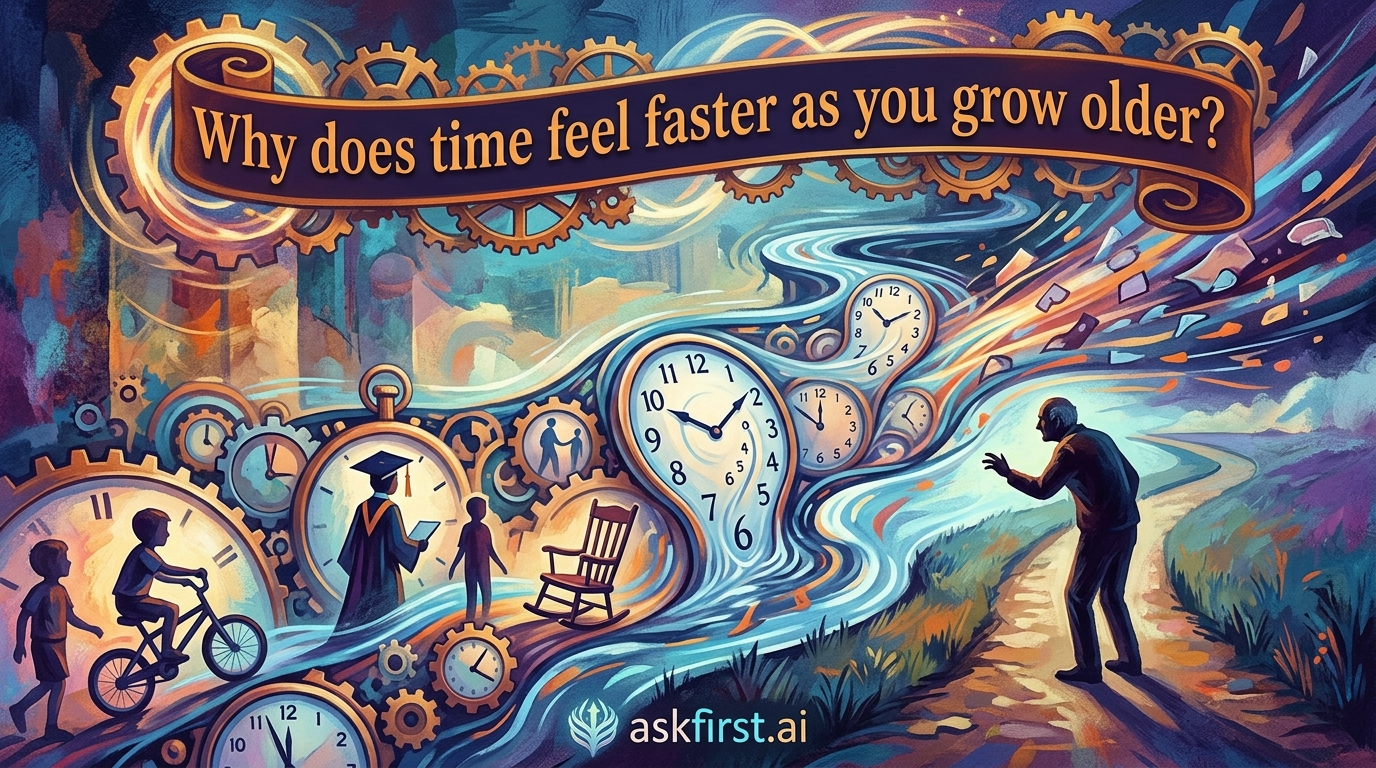
The phenomenon where time seems to accelerate as individuals age is a cornerstone of human psychological experience. While the clock ticks with mathematical precision, the subjective perception of its passage is fluid. This discrepancy is not merely a quirk of memory but a complex synthesis of cognitive processing, neurological development, and emotional engagement.
The Proportional Theory
One of the most frequently cited explanations for this sensation is the Proportional Theory, first proposed by French philosopher Paul Janet in 1877. This theory suggests that our perception of time is relative to the total length of time we have lived. To a five-year-old child, a single year represents 20% of their entire life experience, making it feel like an eternity. Conversely, for a fifty-year-old, a single year accounts for only 2% of their life. As we accumulate more years, each new year becomes a smaller, less significant fraction of the whole, leading to the perception that years pass by in a blur.
The Role of Novelty and Neurochemistry
Neurological factors play a massive role in how we store temporal information. When people encounter new experiences, the brain remains in a state of high arousal. It allocates more neural resources to encode these memories, creating a 'richer' mental map of a period. Childhood is dominated by 'firsts'—first steps, first school days, first travels. These novel events force the brain to capture more sensory details. Because the brain spends more time recording these experiences, the resulting memory is denser. When looking back, that year feels long because it is packed with high-resolution data.
As adults, however, life often settles into procedural routines. Commuting to work, managing household chores, and performing repetitive professional tasks do not trigger the same level of synaptic engagement. Because these routines are predictable, the brain shifts into a 'low-energy' mode. It does not need to record these mundane events in detail. Consequently, the brain creates fewer 'anchor points' in memory. When reflecting on a month spent in a predictable routine, the lack of distinct mental markers leads to the false perception that the time disappeared, a phenomenon known as the Holiday Paradox.
The Impact of Neural Processing Speed
Some scientists, such as Dr. Adrian Bejan, propose that the physical degradation of our sensory systems impacts how we perceive time. As human beings age, the neural pathways in the brain become increasingly complex and subject to degradation, which causes a decrease in the speed at which we process incoming information. Essentially, the 'frame rate' of our mental camera slows down. Younger brains process images more rapidly, which means they perceive more 'frames' per second. As this internal frame rate slows, we experience fewer moments within the same absolute interval, leading to the sensation that the world around us is moving faster.
Strategies to Slow Down Time
Understanding these mechanisms offers a unique opportunity to reclaim a sense of expansive time. By intentionally breaking the cycle of routine, it is possible to alter one’s perception of duration:
- Prioritize Novelty: Engage in new hobbies, travel to unfamiliar places, or learn a skill that pushes the brain out of its comfort zone. The spike in dopamine and the demand for neural processing will make these periods feel longer in retrospect.
- Mindful Presence: Practicing mindfulness forces the brain to focus on the sensory details of the 'now.' By becoming hyper-aware of sounds, sights, and tactile experiences, one essentially forces the brain to record data more densely, similar to how it processed information during childhood.
- Change the Environment: Physical movement and change of environment disrupt the brain's tendency to tune out familiar stimuli. Even small changes, like altering a commute or rearranging a workspace, can force the brain to remain alert.
Conclusion
The acceleration of time is not a sign of life slipping away, but rather a reflection of the brain's efficiency. When the brain knows what to expect, it stops paying attention. The key to making life feel longer and richer is to stay curious. By constantly seeking out the new and the challenging, it is possible to bypass the trap of routine and continue experiencing the world with the same intensity as one did in their youth.