The Psychology of Social Anxiety and Memory Persistence
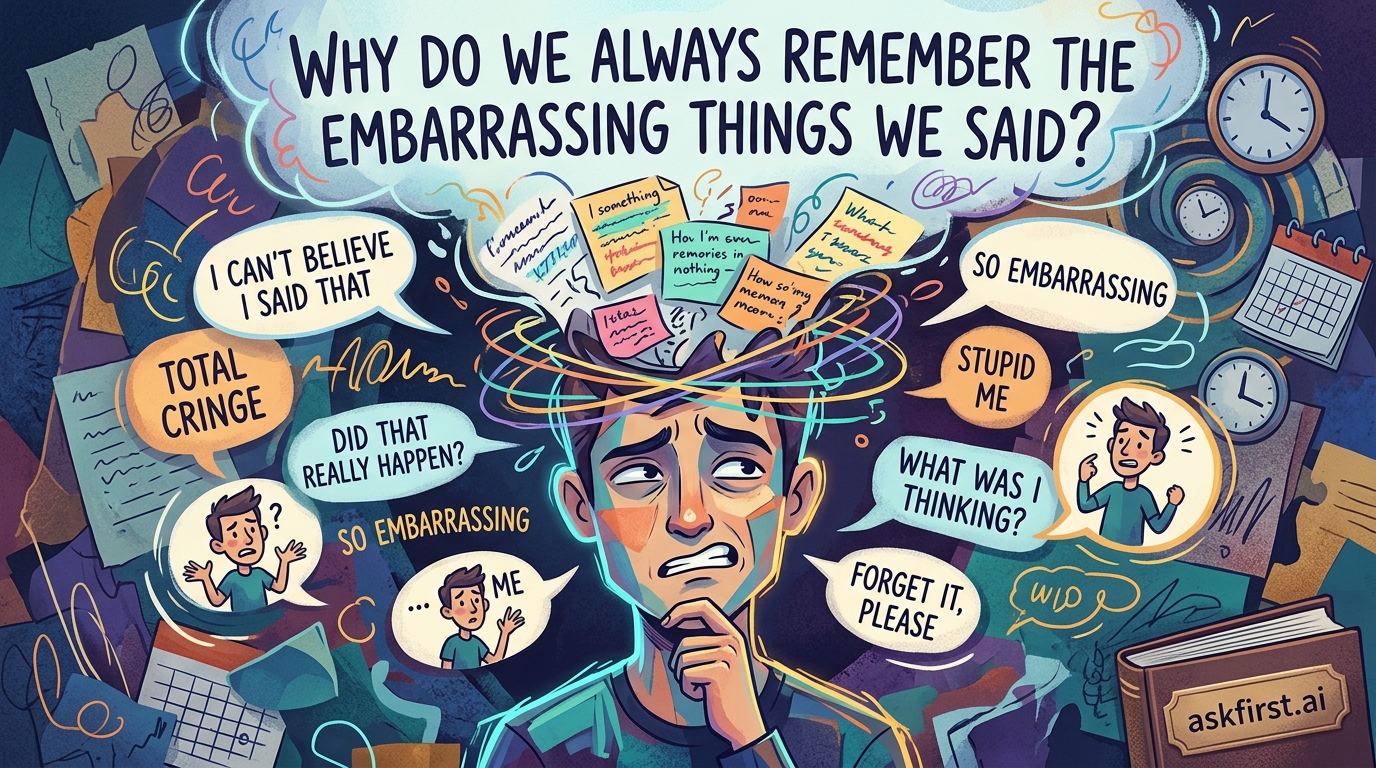
Human memory is not a perfect recorder of events. Instead, it is a highly selective filter designed to optimize survival and social navigation. When individuals find themselves replaying an embarrassing moment—a phenomenon often called 'cringe attacks'—they are experiencing the result of an evolutionary prioritization system. The brain values social rejection as a threat to survival, and as such, it treats embarrassing social faux pas with the same intensity as physical dangers. This is why these memories feel remarkably vivid and persistent compared to mundane daily occurrences.
The Negativity Bias and Survival Mechanisms
The primary culprit behind the haunting recollection of awkward phrases is the Negativity Bias. Evolutionary psychologists argue that ancestral humans who focused more on social mishaps were more likely to mend broken group bonds, ensuring continued inclusion in the tribe. Exclusion from the tribe in prehistoric environments was effectively a death sentence. Therefore, the brain developed a 'rumination' mechanism—a way of endlessly processing social mistakes to ensure they are not repeated. In the modern world, this biological system has become miscalibrated, causing people to dwell on a slightly awkward comment at a dinner party as if it were a life-threatening failure.
The Spotlight Effect
A major component in why these memories endure is the Spotlight Effect. This cognitive bias causes individuals to believe that other people are paying much more attention to their actions and appearance than they actually are. In reality, most observers are focused on their own internal thoughts or their own potential 'cringe' moments. When a person fixates on an embarrassing statement, they assume the audience is doing the same. The anxiety produced by this perceived spotlight solidifies the memory in the hippocampus. The emotional arousal associated with the embarrassment serves as a chemical marker, telling the brain that this specific memory is highly 'important' and should be retrieved often to avoid future embarrassment.
The Zeigarnik Effect and Unfinished Business
The Zeigarnik Effect is a psychological principle stating that people remember uncompleted or interrupted tasks better than completed ones. When a conversation feels 'unfinished' due to a social stumble, the brain creates a tension-like state, constantly trying to 'resolve' the social discomfort by mentally rehearsing what should have been said instead. Because the embarrassment remains unresolved, the memory stays active in the subconscious. People constantly revisit these moments because the mind is subconsciously attempting to 'rewrite' the script, hoping that by analyzing the event enough, it might finally achieve a sense of closure.
Strategies for Mitigating Social Rumination
Understanding the mechanism does not immediately stop the replay, but it provides the tools for regulation. To move past these intrusive thoughts, consider the following evidence-based techniques:
- Cognitive Reframing: Consciously remind yourself that others are preoccupied with their own lives. Shift the perspective from 'What did they think of me?' to 'How much do I actually remember of what others said five years ago?'
- Compassionate Self-Talk: Treat the memory as you would a friend's mistake. You would likely forgive a friend immediately; applying that same standard to yourself reduces the emotional charge of the memory, making it less likely to return.
- Acceptance and Commitment: Recognize that cringe is a byproduct of human connection. If you are interacting with people, you are bound to stumble occasionally. Avoiding the mistake would require avoiding the connection entirely.
The Evolution of Social Intelligence
Ultimately, these memories are not signs of weakness, but proof of social intelligence. Only individuals with high levels of social awareness possess the capacity to reflect on their own behavior. By analyzing why certain statements feel embarrassing, people develop a more nuanced understanding of social norms, boundaries, and communication styles. The memory functions as a internal feedback loop. While the emotional sting of a social blunder may be unpleasant, it serves a functional role in refining how an individual interacts with the world, acting as a mental barometer that helps navigate the complex terrain of human relationships. By shifting focus from the shame of the mistake to the learning inherent in the memory, individuals can transform these intrusive thoughts into tools for personal growth and deeper social empathy.