The Interplay of Agency and Determinism in Social Bonds
The question of whether friendships are the result of conscious selection or an inescapable hand of fate has fascinated philosophers, sociologists, and psychologists for centuries. At the intersection of human agency and structural determinism, this inquiry challenges our understanding of connection. Is the people-person phenomenon merely a string of coincidental meetings, or is there a "social gravity" that pulls specific souls together?
The Case for Conscious Choice: Social Cognitive Theory
From a psychological perspective, friendship is often viewed through the lens of Social Cognitive Theory. This perspective suggests that individuals exert agency by actively curating their social environment based on shared values, interests, and emotional needs. The concept of homophily—the tendency for individuals to associate with similar others—provides a robust framework for this choice-based model. People do not drift into relationships at random; they evaluate potential companions based on:
- Value Alignment: Shared beliefs and moral frameworks act as a filter for compatibility.
- Reciprocal Reinforcement: Friendships are sustained when both parties receive validation and psychological support.
- Proximity and Opportunity: While the choice feels internal, it is often initiated by the environment—schools, workplaces, or shared hobbies—which act as "choice sets" where conscious selection occurs.
The Case for Fate: Evolutionary and Sociological Determinism
Contrarily, the argument for fate often relies on evolutionary psychology and sociological patterns. The idea that "fate" governs our social circles can be interpreted as the influence of deep-seated genetic and environmental predispositions. Humans are inherently social creatures, evolved to seek security within a "tribe." This biological imperative makes certain connections feel preordained.
Sociologically, this is often explained through Social Network Theory. According to researchers like Mark Granovetter, who pioneered the study of "weak ties," our social networks are structurally determined by the paths we walk. If fate is defined as the external architecture of our lives—our birth, our location, our socioeconomic status—then the people we meet are largely governed by forces outside our control. In this sense, friendship is a subset of probability: the people available for us to choose are limited by the "fated" circumstances of our existence.
The Synthesis: The Illusion of Choice
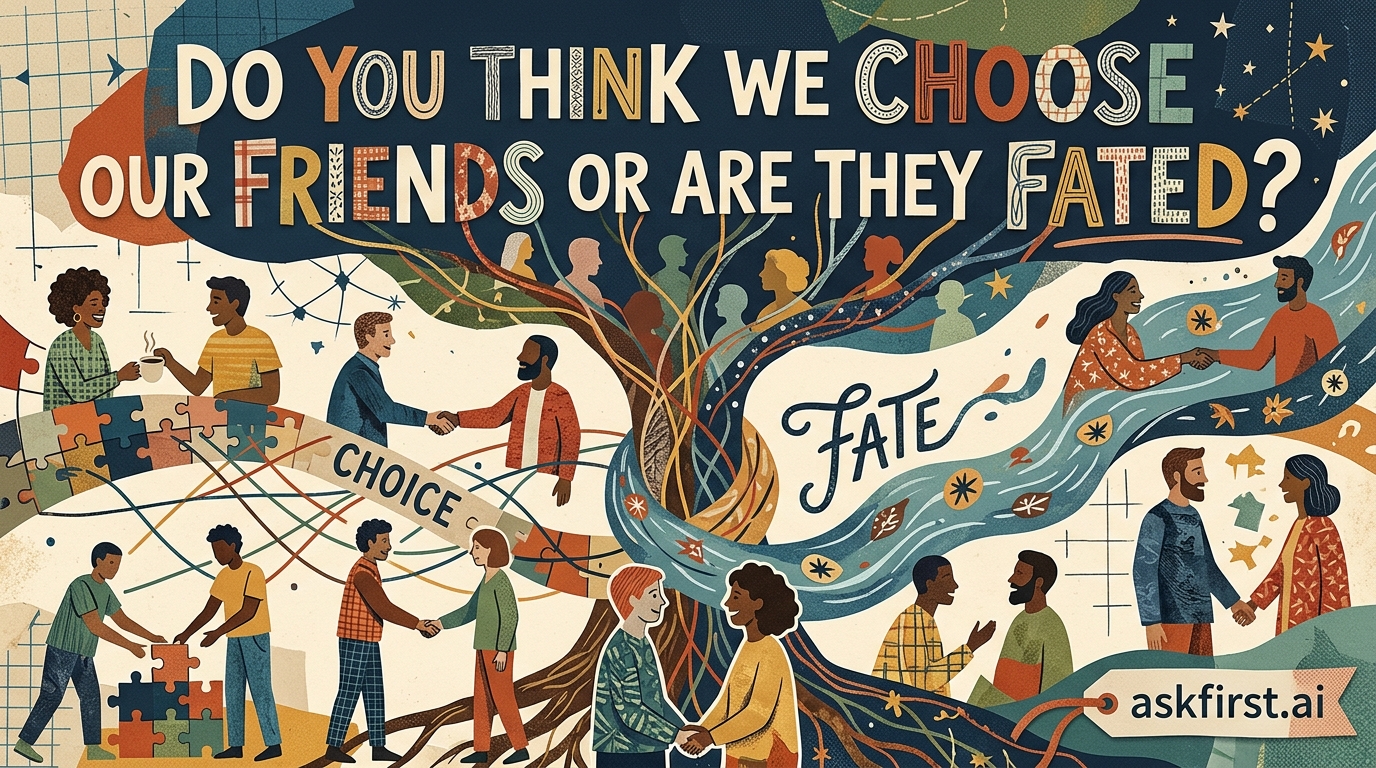
Many experts argue that the dichotomy between choice and fate is a false one. A more comprehensive view suggests that friendships emerge from a process of bounded rationality. The "fated" part of the equation is the probability field—the external environment that presents specific people to us. The "choice" part is the cognitive filtration process we use to decide who, among those presented, we allow into our inner circle.
- The Filter of Similarity: If two people are placed in the same environment, the "choice" to become friends is often triggered by biological or cultural resonance.
- The Role of Personality: Neuroticism, extraversion, and openness influence who a person gravitates toward, acting as an internal "GPS" for social connection.
Why This Matters for Human Connection
Understanding this dynamic changes how one approaches relationships. If one believes that friendships are purely fated, there is a risk of passive social behavior, waiting for the "right" people to arrive. If one believes in pure choice, there is a risk of viewing relationships as transactional or purely utilitarian, ignoring the serendipity that makes human connection so rich.
Scientific literature, particularly studies on peer selection in childhood and adulthood, shows that active maintenance is the true engine of friendship. While the initial contact might be dictated by chance or fate, the duration and depth of the relationship are entirely dependent on effort. Therefore, friendship is a hybrid experience: fate brings the raw materials, but human agency crafts the final structure.
Conclusion: Crafting Your Social Destiny
Ultimately, the mystery of friendship remains a compelling topic because it occupies the space between intention and accident. While the patterns of social existence might feel fated, the decision to invest time, energy, and emotional vulnerability into another person is a radical act of human agency. Whether influenced by evolutionary biology or personal temperament, the bonds we forge are a testament to our desire to transcend the "fated" circumstances of our lives, creating chosen families that define our human experience. By recognizing the power of both environment and choice, individuals can approach their social lives with greater intentionality, recognizing that while they cannot always control who they meet, they always retain the power to decide who remains.