The Psychology of the 'Norman Door' Phenomenon
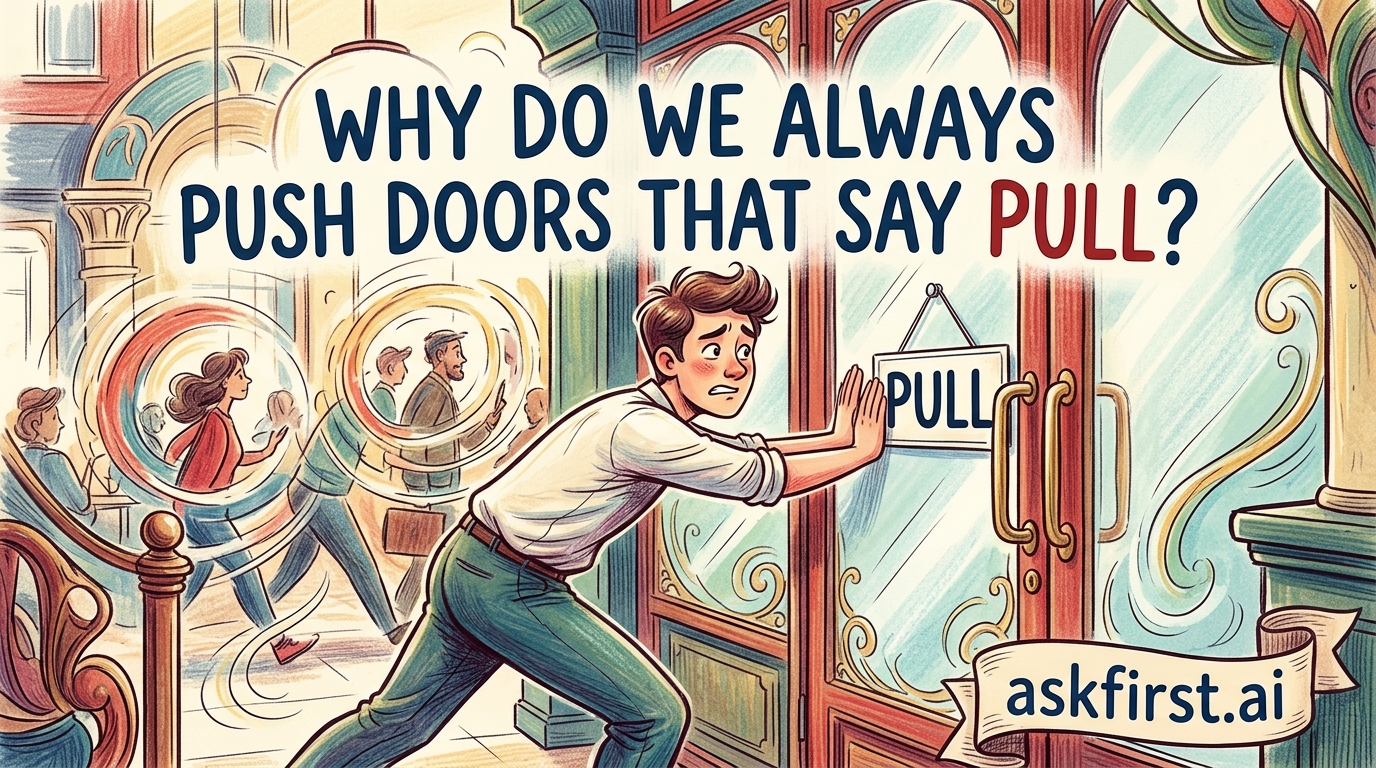
Human interaction with everyday objects is governed by a set of psychological principles often referred to as affordances. The tendency to push a door that clearly says 'pull' is not a failure of intelligence; rather, it is a failure of design. This phenomenon was famously popularized by cognitive scientist Don Norman in his seminal work, The Design of Everyday Things. When a door lacks visible clues about how to operate it, the mind defaults to habitual behaviors or dominant affordances, leading to the infamous 'Norman Door' error.
The Role of Affordances and Constraints
An affordance is a visual clue that tells a user how an object should be used. For instance, a flat plate on a door strongly implies 'push,' whereas a vertical handle or a pull-bar suggests 'pull.' When the physical design of the door contradicts the label, the brain experiences cognitive dissonance. The subconscious mind processes the visual geometry of the door faster than it reads the text instruction. If a surface is flat and flush, the brain perceives a surface that should be pushed, overriding the intellectual instruction provided by the sticker or sign.
- Visual Dominance: Our visual system is evolved to identify shapes and movement quickly. A large, flat surface signals a 'push' action to our motor cortex before our conscious mind registers the written sign.
- Habitual Motor Patterns: In our daily lives, we encounter thousands of doors. The sheer frequency of pushing doors makes 'pushing' a default motor program that requires less cognitive load than pulling.
Cognitive Overload and Selective Attention
In modern environments, people are often distracted, stressed, or rushing. This creates a state of selective attention, where the brain filters out information it deems 'secondary' to navigate the environment. A sign on a door is often perceived as secondary information, while the physical structure of the door is perceived as primary environmental data. When a person approaches a door, they are focusing on their destination—the room beyond—not the mechanics of the barrier itself. Consequently, the instruction 'pull' is often ignored in favor of the physical intuition of the object.
Mapping and Mapping Errors
In design theory, mapping refers to the relationship between controls and their effects. A good design makes it obvious which side of a door operates which mechanism. When a door is designed such that the physical handle suggests the wrong movement, the mapping is considered 'poor.' According to Don Norman, if a designer has to add a sign to explain how to use a door, the design itself has failed. The error is not in the human, but in the interface between human and tool. By failing to provide appropriate physical constraints—like a handle that can only be gripped—the designer inadvertently invites the 'wrong' behavior.
Can Design Solve This Mystery?
To eliminate this frustration, designers suggest implementing 'forcing functions.' A forcing function is a design element that makes it physically impossible to perform an action incorrectly. For example, if a door should only be pulled, removing the push-plate and replacing it with a handle that cannot be pushed (or is positioned in a way that suggests pulling) naturally guides the user. This removes the need for signage altogether, as the object itself communicates its function through its physical form.
The Evolutionary Perspective
From an evolutionary standpoint, humans are not designed to read instructions on every surface they encounter. We are designed to interact with tools based on shape, texture, and orientation. When the built environment creates a 'trap' where our instincts contradict the instruction, we see a clash between our ancient neural wiring and modern architectural choices. The 'push-pull' confusion is a perfect example of how human factors engineering influences our mental well-being; it proves that minor friction in our environment can influence our daily perceptions of competence and situational awareness.
Conclusion: Beyond the Signage
Ultimately, the act of pushing a door that says 'pull' is a fascinating intersection of neurology, design philosophy, and behavioral psychology. It serves as a reminder that the world is composed of 'silent' instructions. While we may laugh at the blunder of pulling on a push door, it is actually a demonstration of how our brain prioritizes physical environment over abstract language. The next time you find yourself pushing a door that clearly demands a pull, remember: you are not failing, you are simply responding to the dominant visual language of your surroundings.