The Legacy and Presidency of George Washington
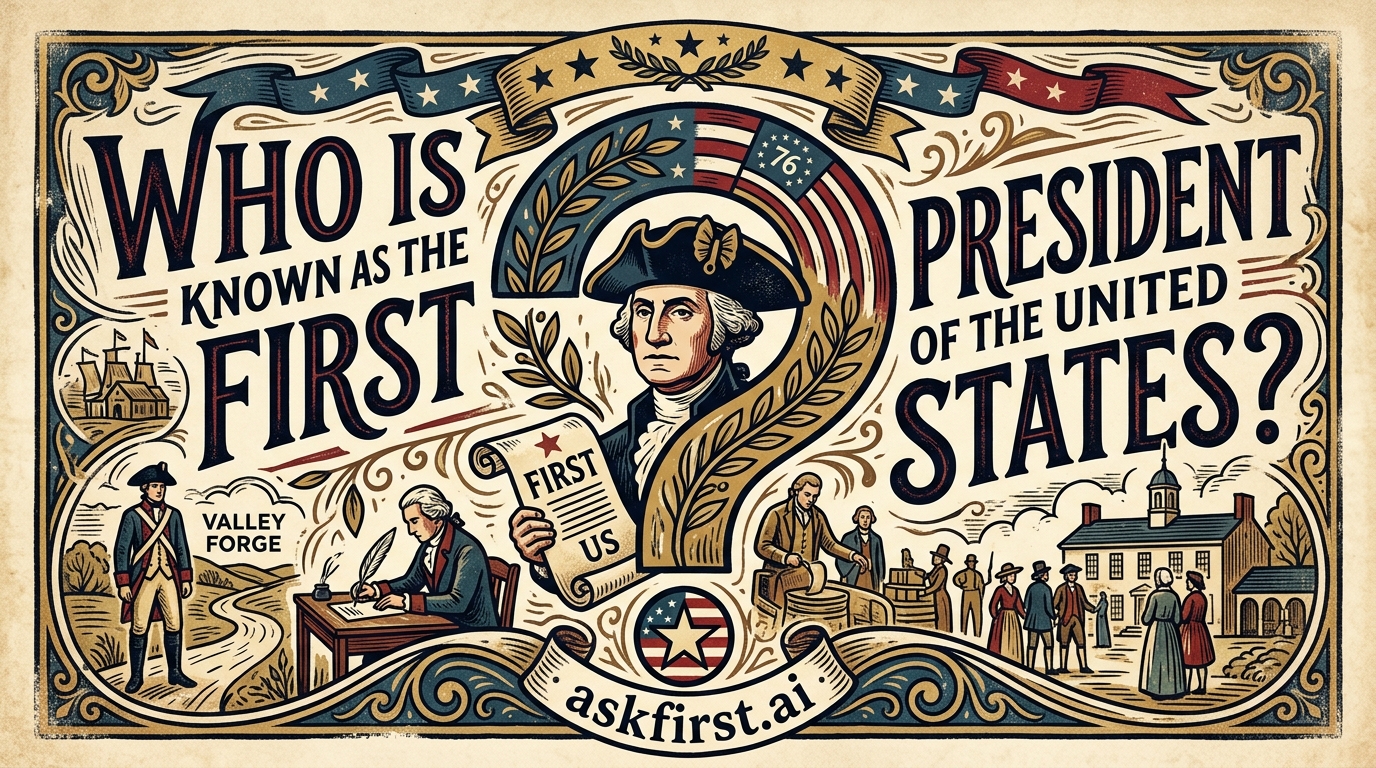
George Washington stands as the singular, foundational figure in the history of the United States. While history often debates the nuances of political titles, there is no ambiguity regarding the office of the presidency: George Washington is universally recognized as the first President of the United States under the current Constitution. His tenure, spanning from 1789 to 1797, established the precedents that would define the American executive branch for centuries to come.
The Context of the Presidency: Beyond the Articles of Confederation
To understand why Washington is the "first" president, one must distinguish between the United States under the Articles of Confederation and the United States under the Constitution. Before the ratification of the Constitution in 1788, the nation was governed by a loose confederation of states. During this period, individuals such as John Hanson held the title of "President of the United States in Congress Assembled." However, this role was largely ceremonial, acting as a presiding officer of a legislative body rather than an independent executive head of state.
It was the Constitutional Convention of 1787 that created the executive office as we know it today. Washington, having presided over the Convention in Philadelphia, was the natural and unanimous choice to lead the new government. As noted by historian Ron Chernow in his definitive biography, Washington: A Life (Penguin Books, 2010), Washington’s election was an expression of total national confidence. He was the only person who possessed the gravitas to unite a fragile, post-revolutionary nation.
Establishing Precedent: The Executive Branch in Action
When Washington took the oath of office on April 30, 1789, at Federal Hall in New York City, he was essentially operating without a job description. The Constitution provided a framework, but the day-to-day operations of the presidency were a blank slate. Washington’s genius lay in his deliberate, cautious approach to power.
- The Cabinet System: Washington recognized early on that he could not govern alone. He established the tradition of the Cabinet, assembling brilliant minds like Thomas Jefferson (Secretary of State) and Alexander Hamilton (Secretary of the Treasury). This collaborative approach is documented extensively in Joseph Ellis’s His Excellency: George Washington (Knopf, 2004), which highlights how Washington mediated between the clashing ideologies of his advisors to forge a coherent national policy.
- The Power of the Veto: Washington used the presidential veto sparingly, only when he believed a bill was unconstitutional. This established the principle that the executive should act as a check on legislative power without becoming a tyrant.
- Neutrality: In his conduct of foreign policy, particularly during the turmoil of the French Revolution, Washington issued the Proclamation of Neutrality in 1793. This decision prevented the young, militarily weak nation from being dragged into European conflicts, a strategy that arguably saved the United States from an early collapse.
The Farewell Address: A Blueprint for Sovereignty
Perhaps Washington’s most significant contribution as the first president was his decision to leave. By refusing to seek a third term, he set a precedent for the peaceful transfer of power—a concept that was virtually unheard of in the monarchical world of the 18th century. His Farewell Address, published in 1796, served as a parting warning to the nation. He cautioned against the "baneful effects of the spirit of party" (factionalism) and urged the country to avoid permanent foreign entanglements.
David McCullough, in his acclaimed work 1776 (Simon & Schuster, 2005), emphasizes that Washington’s character was his greatest asset. He was not a man of abstract theory, but a man of practical judgment and immense self-discipline. His ability to relinquish power voluntarily is cited by political scientists as the moment the American experiment proved it could survive the departure of its most indispensable leader.
Conclusion: The Indispensable Man
George Washington’s status as the first President of the United States is more than a chronological fact; it is a testament to his role as the architect of the American executive. He transformed a vague constitutional office into a position of moral and political authority. By balancing the need for a strong central government with a profound respect for democratic principles, Washington ensured that the presidency would be an office of service rather than rule.
His life and work remain the bedrock of American civic identity. From the journals of his time at Mount Vernon to the legislative records preserved in the National Archives, the evidence is clear: George Washington did not merely occupy the office of the presidency; he invented it. His legacy serves as a perpetual benchmark for all who have followed in his footsteps, reminding the nation that the power of the presidency is derived solely from the trust and consent of the people.