The Psychology of Negative Bias
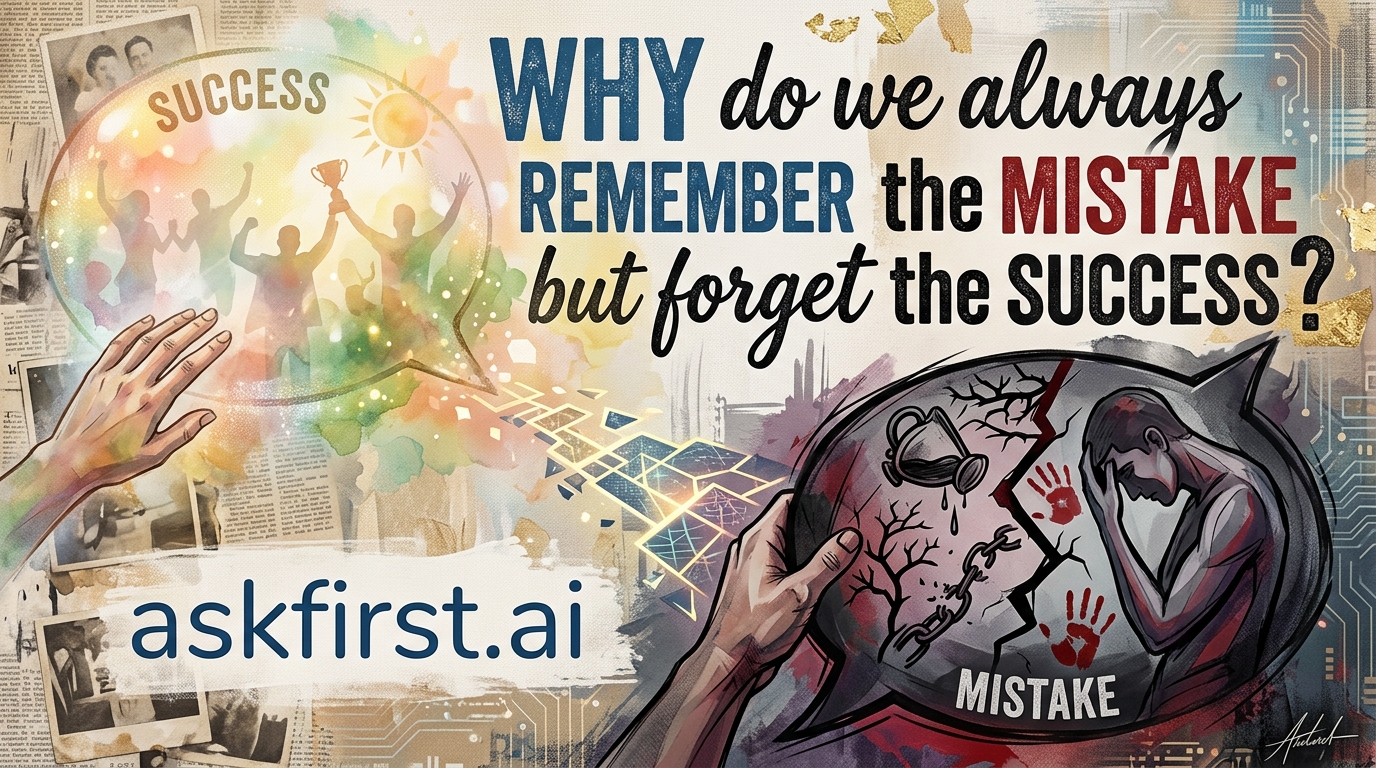
The human tendency to remember errors while glazing over achievements is rooted in a fundamental psychological principle known as the negativity bias. Evolutionarily, this mechanism served as a crucial survival tool. For early humans, identifying and remembering a potential threat—such as a poisonous plant or an aggressive predator—was infinitely more important for long-term survival than remembering a successful meal or a pleasant sunny day. Consequently, the brain evolved to prioritize negative information, encoding it more deeply and retrieving it more rapidly than positive experiences.
Neurobiological Mechanisms of Memory
At a neurological level, the amygdala—the region of the brain responsible for processing emotions—plays a starring role. When a mistake occurs, it often triggers a mild stress response or a feeling of shame, which activates the amygdala. This activation effectively sends a 'high-priority' signal to the hippocampus, the area of the brain responsible for forming long-term memories. In contrast, successful outcomes often trigger a state of relaxation or contentment. Because these positive moments lack the emotional 'alarm' associated with danger or social rejection, the brain tends to process them with less neural intensity, making them easier to discard or categorize as unremarkable.
The Role of Social Evaluation and Shame
Beyond basic survival, social dynamics exacerbate this imbalance. In most human societies, errors carry social consequences, ranging from embarrassment to loss of status. The fear of social judgment acts as a cognitive weight, pressing mistakes into our memory so that we might avoid repeating them and facing the same social penalty. When a success occurs, the lack of external threat means the brain does not need to store the memory as a preventative measure. This is why individuals often dwell on a single critique in a professional review while largely ignoring dozens of pieces of positive feedback.
Cognitive Reframing and Growth
To overcome this natural bias, one must engage in active, intentional cognitive reframing. Understanding that the brain is biased toward the negative does not mean that one is destined to dwell on failure. Instead, it provides a roadmap for conscious intervention. Experts in behavioral psychology suggest several strategies to counter this biological quirk:
- The Gratitude Journaling Technique: By consciously documenting successes daily, the brain is forced to process positive information with the same analytical weight usually reserved for mistakes.
- Savoring: When a success happens, take a moment to intentionally experience the emotion associated with it. By lingering on a positive feeling for at least 15 to 20 seconds, you allow the neural pathways to strengthen, effectively 'installing' the memory into long-term storage.
- The 3:1 Ratio: Research in positive psychology suggests that humans thrive when they experience a ratio of three positive interactions or reflections for every one negative one. Proactively seeking out evidence of progress helps balance the internal scorecard.
The Paradox of Perfectionism
Many high-achieving individuals struggle significantly with the focus on mistakes due to a cycle of perfectionism. Perfectionists treat mistakes as catastrophic failures rather than data points. By shifting the perspective to view errors as 'necessary feedback' rather than 'personal flaws,' the emotional sting is reduced. When the sting is removed, the amygdala is less likely to tag the memory as a 'danger event,' allowing the individual to learn from the mistake without suffering the negative psychological lingering effect.
Evolutionary Perspective on Learning
While the negativity bias seems like a flaw in the modern world, it remains a testament to the effectiveness of the human brain as a learning machine. Success is often a confirmation of what is already known, while mistakes represent the edge of one’s current knowledge. The brain essentially views errors as a primary source of high-quality data. We remember the mistake because we want to ensure we never have to pay the 'tuition' of making that error again.
Conclusion: Rewiring for Success
In summary, the imbalance in our memory recall is not an indication of a personal deficit, but rather a standard factory setting of human hardware. We remember the mistake because our ancestors needed to avoid the saber-toothed tiger; we forget the success because it didn't pose a survival risk. By understanding these biological constraints, we can use tools like intentional reflection and gratitude to override our default programming, ensuring that our triumphs are just as memorable as our stumbles.