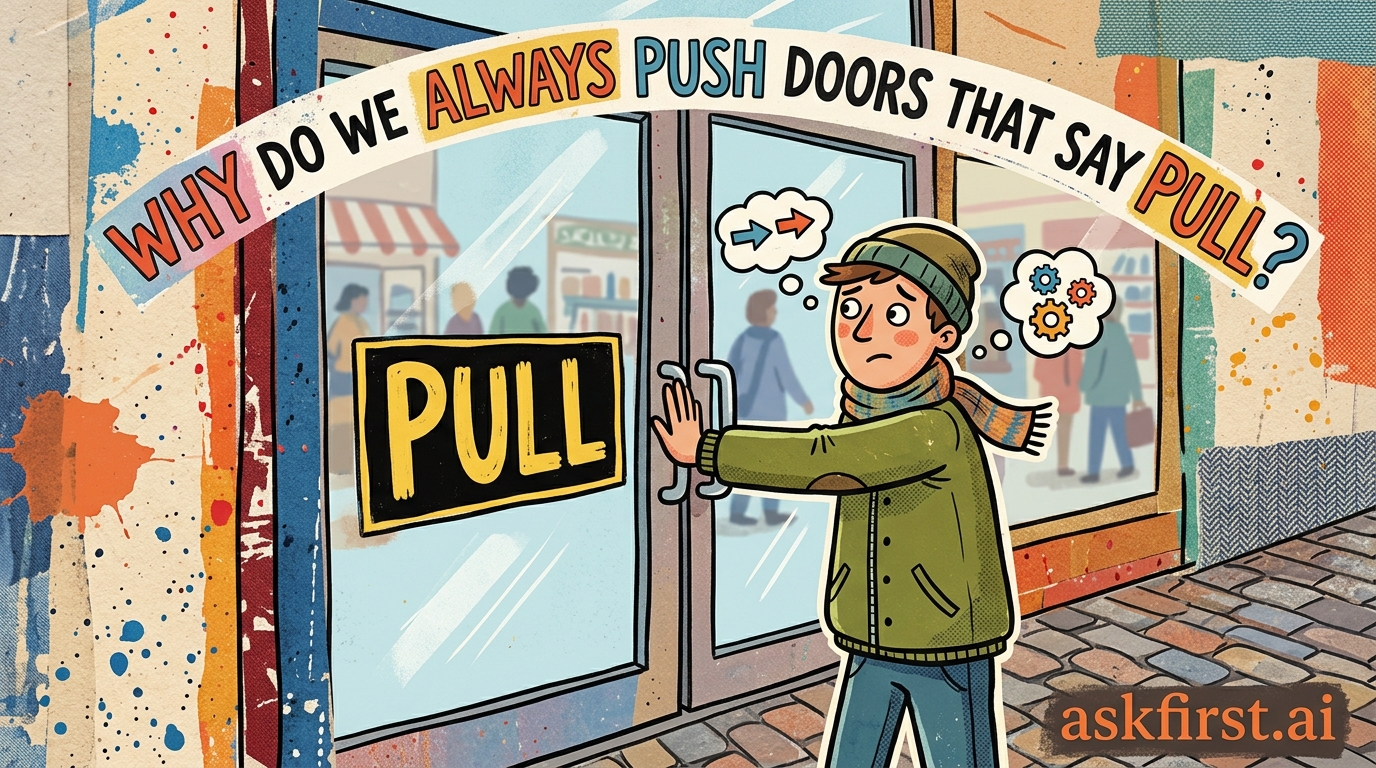
The phenomenon of pushing a door labeled 'pull' is so common that it has earned a specific name in design psychology: the Norman Door. Named after Don Norman, the author of 'The Design of Everyday Things,' this term describes a door that fails to communicate its function clearly through its design. When a person encounters an interface that contradicts its visual affordances, the brain defaults to heuristic patterns formed by thousands of past interactions.
The Psychology of Affordances
Affordances are the perceived and actual properties of an object that determine how it could possibly be used. When a door has a flat metal plate at waist height, it screams 'push.' This is a strong visual affordance. If that same door actually requires a 'pull' action, the physical design is fighting against the user's cognitive map. Humans rely on 'system one' thinking—fast, automatic, and intuitive processing—for mundane tasks like opening doors. When the environment presents a conflict between visual cues (the flat plate) and linguistic cues (the 'pull' sign), the brain chooses the visual path because it processes sensory information faster than it reads text.
Why We Fail to See the Sign
Cognitive Load: The human brain is an efficiency engine. We rarely actively read signage on doors because we believe we have mastered the art of entering and exiting buildings. By the time the brain registers the sign, the body has already initiated the motor program for pushing.
The Principle of Mapping: Good design requires clear mapping. If the handle on a door is a vertical bar, it suggests a pulling motion. If it is a flat plate, it suggests a push. When designers place a pull-required door behind a flat plate, they create an 'interaction debt' that the user must pay in frustration. The user does not fail; the design fails to communicate.
Experience Bias: We build mental models based on probability. Most commercial glass doors in high-traffic environments are push-activated for emergency egress and high-volume flow. Our brain calculates that pushing is the statistically higher-probability action, leading us to override contradictory information.
The Architecture of Mistakes
In architectural psychology, the 'push-pull' error highlights a disconnect between the architect's intent and the user's behavior. Many commercial buildings install push-bars on both sides of a door for uniformity, ignoring the fact that one side may be an exit and the other an entry. This lack of differentiation creates a 'learned helplessness' regarding doors. Over time, people stop looking at the door entirely and rely on trial-and-error, as they have been conditioned to expect that the hardware provided might be a lie.
How to Fix the Interface
To eliminate this common struggle, designers must adopt human-centric solutions:
- Eliminate Visual Ambiguity: If a door must be pulled, do not use a flat push plate. Use a handle that forces a grip, such as a vertical pull handle or a recessed grip.
- Place Signage at Eye Level: Putting a 'pull' sign at the center of the door often goes unnoticed because users are focusing on the floor or the handle. Signage should be placed exactly where the hand reaches.
- Color and Contrast: Using high-contrast elements for the functional part of the door helps direct attention. If the handle is brightly colored against a neutral door, the brain is more likely to interpret the handle as the primary interaction point.
The Larger Lesson
This phenomenon serves as a masterclass in user experience (UX) design. It proves that no matter how much instruction is provided, humans will always follow the subconscious path of least resistance suggested by an object's form. The 'Norman Door' is not just a nuisance; it is a permanent reminder that communication design is as important as structural design. By understanding that we push because our brains are hardwired to process visual affordances before linguistic warnings, we can create environments that are more intuitive, efficient, and user-friendly. We are not making mistakes; we are interacting with systems that have not accounted for the speed and power of human intuition.